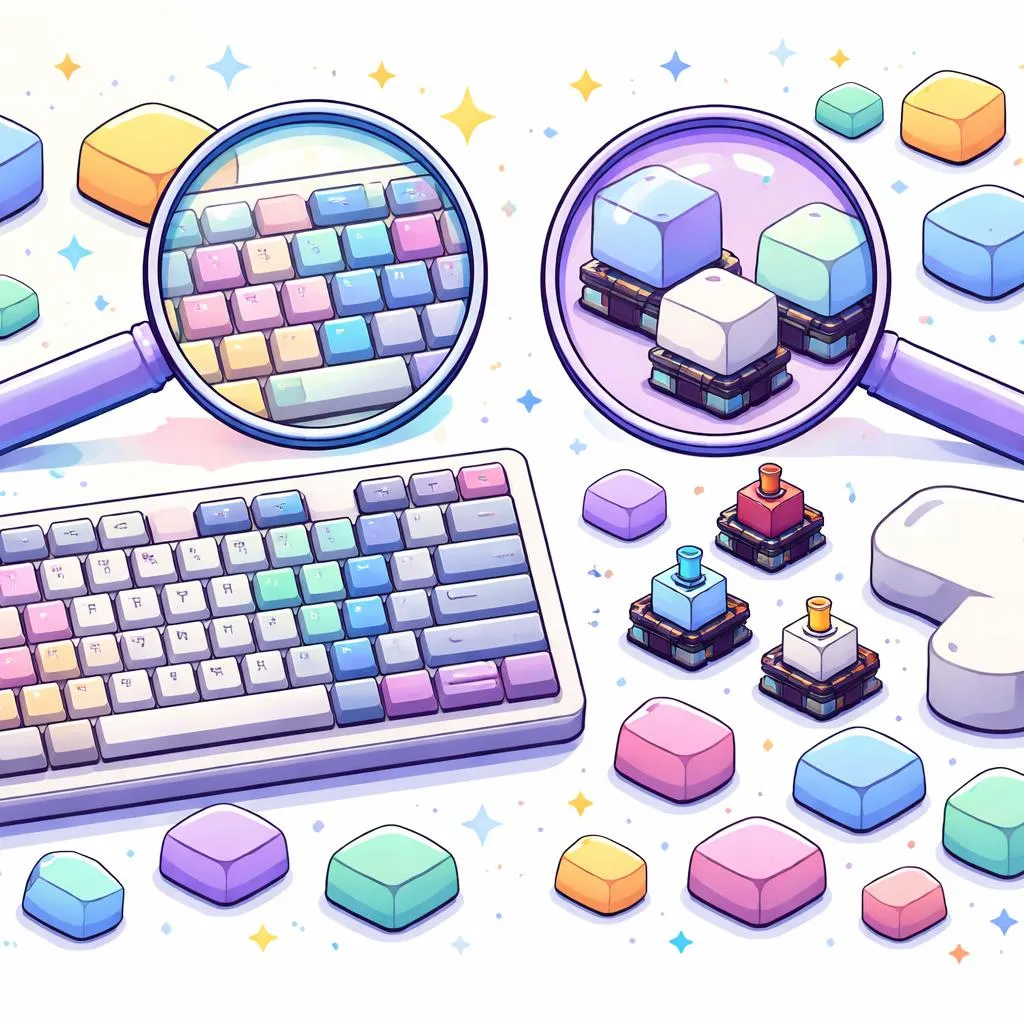

Start! Find a Pair of 'Typing Twin' Words
Hello, word explorer! Do you like to type? You type on a keyboard. You press the letter keys. They are both about typing. Are they the same? This is a fun tech puzzle. Today we explore a word pair. We explore keyboard and keys. They are like a whole cake and the sprinkles on it. One is the whole cake. One is the sprinkles. Knowing the difference is a superpower. Your talk about computers will be clear and smart. Let us start our word mission!
Be a Language Observer now. Our first clue is at home. Your dad says, "Plug in the keyboard." You say, "The 'A' key is stuck." They are both about typing tools. But are they the same? Let us test with two sentences.
"My new keyboard lights up." This is about the whole typing tool. "Some keys on my keyboard are sticky." This is about the individual buttons.
They are both related. But one is the whole group. One is the single parts. Your observation mission starts. Let us press into their word world.
Adventure! Press Into the Word World
Feel the Word's Whole Group and Single Part Vibe!
Feel the word keyboard. It is a whole, complete, single object word. It feels like the entire typing tool you connect or see. The word keys is a plural, many-parts word. It feels like the many individual buttons you press. Keyboard is the whole team. Keys are the team players. One is singular. One is plural. One is the object. One is its parts. Let us see this at school.
The teacher says, "Everyone needs a keyboard for typing class." She means the whole device. A friend says, "My 'E' and 'R' keys are worn out." He means two specific buttons. Saying "my keyboard are worn out" is wrong. The feeling is different. One is the unit. One is the pieces.
Compare Their One Thing and Many Parts Idea!
Think about a pizza and its slices. The word keyboard is the whole pizza. The word keys are the slices. You eat slices. You order a pizza. Their main idea is the key. A keyboard is the complete device with many buttons. Keys are the individual buttons on that device. You buy a keyboard. You press the keys. One is the group name. One is the member name. Let us test this on the playground.
Your game controller has buttons. You call them keys sometimes. You say, "Press the arrow keys." You do not call the controller a "keyboard." A keyboard is for typing. The playground shows the difference.
Meet Their Best Word Friends!
Words have favorite tech partners. The word keyboard likes whole-object words. It teams up with 'computer', 'wireless', 'gaming', 'plug in', 'USB', and 'music'. Computer keyboard. Music keyboard. The word keys likes specific-part words. It teams up with 'letter', 'arrow', 'number', 'press the', 'sticky', and 'press the keys'. Letter keys. Press the keys. Their partners hint at their use. Let us go back to nature.
Imagine a monkey at a large music keyboard. It is the big instrument. It presses the black and white keys. They are the parts. You play the keyboard. You press the keys. The word friends are different.
Our Little Discovery!
We explored the world of typing. We made a clear discovery. The words keyboard and keys are different. A keyboard is the whole device. It has many buttons. It is one object. Keys are the many individual buttons on the keyboard. You press them. Keyboard is singular. Keys is almost always plural. One is the whole tool. One is the parts of the tool. This is the main difference.
Challenge! Become a Typing Word Expert
"Best Choice" Challenge!
Let us look at a nature scene. A parrot walks on a big typing device. It walks on the whole keyboard. Is it Keyboard or Keys? The champion is Keyboard! It is the correct word for the whole device the parrot stands on. Next, the parrot pecks at single buttons. It pecks at the letter keys. Is it keyboard or keys? The champion is keys! It is the right word for the individual buttons it hits. Excellent!
"My Sentence Show"!
Now, create your own sentences. Here is a fun scene: Imagine you get a new typing tool for your computer. It is a whole unit. Use the word keyboard in one sentence. Now imagine the letter buttons on it are colorful. Use the word keys in another. Try it! Here is an example. Sentence one: "I love my new rainbow keyboard!" Sentence two: "The letter keys glow in the dark." See the difference? The first is about the whole device. The second is about its individual buttons.
"Eagle Eyes" Search!
Can you find the word that needs help? Read this sentence: "I need to clean my keys because it has crumbs all over it." Hmm. This is a mix. "Keys" are many buttons. You would not say "it" for many things. You clean the whole surface. That is the keyboard. A better sentence is: "I need to clean my keyboard because it has crumbs all over it." You fixed it!
What a clear and clicky exploration! You started as a curious typer. Now you are a word expert. You know the secret of keyboard and keys. You can feel their different whole and part vibes. You know keyboard is the whole typing tool. You know keys are the many buttons on it. You know their best word friends. This is a real language superpower.
You can learn amazing things from this article. You now know that a 'keyboard' is the name for the whole typing device with many buttons, like on a computer or piano. You understand that 'keys' (almost always plural) are the names for the individual buttons on a keyboard that you press with your fingers. You can explain that you buy a 'keyboard' but you press the 'keys'. You learned terms like 'computer keyboard' and 'letter keys'.
How can you use this today? It is easy and fun. Look at a computer or piano. Touch the whole device. That is the keyboard. Now press a single button. That is a key. When something spills, say "Clean the keyboard." When one button sticks, say "The 'S' key is sticky." Draw two pictures. Draw a whole keyboard. Draw a close-up of a few keys. You are using your new skill every day.
Keep your explorer eyes open. The world is full of amazing keyboards and clicky keys. You are learning the words to describe them all. Great work, word expert. Your English journey is getting more precise and tech-savvy with every new word pair you discover!