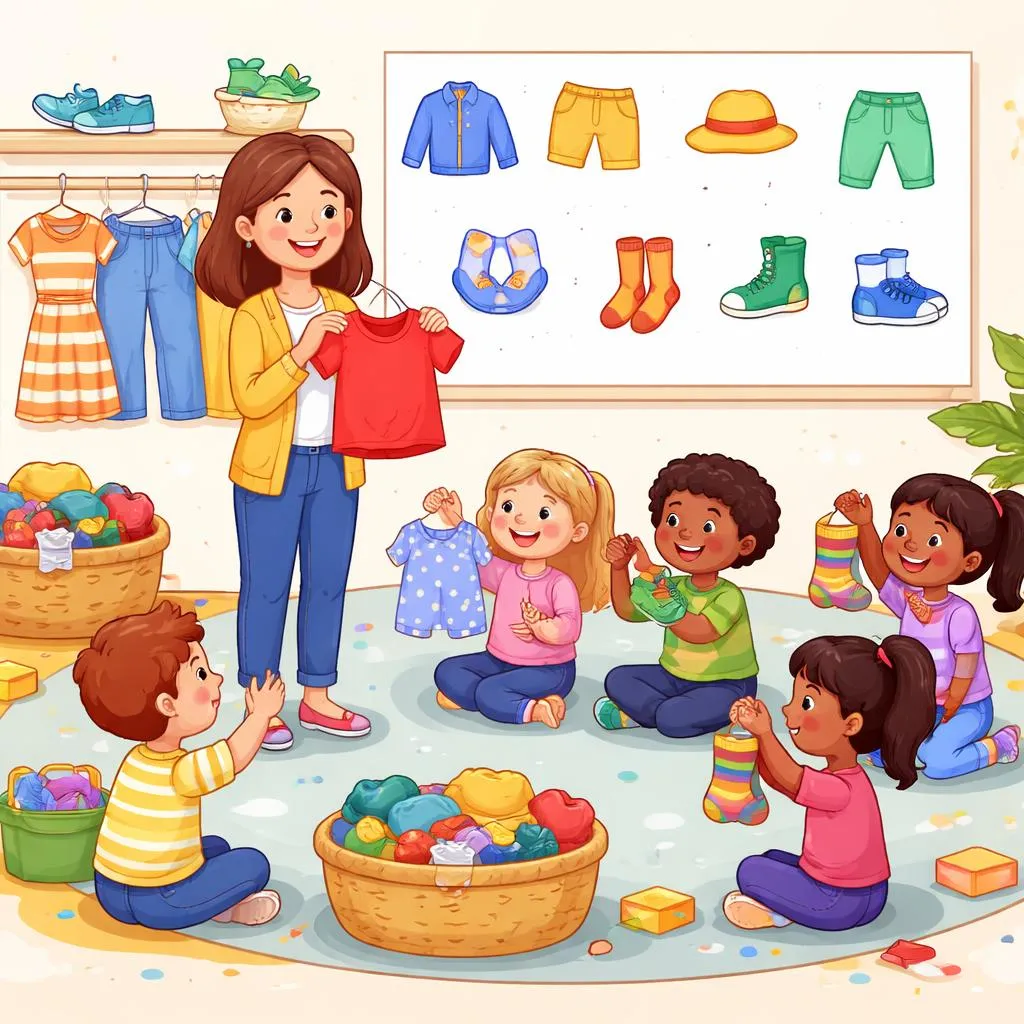

Clothing surrounds children every day. They put on shirts in the morning. They zip jackets before going outside. They notice what friends wear to school. Teaching vocabulary on clothes connects directly to children's lives. They can see the words in action. They can touch the items as they learn. This makes clothing words some of the easiest and most practical vocabulary to teach. Children need these words to dress themselves, to ask for help, and to describe their world. Let us explore how to build clothing vocabulary in engaging and memorable ways.
What Is Clothing Vocabulary? Clothing vocabulary includes all the words we use for items we wear. These words name things that cover our bodies. They keep us warm, dry, and comfortable. They also express our style and personality.
Basic clothing words include shirt, pants, socks, and shoes. These are the essentials that children wear every day. Other words name specific types of clothing. Dress, skirt, jacket, hat, and gloves add variety. Still more words describe clothing features. Sleeves, collar, pocket, and zipper name parts of clothing.
Clothing vocabulary also includes words for accessories. Belt, scarf, watch, and glasses complete an outfit. Children enjoy learning these extra words. They notice when teachers wear glasses or when friends have new backpacks.
Learning clothing words helps children in many ways. They can dress themselves independently. They can ask for specific items. They can describe what someone is wearing. These skills build confidence and communication.
Meaning and Explanation of Clothing Words Each clothing word names a specific item with a specific purpose. Understanding the purpose helps children remember the word.
Shirt: This covers the upper body. It can have short sleeves or long sleeves. It can be made of cotton, polyester, or other fabrics. Shirts keep us warm and protect our skin.
Pants: These cover the legs and lower body. They have two separate sections for each leg. Pants come in many lengths. Short pants are shorts. Long pants are trousers or jeans.
Socks: These cover the feet. They go inside shoes. Socks keep feet warm and dry. They also prevent blisters from shoes rubbing.
Shoes: These cover and protect the feet. They have hard soles on the bottom. Shoes allow us to walk on rough ground safely.
Jacket: This is a heavy top layer for cold weather. Jackets zip or button up the front. They keep the whole upper body warm.
Hat: This covers the head. Hats protect from sun or cold. Different hats have different names. Baseball caps, winter hats, and sun hats all serve different purposes.
Dress: This is one piece that covers the upper and lower body. Dresses are often worn by girls and women. They can be fancy or casual.
Explain these purposes as you introduce each word. Children understand that we wear different clothes for different reasons. This builds a conceptual framework for the vocabulary.
Categories of Clothing Organizing clothing into categories helps children understand relationships between words. Here are useful categories for teaching.
Clothes by body part: Head: hat, cap, helmet, headband Upper body: shirt, jacket, coat, sweater, vest Lower body: pants, shorts, skirt, jeans Feet: socks, shoes, boots, sandals Hands: gloves, mittens
Clothes by weather: Hot weather: shorts, t-shirt, sandals, sun hat Cold weather: coat, sweater, boots, gloves, scarf Rainy weather: raincoat, rain boots, umbrella
Clothes by activity: School clothes: uniform, comfortable pants, t-shirt Sports clothes: gym shorts, sneakers, jersey Sleep clothes: pajamas, nightgown, robe Party clothes: fancy dress, bow tie, nice shoes
Clothes by gender: Boys often wear: pants, shirts, shorts Girls often wear: dresses, skirts, leggings Many clothes work for everyone: jeans, t-shirts, jackets, sneakers
Use these categories in sorting activities. Children learn that the same item can fit in multiple categories. A t-shirt works for hot weather, school, and both boys and girls.
Daily Life Examples for Clothing Words The best vocabulary learning happens in real contexts. Here are ways to use clothing words throughout the school day.
Morning arrival: As children enter, notice what they wear. "What a blue shirt you have today!" "I see your new sneakers!" This casual naming builds vocabulary naturally.
Getting ready for outside: Before outdoor play, talk about what children need. "It is cold today. We need our jackets." "It is sunny. Hats will protect our heads." This connects clothing words to real needs.
Dramatic play area: Stock the play area with different clothing items. Hats, scarves, vests, and dress-up clothes let children practice words through play. They put items on and name them naturally.
Lost and found discussions: When items appear in the lost and found, talk about them. "Whose sweater is this?" "I see a blue mitten here." This makes clothing words relevant to solving real problems.
Weather discussions: Each day, talk about the weather and appropriate clothing. "It is raining today. What should we wear?" Children suggest raincoats and boots. This builds reasoning and vocabulary together.
Getting dressed for gym: Before gym class, name the clothing children change into. "Put on your gym shoes." "Tie your laces carefully." This embeds vocabulary in routines.
Printable Flashcards for Clothing Vocabulary Flashcards provide visual support for learning clothing words. Here are ideas for creating and using them.
Basic clothing cards: Create cards for each clothing item. Use clear images showing the item alone. Write the word clearly below the picture. Include shirt, pants, socks, shoes, jacket, hat, dress, skirt, gloves, scarf, boots, and sweater.
Color cards: Create cards showing different colors. Use these with clothing cards to practice descriptions. "Red shirt." "Blue socks." This builds adjective-noun combinations.
Weather cards: Create cards showing weather conditions. Sunny, rainy, snowy, windy. Children match clothing to weather. Sunny matches hat and shorts. Snowy matches coat and gloves.
Season cards: Create four season cards. Children sort clothing by which season they wear it in. Winter gets coats and gloves. Summer gets shorts and t-shirts.
Body part cards: Create cards showing head, upper body, lower body, feet. Children sort clothing onto the correct body part card. This reinforces where each item goes.
Laminate the cards for durability. Keep them in a pocket chart for easy access. Use them for games, sorting, and daily review.
Learning Activities for Clothing Vocabulary Active learning helps children remember new words. Here are activities for teaching clothing vocabulary.
Clothing Sort: Provide a pile of real clothing items or picture cards. Children sort them into categories. Sort by color. Sort by body part. Sort by weather. This builds categorization skills along with vocabulary.
Dress the Bear: Create a large bear or person outline from cardboard. Provide paper clothing items with tabs. Children choose clothes and dress the bear. They name each item as they put it on. "The bear needs pants." "Now the bear wears a hat."
What's Missing: Lay out several clothing items. Children close their eyes. Remove one item. Children open their eyes and name what is missing. This builds attention and vocabulary recall.
Clothing Relay Race: Divide children into teams. Place a pile of clothing at one end of the room. Call out an item. One child from each team runs, finds it, and brings it back. The first to return with correct item wins a point.
Clothing Bingo: Create bingo cards with clothing pictures. Call out clothing names. Children cover the matching picture. The first to cover a row wins. This builds listening comprehension.
I Spy Clothing: Play I Spy with clothing. "I spy something red that goes on your feet." Children guess "socks!" or "shoes!" This builds descriptive language and vocabulary together.
Dress for Weather: Describe a weather situation. "It is snowing outside. What should we wear?" Children name appropriate clothing. They can pretend to put on each item. This connects vocabulary to real-world reasoning.
Educational Games for Clothing Vocabulary Games make vocabulary practice joyful. Here are games specifically for clothing words.
Clothing Memory Match: Create two sets of clothing cards. Place them face down. Children take turns flipping two cards, trying to find matches. When they make a match, they name the item. This builds visual memory and word recall.
Clothesline Game: String a clothesline across the classroom. Provide small clothing items or pictures with clothespins. Call out an item. Children find it and hang it on the line. This adds a fine motor element to vocabulary practice.
Fashion Show: Children take turns being models. They walk across the room wearing a special outfit. Other children describe what the model wears. "She has a pink dress and white shoes." "He wears blue pants and a striped shirt." This builds descriptive sentences.
Clothing Shopping: Set up a pretend clothing store. One child is the shopkeeper. Others are shoppers. Shoppers ask for items. "Do you have a red hat?" Shopkeeper finds it. This practices question forms and vocabulary together.
What Am I Wearing?: One child stands in front of the class. Describe an item of clothing they are wearing without naming it. "This item is blue. It has long sleeves. It covers your upper body. What is it?" The child guesses "shirt!" This builds listening and inferencing.
Pack the Suitcase: Describe a trip. "We are going to the beach. What should we pack?" Children name clothing items for that trip. For a cold mountain trip, they pack different items. This builds categorization and vocabulary.
Clothing Twister: Adapt the game Twister using clothing. Call out "Put your hand on something red." Children find something red in the room and touch it. "Put your foot on something soft." This combines movement with vocabulary.
Connecting Clothing Words to Writing Writing activities reinforce clothing vocabulary and spelling. Here are writing ideas.
Clothing Labels: Draw a person on large paper. Children label the clothing items. They write "shirt" next to the shirt, "pants" next to the pants. This connects words to pictures.
My Outfit Today: Children draw themselves in their outfit. They write sentences describing what they wear. "Today I wear a blue shirt and black pants." Display these on a class clothesline.
Clothing Book: Create a class book about clothing. Each page features one item. Children draw the item and write a sentence. "A hat goes on your head." "Shoes keep your feet safe." Bind the pages together and read them often.
Weather Journal: Each day, children draw the weather and write what clothing they wore. "Today is rainy. I wore my boots." This builds routine and vocabulary together.
Shopping List: Children create shopping lists for clothing. "I need new socks." "I want a red dress." This makes writing purposeful and connected to real needs.
Colorful Sentences: Provide sentence frames. "My shirt is ______." Children fill in the color. "My socks have ______." Children fill in patterns or designs. This builds sentence structure while practicing vocabulary.
Using Songs for Clothing Vocabulary Songs make vocabulary stick. Here are song ideas for clothing words.
Getting Dressed Song: Sing to a familiar tune like "Here We Go Round the Mulberry Bush." "This is the way we put on our shirt, put on our shirt, put on our shirt. This is the way we put on our shirt, so early in the morning." Change the clothing item each verse.
Head, Shoulders, Knees, and Toes Adaptation: Sing the song but add clothing. "Hat on my head, shirt on my shoulders, pants on my knees, socks on my toes." This connects clothing to body parts.
Color Clothing Song: Sing to "Twinkle, Twinkle, Little Star." "Red shirt, blue pants, yellow socks, and brown shoes too. These are clothes we wear all day. What do you wear when you play?" Children name their own clothing.
Create simple recordings of these songs. Play them during transitions or quiet times. Repetition through music builds long-term memory.
Clothing vocabulary opens the door to independence. Children who know these words can dress themselves. They can ask for what they need. They can describe themselves and others. These words appear in stories, conversations, and daily routines. By teaching vocabulary on clothes through games, activities, and real experiences, we give children tools they will use every day for the rest of their lives. And that is the power of meaningful vocabulary instruction.