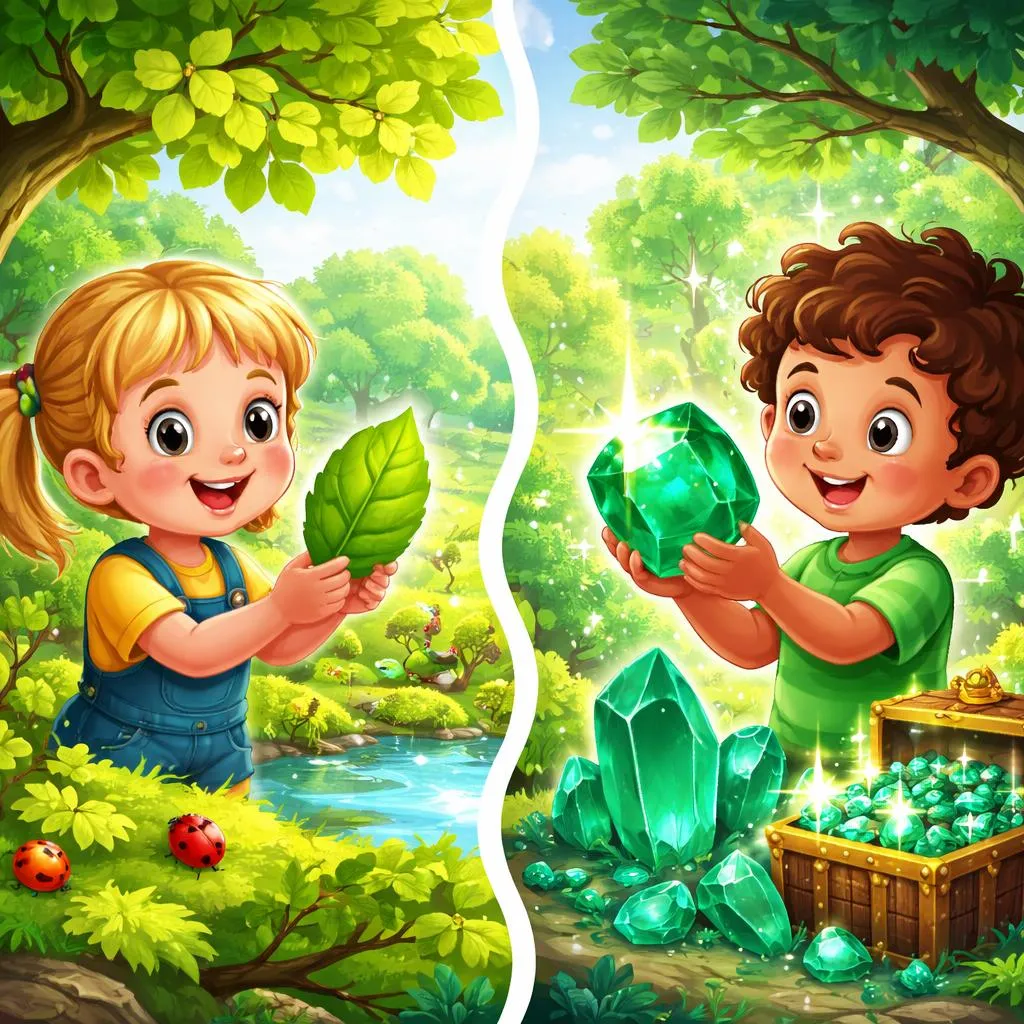

Start! Find a Pair of 'Green Twin' Words
Hello, word explorer! Do you love the color of grass and leaves? That color is green! Now, imagine a shiny, precious stone in a treasure chest. It is a deep, rich green. That is an emerald. They are both green colors. Are they the same? This is a shiny word puzzle. Today we explore a word pair. We explore green and emerald. They are like a leaf and a jewel. One is common. One is precious. Knowing the difference is a superpower. Your talk about colors will be clear and smart. Let us start our word treasure hunt!
Be a Language Observer now. Our first clue is at home. You color a tree. You say, "I used a green crayon." Your mom shows you a ring. She says, "This ring has an emerald stone." They are both shades of green. But are they the same? Let us test with two sentences.
"The grass on the lawn is a bright, healthy green." This is the common, natural color we see everywhere. "Her bracelet was set with a deep, sparkling emerald." This is a specific, valuable gemstone or its color.
They both relate to green. But one is the general color name. One is a specific gem or a rich shade named after it. Your observation mission starts. Let us explore their word forest!
Adventure! Explore the Word Forest
Feel the Word's Common and Precious Vibe!
Feel the word green. It is a common, natural word. It feels like grass, trees, and life. It is everywhere. The word emerald is a precious, special word. It feels like treasure, jewels, and magic. It is rare and beautiful. Green is the forest. Emerald is the treasure in the forest. One is ordinary. The other is extraordinary. Let us see this at school.
In a science class, you learn that plants are green because of chlorophyll. This is a basic fact about nature. In a history class, you read about ancient kings who wore emerald jewelry. This is about luxury and wealth. Saying "chlorophyll makes plants emerald" is not correct. The feeling of the words is different. One is scientific. The other is royal.
Compare Their General and Specific Nature!
Think about the word "metal" and the specific metal "gold." The word green is like "metal." It is the big category. It includes lime green, dark green, and olive green. The word emerald is like "gold." It is a specific, valuable type. It means a rich, clear, bluish-green, like the gemstone. Their scope is the key. Green is the whole family. Emerald is a famous family member. Let us test this on the playground.
You point to the leaves on a tree. You say, "The leaves are green!" Your friend shows you a shiny green bead. She says, "This bead is emerald green." The word green describes the leaves generally. The word emerald describes the specific, jewel-like shade of the bead. The playground shows the difference.
Meet Their Best Word Friends!
Words have favorite color partners. The word green likes common and natural words. It teams up with 'light', 'dark', 'go', 'thumb', 'with envy', and 'screen'. He has a green thumb. She was green with envy. The word emerald likes precious and descriptive words. It teams up with 'city', 'isle', 'deep', 'sparkling', 'gem', and 'green'. The Emerald Isle is a name for Ireland. It is emerald green. Their partners are different. Let us go back to school.
In a health class, you learn to eat your green vegetables. This is about food. In a geography class, you learn about the Emerald City (a nickname for Seattle). This is about a place name. You would not usually call broccoli an "emerald vegetable." The word friends set the tone.
Our Little Discovery!
We searched the word treasure chest. We made a clear discovery. The words green and emerald are different. The word green is the common, general name for a primary color, like grass and leaves. The word emerald is mainly a noun for a precious green gemstone. It is also used as an adjective to describe a rich, sparkling green, like the gem. Green is the big category. Emerald is a specific, valuable part of it. One is everyday. The other is special.
Challenge! Become a Color Word Expert
"Best Choice" Challenge!
Let us look at a nature scene. A frog sits on a lily pad. Its skin is a bright, leafy green. Is it Green or Emerald? The champion is Green! We describe the frog's common, natural color as green. Now, imagine sunlight hitting a tropical lagoon. The water is a brilliant, jewel-like emerald. Is it green or emerald? The champion is emerald! This describes a specific, stunning shade of green, like the gemstone. Excellent!
"My Sentence Show"!
Now, create your own sentences. Here is a fun scene: Imagine a field of fresh grass. Use the word green in one sentence. Now imagine a shiny gem in a storybook treasure. Use the word emerald in another. Try it! Here is an example. Sentence one: "The whole field was covered in soft, spring green." Sentence two: "The dragon guarded a chest full of gold and a huge emerald." See the difference? The first is about a common, natural color. The second is about a specific, precious jewel.
"Eagle Eyes" Search!
Can you find the word that needs help? Read this sentence: "The traffic light turned emerald, so we knew it was safe to go." Hmm. This is a mix-up. Traffic lights are a standard, bright green, not a jewel-like emerald. The common word is green. A better sentence is: "The traffic light turned green, so we knew it was safe to go." You fixed it!
What a sparkling adventure in the word forest! You started as a curious explorer. Now you are a word jeweler. You know the secret of green and emerald. You can feel their different common and precious vibes. You see their general and specific nature. You know their best word friends. This is a real language superpower.
You can learn amazing things from this article. You now know that 'green' is the common name for a primary color, seen in nature everywhere. You understand that an 'emerald' is a precious green gemstone, and the word can also describe a rich, sparkling green color like the gem. You can explain that green is a general term, while emerald is specific and often precious. You learned phrases like 'green thumb' and 'Emerald City'.
How can you use this today? It is easy and fun. Look at plants and leaves. Call them green. If you see a very rich, shiny green, like a jewel or a tropical sea, you can call it emerald. In stories, look for the word emerald to describe treasure or magical places. Draw two pictures. Draw a simple green leaf. Draw a shiny emerald gem. You are using your new skill every day.
Keep your explorer eyes open. The world is full of amazing greens, from the ordinary to the extraordinary. You are learning the words to describe them all. Great work, word expert. Your English journey is getting more colorful and precise with every new word pair you discover!