
Start! Find a Pair of 'Space Twin' Words
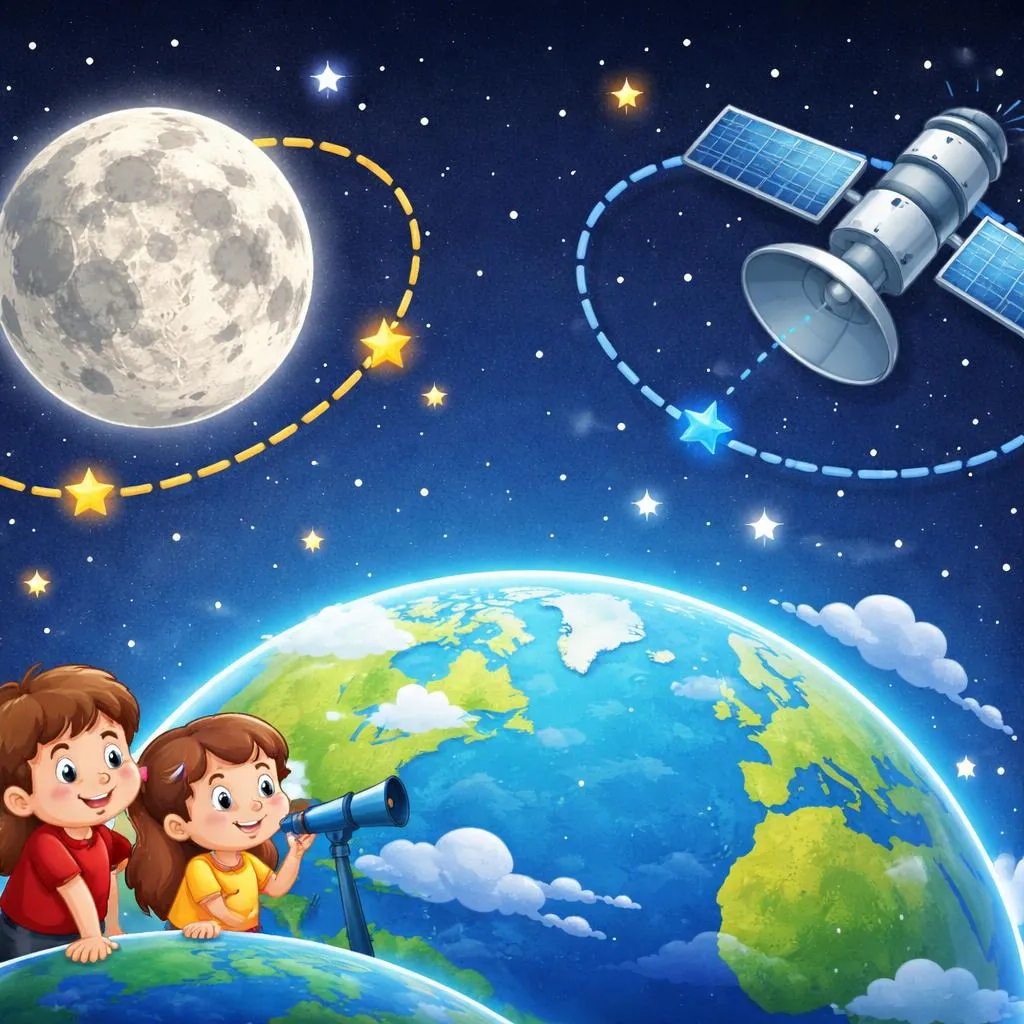
Hello, word explorer! Look up at the night sky. What is that big, round, bright object? It is the moon! Now, think about objects that circle planets. They are called satellites. They both orbit around something in space. Are they the same? This is a fun space puzzle. Today we explore a word pair. We explore moon and satellite. They are like a specific child and the word "children." One is a name. One is a category. Knowing the difference is a superpower. Your talk about space will be clear and smart. Let us start our word orbit!
Be a Language Observer now. Our first clue is at home. You look out the window at night. You say, "The moon looks full tonight." Your dad points to a tiny moving light. He says, "That is a man-made satellite." They are both circling Earth. But are they the same? Let us test with two sentences.
"The moon affects the ocean's tides on Earth." This is about our own natural, rocky companion. "Jupiter has at least 80 satellites orbiting it." This is about all the objects, big and small, that circle planets.
They both describe objects in orbit. But one is the special name for Earth's companion. One is the general job title. Your observation mission starts. Let us launch into their word solar system!
Adventure! Launch Into the Word Solar System
Feel the Word's Specific and General Nature!
Feel the word moon. It is a specific, proper name word. It feels like a first name. It is the name of Earth's natural satellite. The word satellite is a general, scientific word. It feels like a job title. It is the name for any object that orbits a planet. Moon is the specific child. Satellite is the word "children." One is a nickname. The other is the group name. Let us see this at school.
In a poetry class, you write a poem about the moon. This uses the beautiful, common name. In a science class, you learn that Earth's moon is a natural satellite. This sentence uses both words perfectly. It shows the moon is one example of a satellite. The specificity is different. One is the exact one. The other is the type. Let us test this on the playground.
One child stands near another, pretending to orbit. She says, "I am your moon!" Many other children pretend to orbit different "planets." They all say, "We are satellites!" The word moon is for the one special companion. The word satellite is for all orbiting objects. The playground shows the relationship.
Compare Their Natural and Man-Made Types!
Think about a wild tree in a forest and all the trees in a city park. The word moon is like the wild tree. It is natural. The word satellite includes both wild trees and planted trees. It can be natural or man-made. Their origin is a clue. Our moon is a natural satellite. The International Space Station is a man-made satellite. Let us see this at school.
In a literature class, you read stories about the man in the moon. This is about our cultural view of our natural satellite. In a technology class, you learn how GPS satellites help maps work. This is about human-built machines in space. You would not call a GPS a "moon." The moon is always natural. A satellite can be either.
Meet Their Best Word Friends!
Words have favorite space partners. The word moon likes poetic, nightly, and specific words. It teams up with 'full', 'crescent', 'landing', 'light', 'beam', and 'shine'. The moonlight is bright. We saw a full moon. The word satellite likes technical and general words. It teams up with 'man-made', 'natural', 'communication', 'GPS', 'orbit', and 'launch a'. They launched a satellite. It is a satellite dish. Their partners are different. Let us go back to school.
In an art class, you might draw the phases of the moon. This is about its changing shape. In a social studies class, you learn about satellite TV and how it sends signals. This is about technology. You would not usually draw the "phases of a satellite." The word friends set the context.
Our Little Discovery!
We orbited the word space. We made a clear discovery. The words moon and satellite are a family. The word moon is the name of Earth's natural satellite. It is our local space companion. The word satellite is the general name for any object that orbits a planet. It can be natural (like a moon) or man-made. Our moon is a satellite. But a satellite is not always our moon. Moon is the specific one. Satellite is the general type. One is the player on our team. The other is the whole league.
Challenge! Become an Orbiting Word Expert
"Best Choice" Challenge!
Let us look at a nature scene. You are on a beach at night. The big, silver object is reflected in the water. You are looking at the ______. Is it Moon or Satellite? The champion is Moon! The large, bright object in our night sky is our moon. Now, imagine an astronomer finding a new rock orbiting Mars. She says, "We have discovered a new natural ______ of Mars." Is it moon or satellite? The champion is satellite! In science talk, a newly found object is called a satellite. It might later be named a moon. Excellent!
"My Sentence Show"!
Now, create your own sentences. Here is a fun scene: Imagine a clear night with a bright, round shape. Use the word moon in one sentence. Now imagine a scientist tracking a human-made object in space. Use the word satellite in another. Try it! Here is an example. Sentence one: "The moon cast long shadows on the path." Sentence two: "The weather satellite sends images of storms to Earth." See the difference? The first is about the light and view from our natural companion. The second is about the function of a human-built machine in orbit.
"Eagle Eyes" Search!
Can you find the word that needs help? Read this sentence: "The astronauts repaired the broken communication moon so TV signals could work again." Hmm. This is a mix-up. A communication object in space built by humans is a satellite, not a moon. A better sentence is: "The astronauts repaired the broken communication satellite so TV signals could work again." You fixed it!
What a stellar journey through the word orbits! You started as a curious sky-watcher. Now you are a word astronaut. You know the secret of moon and satellite. You can feel their specific and general nature. You see their natural and man-made types. You know their best word friends. This is a real language superpower.
You can learn amazing things from this article. You now know that the 'moon' is the name of Earth's natural satellite, the object we see at night. You understand that a 'satellite' is any object that orbits a planet, and it can be natural (like a moon) or man-made (like the ISS). You can explain that our moon is a satellite, but we only call our own satellite "the Moon". You learned phrases like 'moonlight' and 'satellite TV'.
How can you use this today? It is easy and fun. When you see the bright object at night, call it the moon. When you hear about SpaceX launching something into orbit, that is a satellite. Look at a picture of Jupiter with its many dots. Those are its many satellites (or moons!). Draw two pictures. Draw Earth with its moon. Draw Earth with many different satellites around it. You are using your new skill every day.
Keep your explorer eyes on the sky. Our planet has amazing companions, both natural and built by clever humans. You are learning the words to tell them apart. Great work, word expert. Your English journey is orbiting to new heights with every new word pair you discover!