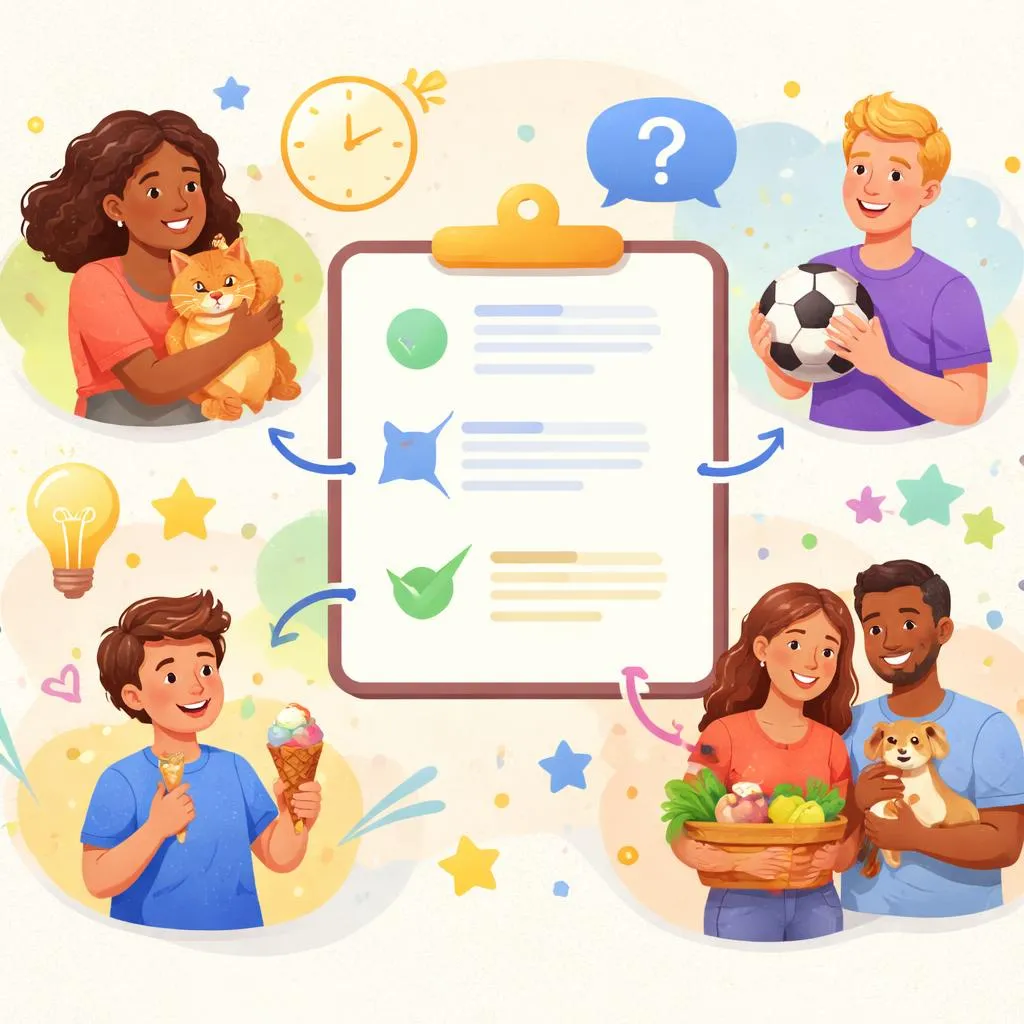

Welcome, grammar learners! Today, we are focusing on a verb we use every single day. We are learning about the "present tense for have". This verb is essential for talking about what we own, what we experience, and even what we eat. Mastering its present tense forms is a key step to speaking English accurately. Let's begin this important lesson together.
Meaning The verb "to have" in the present tense has two main meanings. Its primary meaning is to show possession or ownership. When we say, "I have a pencil," it means the pencil belongs to me. The second important meaning is to show experience or obligation. For example, "I have breakfast at 7 AM" shows a habitual action. "I have to go" shows an obligation (must go). Understanding these core meanings helps us use the verb correctly in many different situations.
Conjugation Conjugation means changing the verb to match its subject. The present tense for have has two main forms: have and has.
We use have with the subjects I, you, we, and they.
I have a book.
You have a friend.
We have a house.
They have a dog.
We use has only with the third person singular subjects: he, she, it, or a singular noun.
He has a ball.
She has an idea.
The cat has a toy.
My brother has a bike.
The simple rule to remember is: He, She, It — HAS. All others use HAVE.
Present tense The present tense for have is used to talk about things that are true now, or habits.
We use it to state current possession. "She has brown hair." "They have a new car."
We use it to talk about family and relationships. "I have two sisters." "He has a kind teacher."
We use it to describe characteristics. "This room has a big window." "You have a nice smile."
We use it for habitual actions, especially with meals or routines. "We have dinner at six o'clock."
The negative form uses do not have (don't have) or does not have (doesn't have). "I don't have a ruler." "She doesn't have her lunch today."
Past tense The past tense form of "have" is had. We use had for all subjects (I, you, he, she, it, we, they) to talk about possession or experience in the past.
For past possession: "Yesterday, I had three apples." "She had a blue dress when she was little."
For past experience: "We had a great time at the party." This shows the experience is finished.
The negative in the past is did not have (didn't have). "He didn't have his homework yesterday." Understanding the past tense helps tell stories about what we owned or did before.
Future tense To express future possession or obligation, we use the helping verb "will."
For future possession: "I will have a new bicycle on my birthday." "They will have a test next week."
For future obligation: "She will have to finish her project." This is less common for young learners. The main focus for the future is the simple structure: Subject + will have + object.
The negative is will not have (won't have). "I won't have time tomorrow."
Questions To form a yes/no question in the present tense, we usually use the auxiliary verb "do" or "does."
The structure is: Do/Does + Subject + have + ...?
Do you have a pencil?
Does she have a dog?
Do they have homework?
To answer, we say: "Yes, I do." / "No, I don't." or "Yes, she does." / "No, she doesn't."
For questions about experience ("have breakfast"), we use the same structure: "Do you have breakfast at home?" This question format is very common and useful.
Other uses The present tense for have appears in several important common expressions.
We use it for obligations: "have to" (must). "I have to clean my room." "She has to go to school."
We use it in the present perfect tense as a helping verb: "I have eaten." "She has finished." This is a more advanced use but important to note.
We use it in fixed phrases: "Have a good day!" "Have fun!" "Have a seat." These are very common in daily conversation.
Learning tips A great tip is to memorize the simple rule: He/She/It HAS. You can use a rhyme: "For he, she, and it, 'has' is the perfect fit."
Practice with what you see around you. "I have a red shirt. The teacher has a whiteboard. We have desks." This makes it relevant.
Use contrast exercises. Fill in blanks: "I ____ a bag. You ____ a bag. She ____ a bag." This drills the conjugation.
For questions, practice the "Do/Does" switch. Turn statements into questions. "You have a brother." becomes "Do you have a brother?"
Educational games "Have You Got It?" Guessing Game: Hide an object. Give clues using "has." "Someone in this room has something blue. It has four corners. Does Maria have it?" Students guess using questions: "Does Jake have it?"
"My Weekend" Interview: Students pair up and interview each other using "Do you have...?" questions. "Do you have a pet?" "Do you have a bike?" They then report: "She has a cat. He has a blue bike."
"Sentence Sort" Relay: Write subjects (I, The dog, We) and predicates (have a ball, has a tail, have books) on separate cards. Teams race to match them into correct sentences and read them aloud.
Mastering the "present tense for have" allows you to talk about your world clearly. You can say what you own, describe your family, and talk about your daily routines. Start by noticing what you and people around you have. Use the simple rule for he/she/it. Every correct sentence builds your confidence. Keep practicing, and soon using "have" and "has" will feel completely natural. You are building a strong foundation for all your English conversations.