
Start! Find a Pair of 'Book Twin' Words
Hello, word explorer! Do you love to read? Where do you go to find books? You probably go to the library! Now, imagine a special room that holds very old letters, maps, and records. That place is an archive. They are both places that keep information. Are they the same? This is a fun word puzzle. Today we explore a word pair. We explore library and archive. They are like two different keepers of stories. One is for sharing. One is for saving. Knowing the difference is a superpower. Your talk about books and history will be clear and smart. Let us start our word reading adventure!
Be a Language Observer now. Our first clue is at home. You need a book for a school project. Your mom says, "Let's check the public library." Then, you watch a documentary. Historians look at old newspapers in a national archive. They are both places with collected materials. But are they the same? Let us test with two sentences.
"I borrowed three mystery novels from the school library." This is about a place for borrowing popular books. "The historian found a centuries-old letter in the national archive." This is about a place for preserving unique documents.
They both describe collections of information. But one feels like a place for current, circulating items. One feels like a place for permanent, historical records. Your observation mission starts. Let us step into their word world.
Adventure! Step Into the Word World
Feel the Word's Purpose and Vibe!
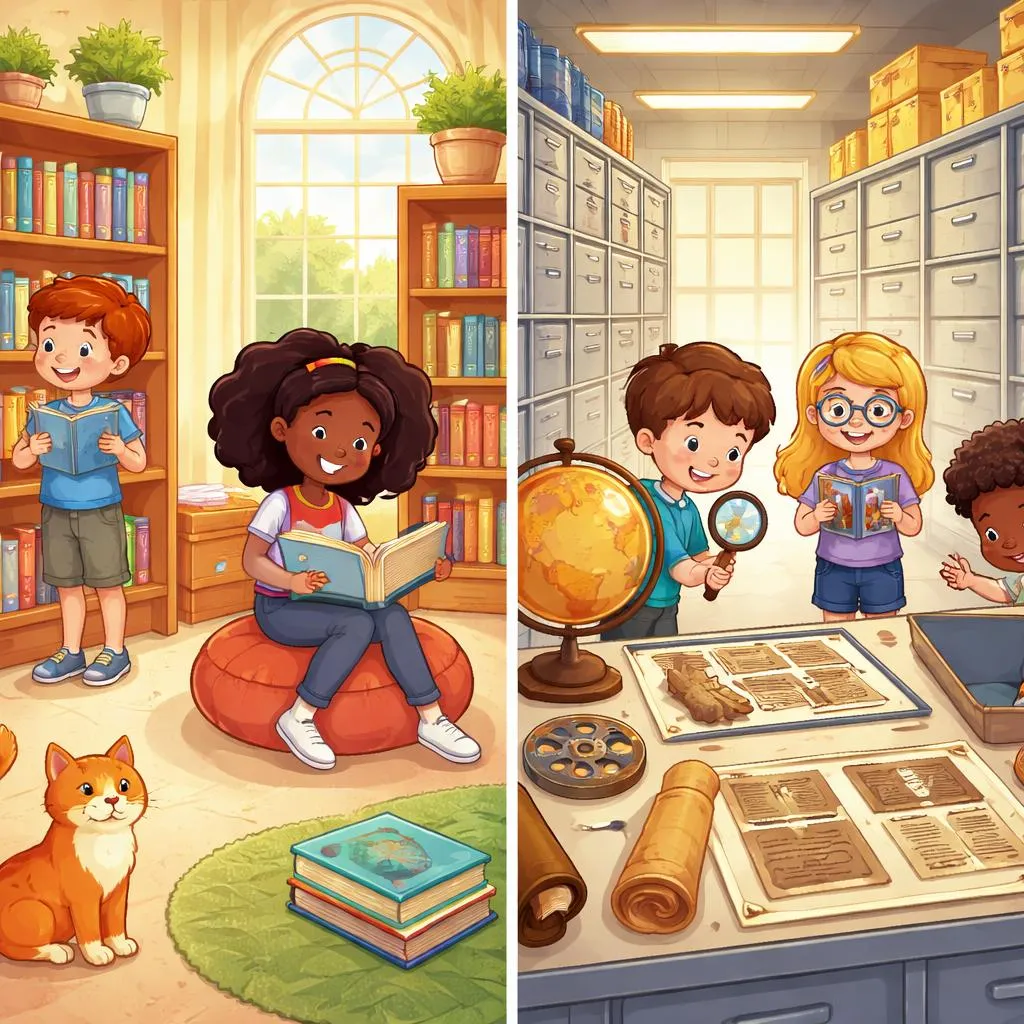
Feel the word library. It is a friendly, active word. It feels like a community hub. It is for borrowing, reading, and learning now. The word archive is a quiet, formal word. It feels like a guarded treasure chest. It is for preserving, researching, and remembering the past. Library is the helpful librarian. Archive is the careful guardian. One is for today's readers. The other is for tomorrow's historians. Let us see this at school.
In your school, you visit the library to get books for class. This is a normal, active part of learning. In a history project, you might look at copies of old yearbooks in the school's archive. This is a special, research-focused activity. Saying "school archive" for borrowing textbooks is wrong. The purpose and vibe are different. One is for circulation. The other is for conservation.
Compare Their Collection and Access!
Think about a public swimming pool and a museum vault. The word library is the swimming pool. It is open to everyone. Its items (books) are meant to be used and borrowed. The word archive is the museum vault. It is for special access. Its items (records) are unique and meant to be preserved. Their collections are a clue. A library has many copies of published works. An archive has one-of-a-kind, unpublished materials. Let us test this on the playground.
You and friends set up a booth to exchange your own comic books. You say, "This is our library!" Your friend has a special box with original drawings and signed notes. He says, "This is my personal archive." The word library suggests sharing and swapping. The word archive suggests safekeeping of originals. The playground shows the difference.
Meet Their Best Word Friends!
Words have favorite collection partners. The word library likes public and active words. It teams up with 'public', 'school', 'lending', 'book', 'card', and 'science'. I have a library card. We studied in the library. The word archive likes historical and preservation words. It teams up with 'national', 'historical', 'digital', 'photo', 'footage', and 'research'. They watched old newsreel archive footage. It is in the digital archive. Their partners are different. Let us go back to school.
In a literature class, you might do a library scavenger hunt. This is a fun, active game. In a social studies class, you might use an online archive to see scanned historical documents. This is a serious research task. You would not usually do an "archive scavenger hunt." The word friends set the activity's tone.
Our Little Discovery!
We explored the word collection house. We made a clear discovery. The words library and archive are different keepers. The word library usually describes a place that lends books and media to the public. It is for active use and learning. The word archive usually describes a place that preserves historical records for research. It is for long-term safekeeping. Library is for borrowing. Archive is for preserving. One is a bustling exchange. The other is a quiet treasure box.
Challenge! Become a Collection Word Expert
"Best Choice" Challenge!
Let us look at two scenes. Read each one. Pick the champion word. Scene one: You need a fun book to read over the weekend. You go to a building with many shelves, a checkout desk, and a children's section. This is a ______. Is it Library or Archive? The champion is Library! It is the place for borrowing books for enjoyment. Scene two: A researcher is studying the founding of your town. She spends days in a special room at city hall looking at old meeting minutes and land deeds. This room is the city ______. Is it library or archive? The champion is archive! It is the place for preserving and studying original historical records. Excellent!
"My Sentence Show"!
Now, create your own sentences. Here is a fun scene: Imagine a bright, modern building with lots of people and computers. Use the word library in one sentence. Now imagine a quiet, climate-controlled room with carefully stored boxes. Use the word archive in another. Try it! Here is an example. Sentence one: "The new library has a special room for story time and crafts." Sentence two: "The film archive holds the original reels of classic movies." See the difference? The first is about a community space for activities. The second is about a specialized facility for preserving originals.
"Eagle Eyes" Search!
Can you find the word that needs help? Read this sentence: "For my history report, I went to the city library to look at the original handwritten letters from the mayor in 1920." Hmm. This is a common mix-up. Original, handwritten letters are usually kept in an archive, not a lending library. A public library is not typically the place for one-of-a-kind historical documents. A better sentence is: "For my history report, I went to the city archive to look at the original handwritten letters from the mayor in 1920." You fixed it!
What a wonderful journey through the word collections! You started as a curious reader. Now you are a word historian. You know the secret of library and archive. You can feel their different purposes and vibes. You see their collections and who can access them. You know their best word friends. This is a real language superpower.
You can learn amazing things from this article. You now know that a 'library' is a place that lends books and media for people to borrow and use. You understand that an 'archive' is a place that preserves unique historical documents and records for research and safekeeping. You can explain that a library is for sharing, while an archive is for saving. You learned terms like 'library card' and 'digital archive'.
How can you use this today? It is easy and fun. Next time you visit your local library, look around. See all the books you can borrow. Then, ask a librarian or a teacher if your town or school has an archive. What do they keep there? Look online for a digital archive of old photos from your area. Draw two pictures. Draw a busy, friendly library. Draw a quiet, careful archive. You are using your new skill every day.
Keep your explorer eyes open. The world is full of places that keep our stories and knowledge. You are learning the words to describe them correctly. Great work, word expert. Your English journey is getting more knowledgeable and precise with every new word pair you discover!