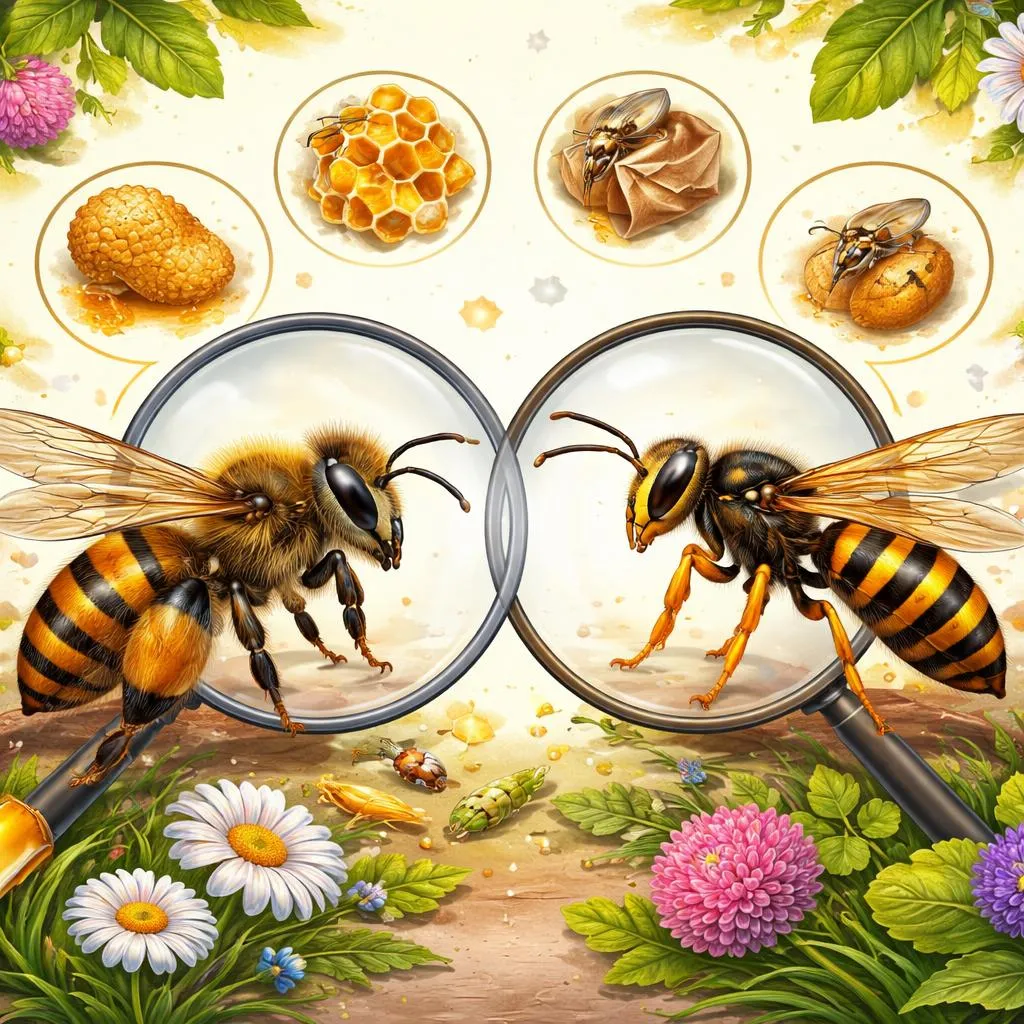

Hello, word explorer! Have you ever heard a buzzing sound near a flower? You see a striped insect. What do you call it? You might say "bee." But then you see another striped insect at a picnic. It looks similar. Is that a bee too? Maybe it's a "wasp." They both buzz and have stripes. Are they the same? This is a common summer puzzle. Today we explore a word pair. We explore bee and wasp. They are like two striped cousins. They both can sting. But they are very different friends! Knowing the difference is a superpower. Your garden safety and knowledge will be much better. Let us start our buzzy word adventure!
Be a Language Watcher now. Our first clue is at home. You help in the garden. You see a fuzzy insect on a sunflower. Your mom says, "That bee is collecting pollen." Then, you see a smooth insect near your soda can. Your dad says, "Watch out for that wasp!" They are both striped flyers. But are they the same? Let us test with two sentences.
"The bee moved from flower to flower, covered in yellow dust." This shows a busy, helpful insect. "The wasp landed on the apple slice, looking for sugar." This shows a more bold, searching insect.
They both describe buzzing, striped creatures. But one feels like a helpful gardener. One feels like a hungry visitor. Your watching mission starts. Let us buzz into their word world.
Adventure! Buzz Into the Word World
Feel the Word's Purpose!
Feel the word bee. It is a fuzzy, productive word. It feels like a hard worker. It is a friend to flowers. The word wasp is a smooth, sharp word. It feels like a hunter or a scavenger. It is often seen as more aggressive. Bee is the helpful maker. Wasp is the fierce hunter. One is a farmer. The other is a soldier. Let us see this at school.
In a science class, you learn: "The bee makes honey in its hive." This is about creating something sweet. In a safety lesson, you might learn: "A wasp can sting many times." This is about defense and danger. Saying "a bee can sting" is also true. But the feeling of the words is different. The purpose of the insects shapes the word's feeling.
Compare Their Bodies and Behavior!
Think about a fuzzy sweater and a sleek raincoat. The word bee is the fuzzy sweater. A bee is often rounder and hairy. It carries pollen on its legs. The word wasp is the sleek raincoat. A wasp is often smoother and has a narrow waist. It does not collect pollen. Their behavior is different too. Bees die after one sting. Wasps can sting again and again. Let us test this on the playground.
You play a pretending game. You buzz gently from one spot to another. You say, "I am a bee gathering food!" Your friend darts quickly and sharply. He says, "I am a wasp protecting my nest!" The word bee suggests busy, gentle work. The word wasp suggests quick, defensive action. The playground shows the difference in attitude.
Meet Their Best Word Friends!
Words have favorite garden partners. The word bee likes sweet and busy words. It teams up with 'honey', 'bumble', 'queen', 'hive', and 'busy as a'. You are as busy as a bee. You eat bee honey. The word wasp likes sharp and nest words. It teams up with 'yellow jacket', 'hornet', 'nest', 'sting', and 'paper'. A wasp builds a paper nest. A wasp sting hurts. Their partners are different. Let us go back to school.
In a health class, you might learn about bee pollen. This is a health product. In a art class, you might make a model of a wasp nest. This is about its home. You would not usually talk about "wasp pollen." The word friends help set the right topic.
Our Little Discovery!
We buzzed around the word garden. We made a clear discovery. The words bee and wasp are different insects. The word bee usually describes a fuzzy, pollen-collecting insect that makes honey. The word wasp usually describes a smoother, hunting insect that can sting repeatedly. Bee is the helpful pollinator. Wasp is the fierce predator. One is a creator. The other is a defender. This is the key difference.
Challenge! Become a Garden Word Expert
"Best Choice" Challenge!
Let us look at two scenes. Read each one. Pick the champion word. Scene one: You visit a farm. You see boxes stacked in a field. The farmer says, "These are my ______ hives for making honey." Is it Bee or Wasp? The champion is Bee! Beekeepers have bee hives for honey. Scene two: You see a gray, papery ball under the roof of a shed. Your parent says, "That is a ______ nest. Do not go near it." Is it bee or wasp? The champion is wasp! Wasps make papery nests. Excellent choice!
"My Sentence Show"!
Now, create your own sentences. Here is a scene: Imagine a sunny lavender field. Use the word bee in one sentence. Now imagine a backyard barbecue. Use the word wasp in another. Try it! Here is an example. Sentence one: "The bee buzzed softly as it worked on the lavender." Sentence two: "A wasp circled the lemonade pitcher, looking for a way in." See the difference? The first is peaceful and productive. The second is more intrusive and searching.
"Eagle Eyes" Search!
Can you find the word that needs help? Read this sentence: "I got stung by a honey wasp while I was picking flowers in the garden." Hmm. This is a mix-up. Honey is made by bees, not wasps. The insect was likely a bee. A better sentence is: "I got stung by a honey bee while I was picking flowers in the garden." You spotted the mix-up!
What a wonderful garden adventure! You started as a curious listener. Now you are a word entomologist. You know the secret of bee and wasp. You can feel their different purposes. You see their bodies and behavior. You know their best word friends. This is a real language superpower.
You can learn amazing things from this article. You now know that a 'bee' is a fuzzy, pollen-collecting insect that makes honey and usually dies after stinging once. You understand that a 'wasp' is a smoother, hunting insect that can sting many times and builds paper nests. You can explain that bees are vital pollinators, while wasps are important predators of other pests. You learned the phrases 'busy as a bee' and to be careful around a 'wasp nest'.
How can you use this today? It is easy and fun. Next time you are outside, be a detective. Is the insect fuzzy and on a flower? It is likely a bee. Is it smooth, with a narrow waist, near your food? It might be a wasp. Watch a nature show about insects. Listen for these words. Draw two pictures. Draw a fuzzy bee with pollen baskets. Draw a sleek wasp with a narrow waist. You are using your new skill every day.
Keep your explorer eyes open. The world is full of amazing word pairs. You are learning to see the important details. Great work, word expert. Your English journey is becoming more precise and safe with every new word pair you master!