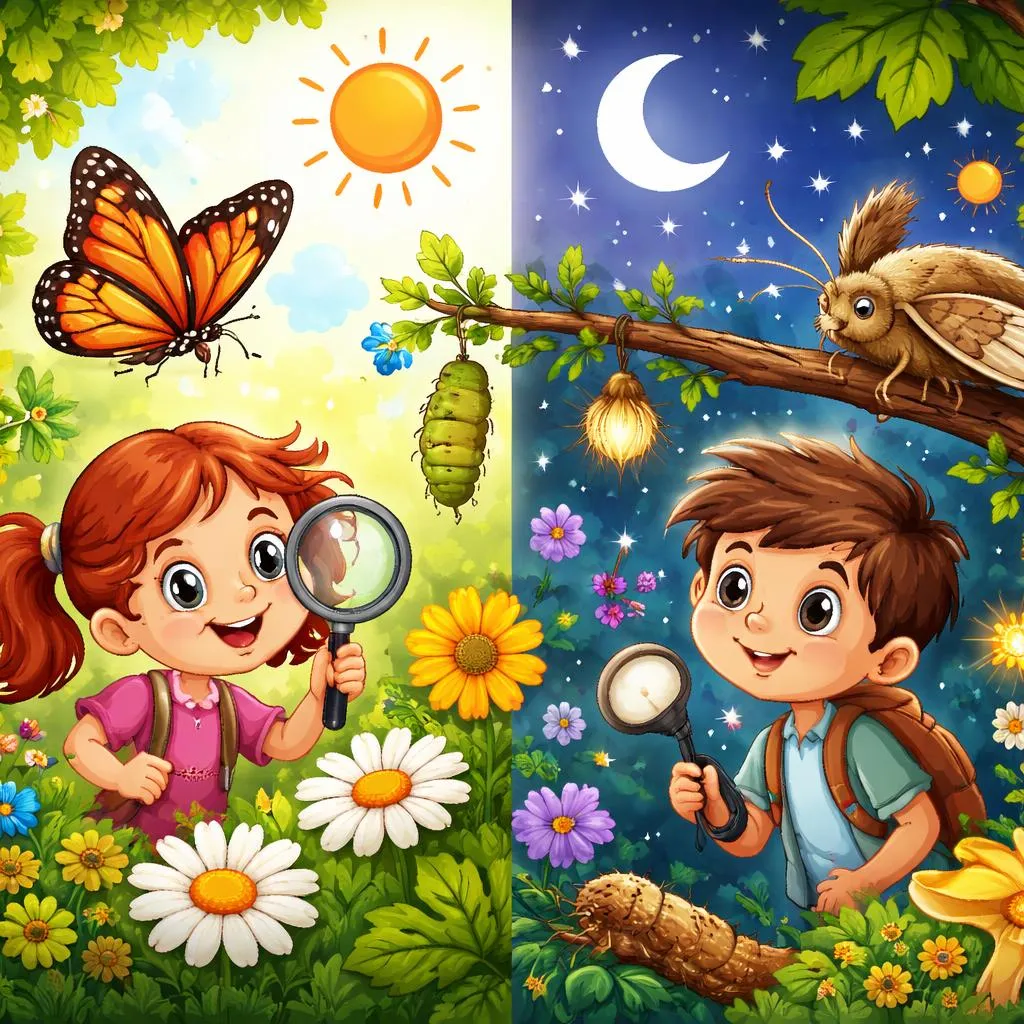

Start! Find a Pair of 'Magic Twin' Words
Hello, word explorer! Have you ever seen a beautiful insect with colorful wings? It flutters in the sun. What do you call it? A butterfly! Now, imagine a similar, but often duller, insect flying around a lamp at night. What is that? A moth! They look a lot alike. Are they the same? This is a common nature puzzle. Today we explore a word pair. We explore butterfly and moth. They are like two cousins in the insect world. They are both Lepidoptera. But they have different lifestyles! Knowing the difference is a superpower. Your nature observations will be sharp and clear. Let us start our word flight!
Be a Language Watcher now. Our first clue is at home. You read a book about gardens. It shows a picture of a monarch butterfly. Then, you see a small, beige insect on the window screen at night. Your parent says, "That's a moth." They are both winged insects. But are they the same? Let us test with two sentences.
"The butterfly landed gently on the flower to drink nectar." This sounds graceful and daytime. "The moth fluttered wildly around the porch light." This sounds active and nighttime.
They both describe flying insects. But one feels like a sunny day. One feels like a dark night. Your watching mission starts. Let us flutter into their word world.
Adventure! Flutter Into the Word World
Feel the Word's Vibe!
Feel the word butterfly. It is a bright, cheerful word. It feels like a sunny garden. It is graceful, colorful, and friendly. The word moth is a soft, mysterious word. It feels like a quiet night. It is sturdy, secretive, and drawn to light. Butterfly is the daytime dancer. Moth is the nighttime visitor. One is a ballerina. The other is a shadow. Let us see this at school.
In an art class, you might paint a colorful butterfly. This is a happy, bright subject. In a creative writing class, you might describe a moth beating against a window. This creates a mysterious mood. Saying "a butterfly beating against a window" is less common. The vibe of the words is different.
Compare Their Looks and Habits!
Think about a ballerina's costume and a hiker's jacket. The word butterfly is the ballerina. It is often more colorful. It has thin, club-shaped antennae. It rests with its wings closed together, upright. The word moth is the hiker. It is often more dull-colored. It has feathery or thread-like antennae. It rests with its wings spread flat. Their habits are different too. Butterflies fly by day. Moths often fly by night. Let us test this on the playground.
You play a game. You flutter gracefully in the sun. You say, "I am a butterfly!" Your friend flies in a zigzag path in the shade. He says, "I am a moth searching for light!" The word butterfly means graceful, daytime flight. The word moth means erratic, nighttime flight. The playground shows the difference.
Meet Their Best Word Friends!
Words have favorite nature partners. The word butterfly likes bright and gentle words. It teams up with 'monarch', 'flutter', 'garden', 'colorful', and 'effect'. You get butterflies in your stomach. You see a butterfly garden. The word moth likes night and fabric words. It teams up with 'luna', 'light', 'ball', 'clothes', and 'cocoon'. You set up a moth light trap. A moth ate a hole in the sweater. Their partners are different. Let us go back to school.
In a science lesson, you study the butterfly life cycle. This is a common school topic. In a home economics class, you learn to protect clothes from moths. This is about practical care. You would not usually study the "butterfly life cycle" of a clothes-eating insect. The word friends set the right context.
Our Little Discovery!
We explored the word meadow and night sky. We made a clear discovery. The words butterfly and moth are different fliers. The word butterfly usually describes a colorful, day-flying insect with club-shaped antennae. It rests with wings up. The word moth usually describes a often duller, night-flying insect with feathery antennae. It rests with wings flat. Butterfly is the sun-lover. Moth is the moon-child. One is a symbol of day. The other is a creature of the night.
Challenge! Become an Insect Word Expert
"Best Choice" Challenge!
Let us look at nature. Read each scene. Pick the champion word. Scene one: You are in a sunny field. You see a large, orange and black insect on a milkweed plant. Your guide says, "That's a monarch ______." Is it Butterfly or Moth? The champion is Butterfly! The monarch is a famous butterfly. Scene two: You see a large, pale green insect with long tails on its wings. It is flying at dusk. Your book says, "That is a luna ______." Is it butterfly or moth? The champion is moth! The luna is a famous moth. Great spotting!
"My Sentence Show"!
Now, create your own sentences. Here is a scene: Imagine a bright, flower-filled meadow at noon. Use the word butterfly in one sentence. Now imagine a warm, dark summer night. Use the word moth in another. Try it! Here is an example. Sentence one: "A yellow butterfly flitted from blossom to blossom." Sentence two: "A dusty moth circled the streetlamp in a silent dance." See the difference? The first is about daytime beauty. The second is about nighttime mystery.
"Eagle Eyes" Search!
Can you find the word that needs help? Read this sentence: "We raised a caterpillar in class, and it became a beautiful moth with bright blue wings that flew during the day." Hmm. This is tricky. Some moths are colorful and fly by day. But the word "beautiful" and "bright blue wings" often make us think of butterflies. Also, raising caterpillars in class is very common for butterflies. A more typical sentence is: "We raised a caterpillar in class, and it became a beautiful butterfly with bright blue wings that flew during the day." You spotted the common association!
What a wonderful flight through words! You started as a curious observer. Now you are a word entomologist. You know the secret of butterfly and moth. You can feel their different vibes. You see their looks and habits. You know their best word friends. This is a real language superpower.
You can learn amazing things from this article. You now know that a 'butterfly' is usually a colorful, day-flying insect that rests with its wings up. You understand that a 'moth' is often a duller, night-flying insect that rests with its wings flat. You can explain that butterflies have club-shaped antennae and moths often have feathery ones. You learned the phrases 'butterflies in your stomach' and 'mothball'.
How can you use this today? It is easy and fun. Next time you see a fluttering insect, be a detective. Is it daytime? Are the antennae clubbed? It might be a butterfly. Is it nighttime? Are the wings flat? It might be a moth. Visit a butterfly garden or look at pictures. Test your knowledge. Draw two pictures. Draw a bright butterfly and a subtle moth. You are using your new skill every day.
Keep your explorer eyes open. The world is full of amazing word pairs. You are learning to see the delicate details. Great work, word expert. Your English journey is becoming more colorful and fascinating with every new word pair you discover!