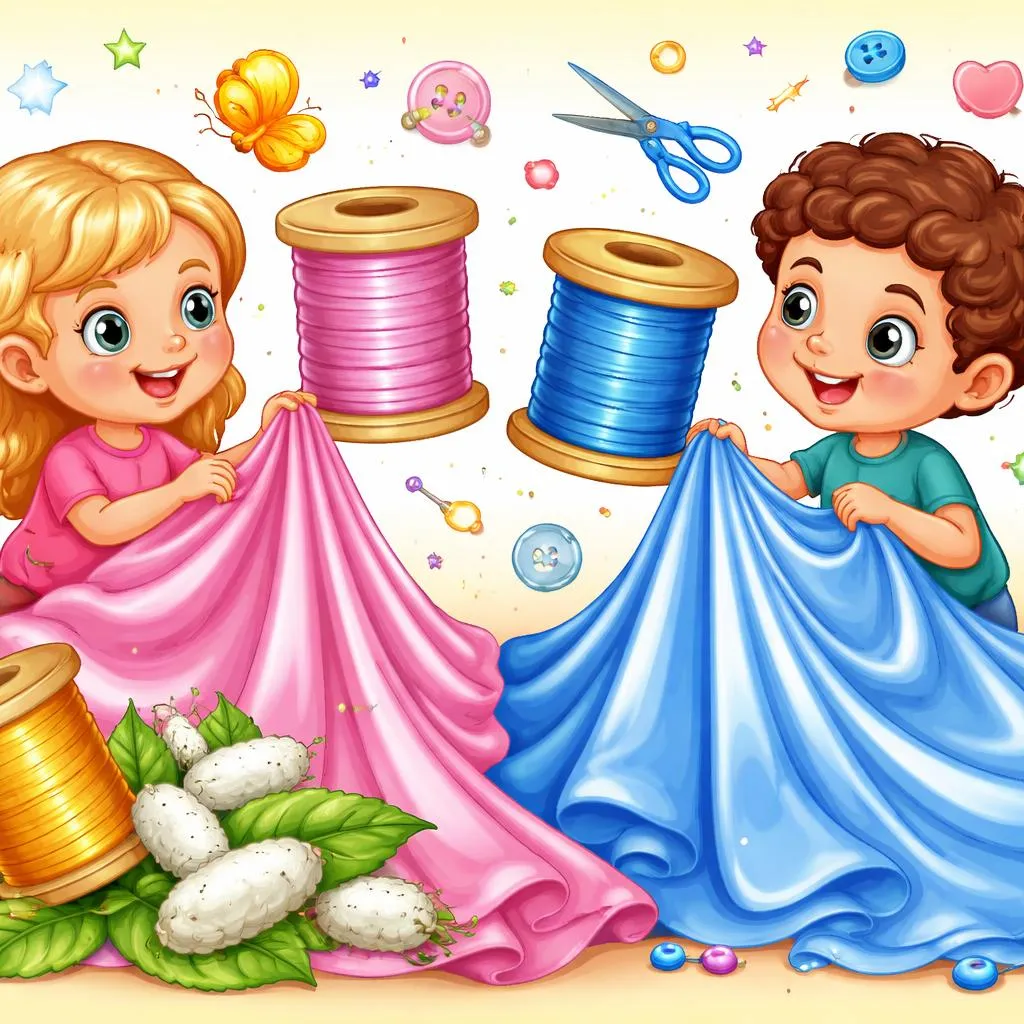

Start! Find a Pair of 'Shiny Twin' Words
Hello, word explorer! Have you ever touched a super smooth scarf? It might be made of soft silk. Have you seen a shiny pillowcase or a fancy dress? It might be made of satin. They both feel smooth and look special. Are they the same? This is a shiny and slippery puzzle. Today we explore a word pair. We explore silk and satin. They are like a soft worm's thread and a shiny mirror. One is a special thread. One is a way to weave it. Knowing the difference is a superpower. Your talk about fancy fabrics will be clear and smart. Let us start our shiny word journey!
Be a Language Observer now. Our first clue is at home. Your mom's special scarf feels like cool, smooth silk. The pillowcase on the guest bed is very shiny and made of satin. They are both smooth. But are they the same? Let us test with two sentences.
"The scarf was made of delicate, expensive silk." This is about a specific, natural material. "The wedding dress had a beautiful, shiny satin finish." This is about a glossy type of weave or fabric.
They are both smooth. But one is a material from a worm. One is a way to make fabric shiny. Your observation mission starts. Let us explore their word world.
Adventure! Explore the Shiny Word World
Feel the Word's Natural and Glossy Vibe!
Feel the word silk. It is a natural, ancient, and rich word. It feels soft, cool, and expensive. It whispers of caterpillars and faraway places. The word satin is a glossy, smooth, and fancy word. It shines and feels sleek. It is all about a special shine. Silk is the story of a caterpillar. Satin is the magic of light on cloth. One is about the source. The other is about the shine. Let us see this at school.
In a history class, you learn about the Silk Road. This is about the trade of a precious material. In a home economics class, you learn to sew with a satin ribbon. This is about a type of shiny fabric trim. Saying a "satin worm" is wrong. The feeling of the words is different. One is about history and nature. One is about craft and shine.
Compare Their Identity: The Material vs. The Weave!
Think about milk and ice cream. The word silk is the milk. It is the natural ingredient. The word satin is the ice cream. It is a product you can make from that ingredient. Their identity is the key. Silk is a strong, fine, natural fiber spun by silkworms. It is the material. Satin is a way of weaving threads. This weave creates a shiny front and a dull back. You can have silk satin (satin made from silk threads) or polyester satin (satin made from plastic threads). Silk names the thread. Satin names the weave. Let us test this on the playground.
Imagine a costume for a school play. A cape might be lined with smooth silk for comfort. The outside of the cape might be shiny satin for a royal look. The word silk describes the soft lining material. The word satin describes the shiny outside fabric's weave. The playground shows the difference.
Meet Their Best Word Friends!
Words have favorite smooth partners. The word silk likes natural and luxury words. It teams up with 'worm', 'road', 'scarf', 'smooth as', 'touch', and 'kimono'. Smooth as silk. A silk worm. The word satin likes finish and fabric words. It teams up with 'sheet', 'dress', 'ribbon', 'finish', 'bow', and 'pajamas'. Satin sheets. A satin bow. Their partners are different. Let us go back to school.
In a science book, you see a picture of a silk worm spinning a cocoon. In an art class, you paint on a satin finish surface. You would not say "satin worm" or "silk finish" on paint. The word friends help us use the right word.
Our Little Discovery!
We explored the world of smooth fabrics. We made a clear discovery. The words silk and satin are different. Silk is the strong, natural fiber made by silkworms. It is the raw material. Satin is a type of weave that makes fabric very shiny on one side. You can make satin from silk, or from other materials like polyester. One is a substance. One is a style. This is the main difference.
Challenge! Become a Shiny Word Expert
"Best Choice" Challenge!
Let us look at a nature scene. A tiny silkworm spins a long, fine, strong thread to make its cocoon. This thread is silk. Is it Silk or Satin? The champion is Silk! It is the natural fiber from the worm. Now, imagine a weaver takes threads and uses a special pattern. This pattern gives the cloth a glossy front. This weaving method makes satin. Is it silk or satin? The champion is satin! It describes the shiny weave, not the thread itself. Excellent!
"My Sentence Show"!
Now, create your own sentences. Here is a fun scene: Imagine a beautiful, natural fabric that feels cool and soft. It comes from a worm's cocoon. Use the word silk in one sentence. Now imagine a shiny, smooth fabric with a glossy surface. It is often used for fancy dresses. Use the word satin in another. Try it! Here is an example. Sentence one: "The kimono was made from the finest, most delicate silk." Sentence two: "Her dance costume had a bright, red satin skirt." See the difference? The first is about the precious material. The second is about the shiny fabric type.
"Eagle Eyes" Search!
Can you find the word that needs help? Read this sentence: "For the royal costume, the queen's long gown was made from the smoothest, most expensive satin, all spun by special worms." Hmm. This is a mix! Worms spin silk, not satin. Satin is the weave. The gown could be made from silk satin. A better sentence is: "For the royal costume, the queen's long gown was made from the smoothest, most expensive silk, woven into a beautiful satin fabric." Or simply: "...was made from expensive silk." You fixed it!
What a smooth and shiny exploration! You started as a curious observer. Now you are a word expert. You know the secret of silk and satin. You can feel their different natural and glossy vibes. You know silk is the worm's thread and satin is a shiny weave. You know their best word friends. This is a real language superpower.
You can learn amazing things from this article. You now know that 'silk' is the strong, fine, natural thread that comes from a silkworm's cocoon, used to make soft, luxurious fabrics. You understand that 'satin' is not a material itself, but a special way of weaving threads that creates a glossy, smooth surface on one side of the fabric. You can explain that silk is what something is made from, and satin is how it is made to look. You learned phrases like 'silk road' and 'satin sheets'.
How can you use this today? It is easy and fun. Look at the tags on fancy clothes or bedding at home. Do you see silk? Do you see satin? Touch different fabrics. Feel the cool softness of a silk scarf. Feel the slick shine of a satin ribbon. Next time you see a shiny dress, ask: "Is that satin?" Draw two pictures. Draw a silkworm and its cocoon. Draw a diagram of shiny satin weave. You are using your new skill every day.
Keep your explorer eyes open. The world is full of amazing silk and shiny satin. You are learning the words to describe them all. Great work, word expert. Your English journey is getting more precise and shiny with every new word pair you discover!