
Start! Find a Pair of 'Mark Twin' Words
Hello, word artist! Do you love to draw? What is the first thing you make on a blank page? You might draw a line. Now, think about painting. The artist makes a brushstroke. They are both marks you make. Are they the same? This is a creative word puzzle. Today we explore a word pair. We explore line and stroke. They are like a road and a footstep. One is the path. One is the step that makes the path. Knowing the difference is a superpower. Your talk about art and writing will be clear and smart. Let us start our word drawing!
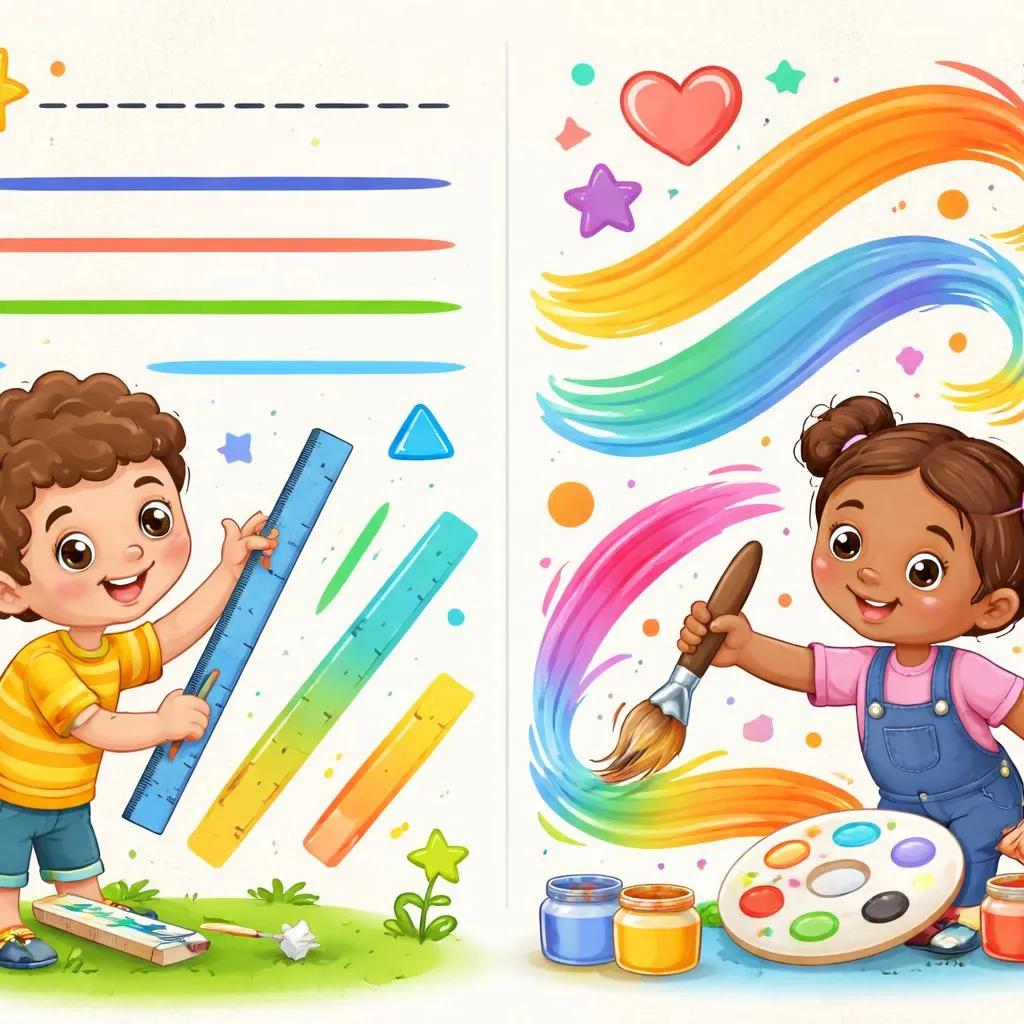
Be a Language Observer now. Our first clue is at home. You use a ruler. You draw a straight line. Your sibling paints a picture. You watch the brush make a thick stroke. They are both marks. But are they the same? Let us test with two sentences.
"Use a ruler to draw a straight line from point A to point B." This is about a precise, continuous mark. "Her painting was full of bold, blue brushstrokes." This is about a single movement or mark made with a tool.
They both describe marks on a surface. But one feels precise and continuous. One feels like an action, a single movement. Your observation mission starts. Let us draw our way into their word world.
Adventure! Draw Into the Word World
Feel the Word's Abstract and Physical Vibe!
Feel the word line. It is an abstract, conceptual word. It feels like geometry, a boundary, or a connection. It is the idea of a long, thin mark. The word stroke is a physical, action word. It feels like movement, effort, and touch. It is the act of making a mark. Line is the result. Stroke is the action that creates it. One is the "what." The other is the "how." Let us see this at school.
In a math class, you learn about a line segment. This is a geometric concept. In an art class, you practice your brushstroke. This is about your hand's movement. Saying "practice your brush line" is less common. The feeling of the words is different. One is about form. The other is about technique.
Compare Their Continuous and Single Nature!
Think about a long piece of string and a single snap of your fingers. The word line is the string. It is continuous. It can be straight, wavy, or dotted. The word stroke is the snap. It is a single, distinct action. A line can be made with one long stroke. Or it can be made with many small strokes. Their nature is the key. A line is the mark itself. A stroke is one delivery of that mark. Let us test this on the playground.
You drag a stick along the ground to make a long mark. You say, "I made a line in the dirt!" Your friend makes one quick slash with the stick. He says, "That was one stroke." The word line describes the long mark. The word stroke describes the single action of making the slash. The playground shows the difference.
Meet Their Best Word Friends!
Words have favorite mark partners. The word line likes geometric and connective words. It teams up with 'straight', 'finish', 'bottom', 'assembly', 'telephone', and 'draw the'. Draw the line here. Wait in the assembly line. The word stroke likes action and medical words. It teams up with 'brush', 'master', 'luck', 'heat', 'of genius', and 'swimming'. She is a master stroke. Do the backstroke in swimming. Their partners are different. Let us go back to nature.
At the beach, you see the line where the ocean meets the sky. This is the horizon. A heron stands still, then makes a quick stroke with its beak to catch a fish. This is a single, swift movement. You would not say the "stroke of the horizon." The word friends set the scene.
Our Little Discovery!
We drew marks in the word world. We made a clear discovery. The words line and stroke are different. The word line usually means a long, thin, continuous mark. It is the result, the path, the connection. The word stroke usually means a single movement or mark, often made by a tool like a brush or pen. It is the action. A line is what you see. A stroke is how you make it. One is the product. The other is the process.
Challenge! Become a Mark-Making Word Expert
"Best Choice" Challenge!
Let us look at a nature scene. A caterpillar crawls along a branch. It leaves a thin, silvery trail behind it. This trail is a line. Is it Line or Stroke? The champion is Line! The caterpillar's trail is a continuous mark. Now, imagine a woodpecker. It hits the tree trunk once with its beak. That single, hard peck is a stroke. Is it line or stroke? The champion is stroke! This describes the single, forceful action. Excellent!
"My Sentence Show"!
Now, create your own sentences. Here is a fun scene: Imagine the strings on a guitar. They are straight and tight. Use the word line in one sentence. Now imagine a painter adding one swipe of red paint to a canvas. Use the word stroke in another. Try it! Here is an example. Sentence one: "Each guitar string is a straight line of metal." Sentence two: "With one final stroke of red, the artist signed her painting." See the difference? The first is about the string as a continuous object. The second is about the single action of signing.
"Eagle Eyes" Search!
Can you find the word that needs help? Read this sentence: "The calligrapher's pen moved gracefully, creating beautiful, flowing lines with every elegant line of her hand." Hmm. This repeats "line" in a clumsy way. The second "line" should be stroke, as it refers to the movement of her hand. A better sentence is: "The calligrapher's pen moved gracefully, creating beautiful, flowing lines with every elegant stroke of her hand." You made it more vivid!
What a creative drawing session in the word world! You started as a curious doodler. Now you are a word calligrapher. You know the secret of line and stroke. You can feel their different abstract and physical vibes. You see that a line is the mark and a stroke is the action. You know their best word friends. This is a real language superpower.
You can learn amazing things from this article. You now know that a 'line' is a long, thin, continuous mark, like a string or a boundary. You understand that a 'stroke' is a single movement or mark made by a tool, like a brushstroke or a pen stroke. You can explain that a line is what you see, and a stroke is how you make it. You learned phrases like 'draw the line' and 'master stroke'.
How can you use this today? It is easy and fun. When you write in your notebook, look at the lines on the paper. Watch your hand make each letter with different pen strokes. In art class, practice making different types of lines using short and long brushstrokes. Watch a tennis player. Their racket makes a stroke. The ball flies in a line. Draw two pictures. Draw different types of lines. Draw a picture showing bold strokes. You are using your new skill every day.
Keep your explorer eyes and hands ready. The world is full of lines and the strokes that create them. You are learning the words to describe them all. Great work, word expert. Your English journey is getting more expressive and precise with every new word pair you discover!