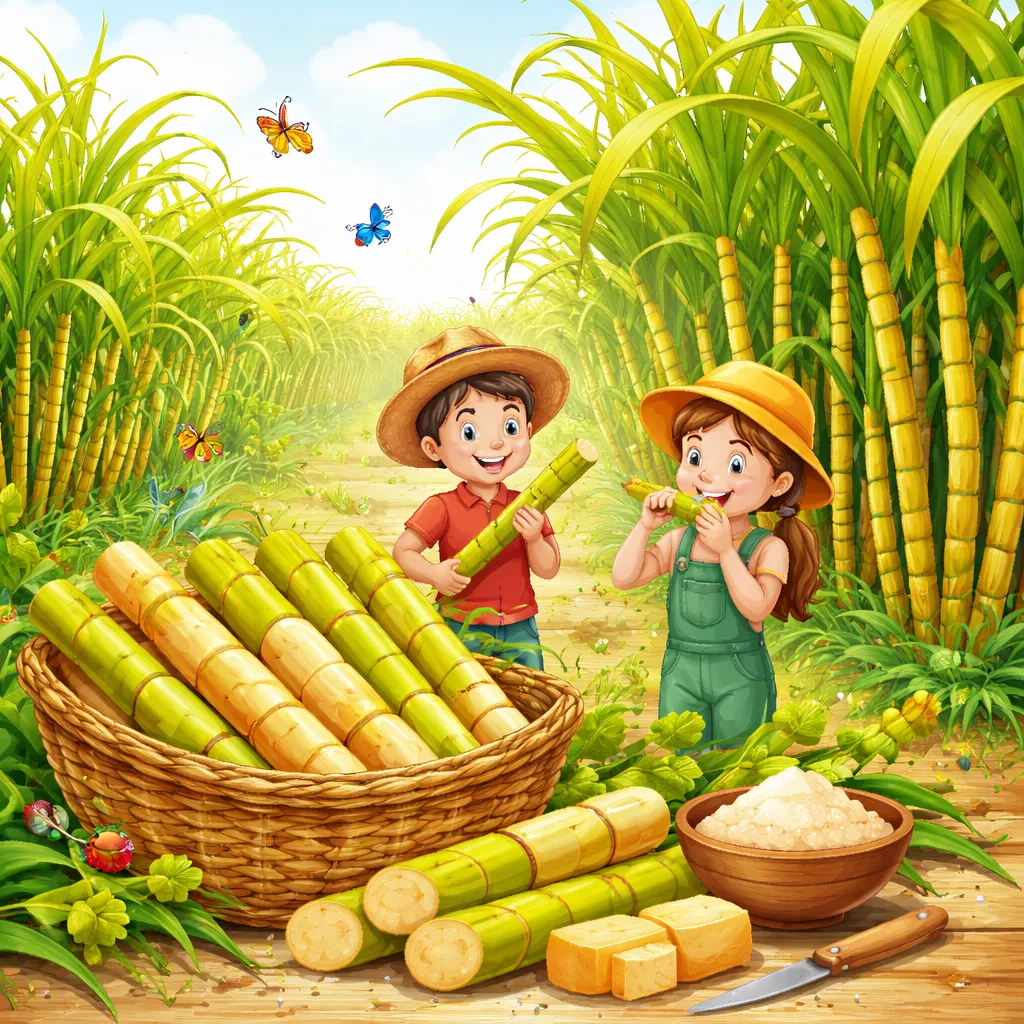

Have you ever stirred a spoonful of white sugar into your cereal or lemonade? That sweet, crunchy crystal starts its life not in a bag, but in a field of the tallest grass you’ve ever seen! Picture a green ocean of stalks, each one as tall as a basketball hoop, swaying in the wind. If you could cut a stalk and chew on it, sweet, delicious juice would fill your mouth. This amazing plant is a giant sweet factory. Let’s take a walk into the sunny fields to learn about the towering Sugarcane plant.
Let’s Learn the Word! – Open the Treasure Box of Language
Formal Name and Pronunciation
This tall sweet giant is called Sugarcane. Its scientific name is Saccharum officinarum. You can say it like this: /ˈʃʊɡ.ə.keɪn/ (SHUUG-uh-kayn). The “Sugar” is like the sweet stuff, and “cane” is like a walking stick. Sugar-cane. Say it: Sugarcane. It’s a perfectly descriptive name.
The Etymology Tale
The word tells its own story! “Sugar” comes from the Sanskrit word “sharkara,” meaning gravel or grit, which is what sugar crystals look like. This word traveled through Persian and Arabic to Europe. “Cane” comes from the Latin “canna,” meaning a reed or a stalk. So, “Sugarcane” literally means “the stalk that gives us sugar.”
Nicknames and Friendly Aliases
Sugarcane is often just called Cane. Because it is a grass, it is called Noble Cane or the Sugar Grass. The tall stalks ready for harvest are a Cane Crop. The place where it is processed is a Sugar Mill. In some places, people simply call it the Sweet Reed.
Building Your Word Web: Core Parts
Let’s learn the words for Sugarcane’s towering body. The Culm is the main stalk—tall, thick, and jointed like bamboo. The Node is the solid, bumpy ring on the stalk. The Internode is the long, juicy section between the nodes. The Leaf is long, green, and sword-like, growing from the node. The Tassel is the feathery, silvery flower at the very top. The Ratoon is the new shoot that grows from the roots after the main stalk is cut. A Field is a cane field.
Action and State Words
Sugarcane is a powerhouse of growth. It grows incredibly tall and thick. Farmers harvest the mature stalks. The stalks are crushed and pressed to squeeze out the juice. The juice is boiled and crystallized into sugar. A sugarcane plant is tall, juicy, fibrous, and perennial (it can regrow for several years).
Ecosystem Friends Vocabulary
A sugarcane field is a dense jungle for small creatures. Birds nest and hunt for insects in the tall leaves. Frogs and lizards find shelter in the moist, shaded soil below. The plant itself doesn’t have many pests because it’s so tough, but it does provide a huge habitat. After harvest, the leftover leaves (called trash) are often left to protect the soil.
Cultural Imprint in Language
Sugarcane is linked to hard work, sweetness, and trade. An old saying from farming is, “You reap what you sow,” and growing sugarcane takes a lot of work for a sweet reward. Calypso and folk songs from the Caribbean often mention the cane fields. The phrase “sugar-coat” something means to make a difficult truth seem nicer, just like coating a pill in sugar. It represents both the reward of hard work and the idea of adding sweetness.
Ready for Discovery
We know its tall, sugary name. Are you ready to be a field detective and discover how this giant grass makes the world’s favorite sweetener? Let’s explore the secrets of the Sugarcane plant.
Discover the Plant’s Secrets! – A Nature Detective’s Notebook
The Plant Passport
Sugarcane belongs to the grass family, Poaceae, just like wheat, rice, and bamboo. Its genus is Saccharum. It is a giant perennial grass, often growing 10 to 20 feet tall! The stalk is solid, not hollow like bamboo, and filled with sweet juice. The leaves are long, sharp-edged, and can cut skin. It rarely flowers. It grows in hot, tropical, and subtropical regions with lots of sun and rain, forming vast, impenetrable fields.
Survival Smarts
Sugarcane’s superpower is its mastery of the sun. It grows incredibly fast, capturing huge amounts of sunlight. It then stores the sun’s energy not as seeds, but as sugar (sucrose) in its juicy stalks. This sugar is food for the plant to grow new shoots. Another trick is its root system. After the stalk is harvested, the roots send up new shoots called ratoons, allowing the same plant to be harvested again for several years without replanting.
Its Role and Gifts
Sugarcane fields produce a lot of plant material, which can help prevent soil erosion. Its most famous gift is, of course, sugar. The crushed juice is purified and crystallized into the white and brown sugar we use. But that’s not all! The crushed stalks (called bagasse) are burned to power the sugar mills, and leftover molasses is used for animal feed or to make rum. It’s a very efficient plant.
Human History and Cultural Symbol
Sugarcane was first domesticated in New Guinea around 8,000 years ago. It spread to Asia and was brought to the Americas by European colonists. For centuries, its cultivation was closely tied to difficult histories of labor and trade. Today, it is a major global crop. It symbolizes the transformation of nature’s energy (sun) into a powerful commodity that changed world diets and economies.
Fun “Wow!” Facts
Get ready for a speed fact! Sugarcane is one of the most efficient plants on Earth at converting sunlight into stored energy (sugar). And here’s a yield fact: One acre of sugarcane can produce about 7 to 10 tons of sugar! That’s enough to fill thousands and thousands of sugar bowls.
From Sunny Field to Your Garden
The story of the Sugarcane plant is one of tropical abundance. Would you like to grow your own sweet stalks? You can grow sugarcane in a warm garden or a very large pot! Let’s see how.
Let’s Grow It Together! – A Little Guardian’s Action Guide
Good for Home Growing?
Yes, if you have a warm climate or a hot summer! Sugarcane needs heat, sun, and space. You can grow a few stalks in a very large, deep pot or in a sunny garden bed. You won’t make your own sugar, but you can grow stalks to chew for their sweet juice. It’s a fun and fast-growing project.
Little Gardener’s Toolkit
You will need a section of fresh sugarcane stalk from a grocery store or garden center (look for it in the international food section). Get a very large, deep pot or a sunny garden spot. Use rich, well-draining potting soil. Have a watering can, some compost, and the sunniest spot you have ready.
Step-by-Step Growing Guide
Planting Your Sweet Stalk
Plant in late spring or early summer when the soil is warm. Take your stalk piece and make sure it has at least 2-3 “nodes” (the rings). Lay it horizontally in a trench about 3 inches deep, or plant it upright. Cover it with soil, leaving the top node just peeking out. Water it well. Place it in full, blazing sun.
Care Calendar
Keep the soil moist to help it sprout. Once it starts growing, water it regularly—it’s a thirsty plant! It needs full, hot sunshine. You can feed it with a high-nitrogen fertilizer to encourage leafy growth. The most important thing is warmth and sun.
Watch and Be Friends
Watch for new green shoots bursting from the nodes. They will grow incredibly fast, shooting up like rockets. Measure your plant every week—you’ll be amazed! Feel the thick, hard stalk. When it’s tall, you can carefully cut a stalk at the base, peel it, and chew on a small piece to taste the sweet juice (with adult permission).
Problem Diagnosis
If the leaves get brown tips, it might need more water. If growth is slow, it needs more sun or fertilizer. Watch for aphids on the new leaves; spray them off with water. The most common problem is not enough heat or sun. It truly is a sun-worshipper.
Your Rewards and Gifts
Your gift is growing your own natural candy. You are learning about grasses, photosynthesis, and where our food comes from. Caring for sugarcane teaches observation, patience, and the satisfaction of growing something tall, useful, and sweet. You become a grower of sunshine.
Creative Fun
Start a Sweet Grass Journal. Draw your sugarcane’s rapid growth. Measure it weekly and make a bar chart. Try pressing a tiny piece of stalk with a garlic press to get a drop of juice. Research the journey of sugar around the world and trace it on a map. Build a tiny model “mill” from LEGO or cardboard. Write a song about the tall grass swaying in the wind. With an adult, use store-bought sugarcane juice to make a simple syrup for pancakes.
Growing a Stick of Sunshine
By planting sugarcane, you are not just growing grass. You are growing a lesson in botany and history, a taste of the tropics, and a living example of how plants store the sun’s energy. You are a cultivator of sweetness and knowledge.
Conclusion and Forever Curiosity
What a tall, juicy, and sun-soaked journey! You started to learn about the Sugarcane plant, you discovered its secrets as the towering, sugar-storing giant of the grass family, and you learned how to grow your own sweet stalks. You now know the Sugarcane plant is not just a sugar source; it is a champion of photosynthesis, a historical force, a versatile resource, and a symbol of natural sweetness. Remember, its power comes from capturing and bottling sunshine. Your curiosity helps you see the incredible science in everyday things. Keep exploring where your food comes from, tasting nature’s gifts wisely, and planting seeds of understanding. Your adventure to learn about the Sugarcane plant shows us that sometimes, the sweetest things in life grow tall, green, and mighty under the sun.