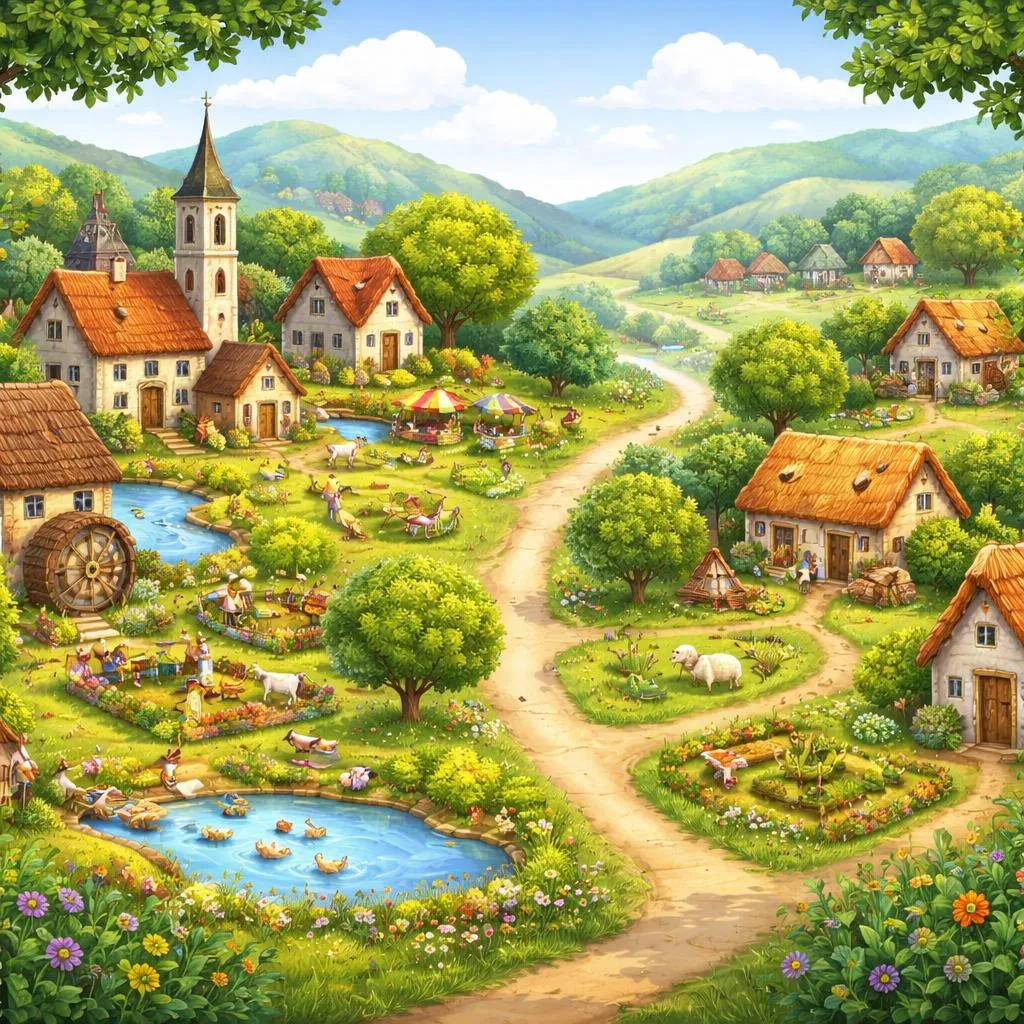

Start! Find a Pair of 'Tiny Twin' Words
Hello, word explorer! Have you ever seen a very, very small place with just a few houses? What do you call that? You might say "village." But sometimes, in a story or on a map, you see a place even smaller. Maybe it is called a "hamlet." They are both tiny communities. Are they the same? This is a fun word puzzle. Today we explore a word pair. We explore village and hamlet. They are like two different sizes of small. One is a small dot. One is a tiny speck. Knowing the difference is a superpower. Your talk about places will be clear and smart. Let us start our word adventure!
Be a Language Observer now. Our first clue is at home. You read a fairy tale. It begins, "In a small village by the forest..." Then, you look at an old map. It shows a cluster of three houses called "Greenwood Hamlet." They are both tiny settlements. But are they the same? Let us test with two sentences.
"The village had a school, a shop, and a little church." This describes a small but complete community. "The hamlet was just a few farms along a lonely road." This describes a tiny, sparse group of homes.
They both describe very small groups of houses. But one might have a few services. One is just houses. Your observation mission starts. Let us walk into their word world.
Adventure! Walk Into the Word World
Feel the Word's Size and Completeness!
Feel the word village. It is a small, but complete word. It feels like a tiny, working community. It might have a central point like a green or a church. The word hamlet is a microscopic, simple word. It feels like a handful of houses with no center. It is the smallest type of settlement. Village is the tiny town. Hamlet is the miniature cluster. One has a heartbeat. The other is just a few quiet breaths. Let us see this at school.
In a geography lesson, you learn that a village is larger than a hamlet. This is about settlement hierarchy. In a history lesson, you read about a medieval hamlet that served a nearby castle. This is about a very small, dependent settlement. Saying "medieval village" might imply more independence. The feeling of size and self-sufficiency is different. One is a bit more complete. The other is extremely basic.
Compare Their Services and Independence!
Think about a small toy set and two loose building blocks. The word village is the small toy set. It might have a few pieces that work together. The word hamlet is the two loose blocks. It is just the basics. Their level of development is a clue. A village might have a place of worship or a shop. A hamlet usually has no public services. It is often part of a larger parish. Let us test this on the playground.
You and a group of friends build a little model with houses, a pretend shop, and a road. You say, "This is our village!" Another friend points to just two or three blocks close together. He says, "This is our hamlet." The word village suggests a slightly more organized tiny community. The word hamlet suggests the smallest possible gathering of homes. The playground shows the difference.
Meet Their Best Word Friends!
Words have favorite small-place partners. The word village likes community and descriptive words. It teams up with 'fishing', 'global', 'small', 'green', 'people', and 'life'. It is a global village. I love village life. The word hamlet likes specific, historical, and lonely words. It teams up with 'sleepy', 'tiny', 'remote', 'English', and is often used in proper names (e.g., "Hamlet of Willow Creek"). It was a sleepy hamlet. The hamlet had no inn. Their partners are different. Let us go back to school.
In a social studies class, you might do a project about your local village. This is about community. In a literature class, you might read about a lonely hamlet in a story. This sets a very small, isolated scene. You would not usually do a project about your "local hamlet" unless it is very, very small. The word friends set the expectation.
Our Little Discovery!
We walked through the word countryside. We made a clear discovery. The words village and hamlet are both very small settlements. The main difference is size and what they have. A village is a small community, usually with a few houses and sometimes a church or shop. A hamlet is even smaller. It is just a tiny cluster of houses, often without any central services. Village is the bigger tiny. Hamlet is the smallest tiny. One is a mini-community. The other is a micro-community.
Challenge! Become a Rural Word Expert
"Best Choice" Challenge!
Let us look at a nature scene. You are hiking in the countryside. You see a sign. Option one says, "Welcome to Oak Village, population 120." Option two says, "You are now entering Maple Hamlet, 4 households." Which one describes a place with just a few families? The champion is Hamlet! A hamlet is typically just a handful of homes. Which one might have a small shop or a post office? The champion is Village! A village, though small, is more likely to have a basic service. Great thinking!
"My Sentence Show"!
Now, create your own sentences. Imagine a peaceful scene in the countryside. Use the word village in one sentence. Now imagine an even quieter, lonelier spot. Use the word hamlet in another. Try it! Here is an example. Sentence one: "The old stone village sat in a valley, with smoke rising from a few chimneys." Sentence two: "The hamlet was so small it wasn't even on most maps." See the difference? The first paints a picture of a small, contained community. The second emphasizes how extremely tiny and unnoticed the place is.
"Eagle Eyes" Search!
Can you find the word that needs help? Read this sentence: "We drove through a busy little hamlet that had a supermarket, a gas station, and a movie theater." Hmm. This is wrong. A place with a supermarket and a movie theater is far too developed to be a hamlet. That is a town or a large village. The correct word is village or town. A better sentence is: "We drove through a busy little village that had a supermarket, a gas station, and a movie theater." You fixed it!
What a wonderful walk through the word countryside! You started as a curious explorer. Now you are a word geographer. You know the secret of village and hamlet. You can feel their different sizes and completeness. You see their services and independence. You know their best word friends. This is a real language superpower.
You can learn amazing things from this article. You now know that a 'village' is a very small community, sometimes with a church or a shop. You understand that a 'hamlet' is the smallest type of settlement, often just a few houses with no services. You can explain that a hamlet is even smaller and simpler than a village. You learned that we talk about 'village life' but a 'sleepy hamlet'.
How can you use this today? It is easy and fun. Look at a detailed map with your family. Can you find the name of a village? Can you spot a hamlet? They might be in very small print. When you travel, notice the signs. Does it say "Village of..." or "Hamlet of..."? Draw two pictures. Draw a cozy village with a few buildings. Draw a hamlet with just two or three houses in a field. You are using your new skill every day.
Keep your explorer eyes open. The world is full of amazing small places. You are learning the words to describe the tiniest ones. Great work, word expert. Your English journey is getting more detailed and precise with every new word pair you discover!