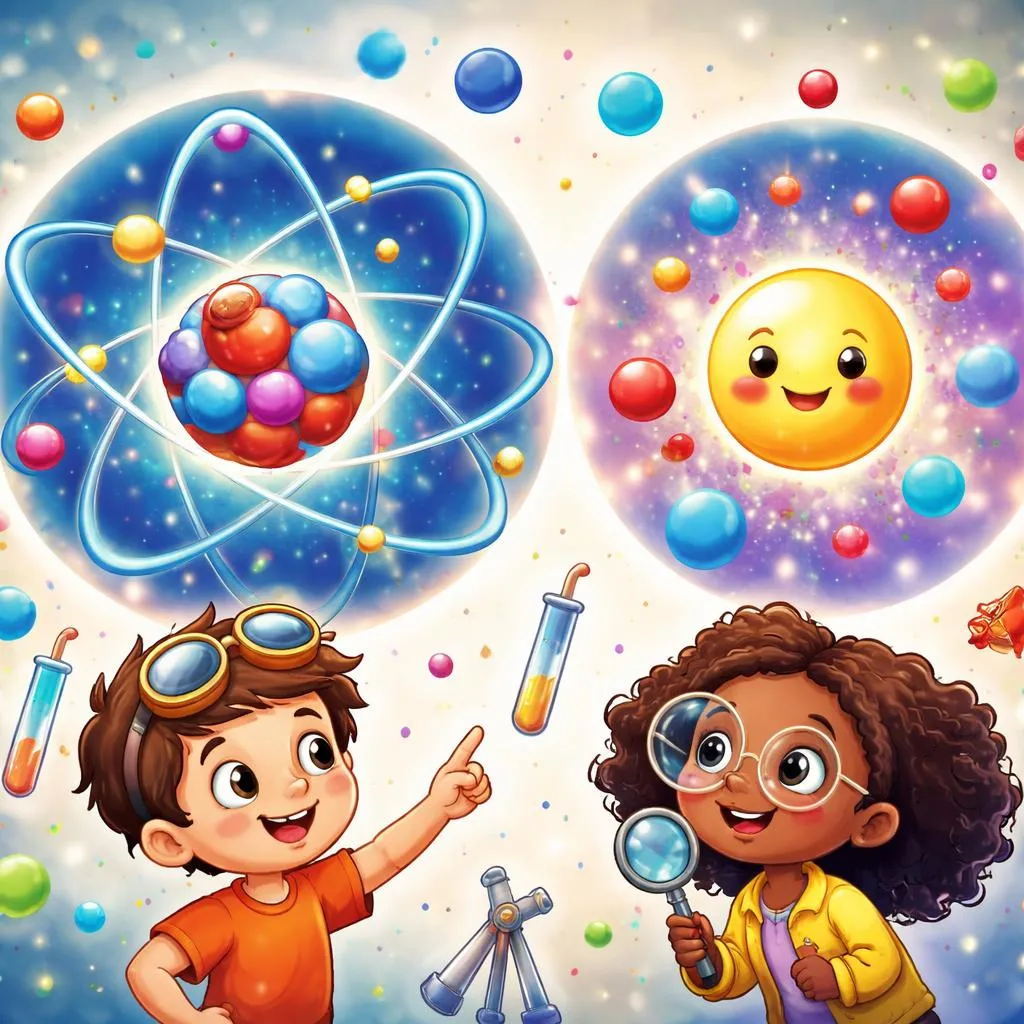

Start! Find a Pair of 'Tiny Twin' Words
Hello, word explorer! Have you ever thought about the smallest things? I mean, the very, very smallest bits that make up everything? Scientists have two important words for that. They say atom. They also say particle. They are both about tiny, tiny pieces. Are they the same? This is a fun science puzzle. Today we explore a word pair. We explore atom and particle. They are like two different boxes. One is a specific building block. One is a general word for a tiny bit. Knowing the difference is a superpower. Your talk about science will be clear and smart. Let us start our tiny word adventure!
Be a Language Observer now. Our first clue is at home. You watch a science show. The host says, "Water is made of atoms of hydrogen and oxygen." Then, you hear about a machine. It is called a particle accelerator. They are both about tiny things. But are they the same? Let us test with two sentences.
"An atom is the smallest unit of a chemical element, like gold or carbon." This is a specific, defined building block. "Dust floating in the air is made of tiny particles." This is a general word for very small pieces.
They both describe very small pieces of matter. But one is a specific, scientific unit. One is a general word for any tiny bit. Your observation mission starts. Let us shrink into their word world.
Adventure! Shrink Into the Word World
Feel the Word's Specificity and Generality!
Feel the word atom. It is a specific, scientific word. It feels like a precise building block. It is the smallest unit of an element. The word particle is a general, broad word. It feels like any tiny piece of something. It can be an atom, a speck of dust, or a grain of sand. Atom is the specific Lego brick. Particle is the word for any small piece, even a Lego brick. One is a member of a set. The other is a description of size. Let us see this at school.
In a chemistry class, you learn about the structure of an atom. This is a specific model with protons, neutrons, and electrons. In a physics class, you learn that light is made of particles called photons. This is a general term for a piece of light. Saying "light is made of atoms" is wrong. The specificity of the words is different. One is a defined chemical unit. The other is a general piece.
Compare Their Structure and What They Are!
Think about a specific model of car and the word "vehicle." The word atom is the specific model. It has a known structure. The word particle is the word "vehicle." It can be a car, a bike, or a bus. Their definition is the key. An atom has a nucleus and electrons. A particle can be anything tiny. It might not have parts. An atom is one type of particle. Let us test this on the playground.
You and a group of friends form a tight cluster. One friend is the nucleus. Others orbit. You say, "We are an atom!" Then, everyone scatters and runs around as tiny, separate bits. You say, "Now we are particles!" The word atom suggests a specific, organized structure. The word particle suggests being a separate, tiny piece. The playground shows the difference.
Meet Their Best Word Friends!
Words have favorite tiny partners. The word atom likes chemistry and model words. It teams up with 'bomb', 'smash', 'structure', 'carbon', 'hydrogen', and 'model'. They study the atomic model. It was an atom bomb. The word particle likes physics and general words. It teams up with 'subatomic', 'accelerator', 'board', 'dust', 'tiny', and 'elementary'. A particle board is made of wood chips. It is a subatomic particle. Their partners are different. Let us go back to school.
In a history class, you might learn about the atom bomb. This is a specific weapon. In a technology class, you learn about particle board furniture. This is a material made of small wood pieces. You would not usually say "atom board." The word friends set the field.
Our Little Discovery!
We explored the word micro-world. We made a clear discovery. The words atom and particle are different. The word atom is a specific, scientific term. It is the smallest unit of a chemical element. The word particle is a general term for a very small piece of matter. It can be an atom, a speck of dust, or even a subatomic piece. Atom is a type of particle. But a particle is not always an atom. One is the specific building block. The other is the word for any tiny bit.
Challenge! Become a Tiny Word Expert
"Best Choice" Challenge!
Let us look at a nature scene. A scientist is studying the air. She wants to know what tiny things are in it. If she finds a piece of pollen, she calls it a dust ______. Is it Atom or Particle? The champion is Particle! Pollen is a tiny piece, not a specific chemical atom. Now, she studies a gas. She finds the smallest unit of the gas helium. That unit is an ______. Is it atom or particle? The champion is atom! The smallest unit of an element is an atom. Excellent!
"My Sentence Show"!
Now, create your own sentences. Here is a fun scene: Imagine a model of a carbon unit with a nucleus and electrons. Use the word atom in one sentence. Now imagine a sunbeam with tiny bits of dust floating in it. Use the word particle in another. Try it! Here is an example. Sentence one: "The carbon atom has six protons." Sentence two: "Every particle of dust danced in the sunbeam." See the difference? The first is about the structure of a specific element. The second is about many tiny, visible pieces.
"Eagle Eyes" Search!
Can you find the word that needs help? Read this sentence: "The scientist used a powerful microscope to see the individual atoms of pollen on the flower." Hmm. This is a mix-up. A microscope might see pollen grains, which are made of many, many atoms. A single pollen grain is a particle, not a single atom. A better sentence is: "The scientist used a powerful microscope to see the individual particles of pollen on the flower." You fixed it!
What an amazing journey into the word micro-universe! You started as a curious observer. Now you are a word scientist. You know the secret of atom and particle. You can feel their different specificity and generality. You see their structure and what they are. You know their best word friends. This is a real language superpower.
You can learn amazing things from this article. You now know that an 'atom' is the smallest unit of a chemical element, like oxygen or iron. You understand that a 'particle' is a general word for any very small piece of matter, like a dust speck or a grain of sand. You can explain that an atom is one type of particle, but particles can be many things. You learned terms like 'atomic model' and 'particle board'.
How can you use this today? It is easy and fun. Look at a grain of salt. It is a particle. That grain is made of trillions of sodium and chlorine atoms. When you see dust in the light, those are particles. When you learn about the periodic table, that is about atoms. Draw two pictures. Draw a diagram of an atom. Draw a picture of many different particles. You are using your new skill every day.
Keep your explorer mind curious. The tiny world is full of amazing words. You are learning to choose the right one. Great work, word expert. Your English journey is getting more precise and scientific with every new word pair you discover!