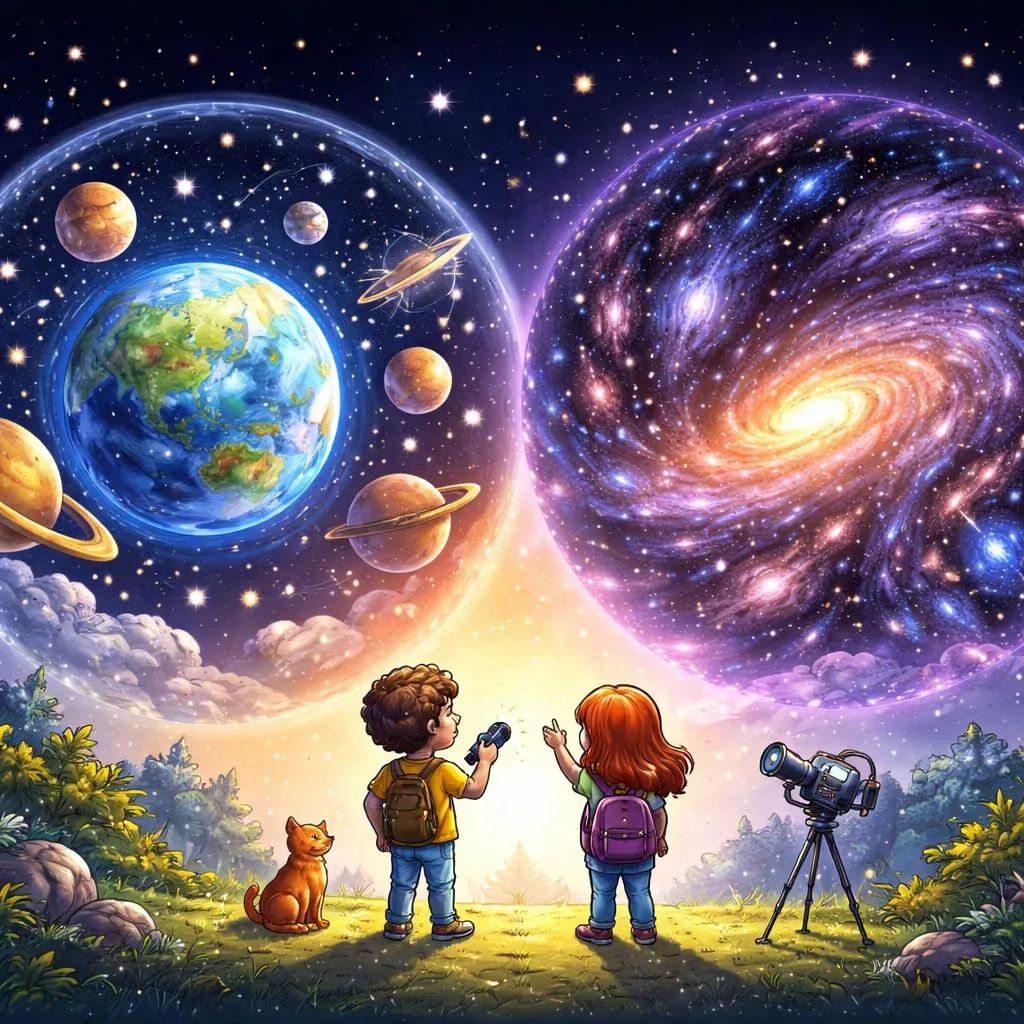

Start! Find a Pair of 'Space Twin' Words
Hello, word explorer! Look up at the night sky. What do you see? You see stars, planets, and endless space. What is all of that called? You might say "the universe." But sometimes, you hear a scientist or poet say "the cosmos." They are both about all of space and everything in it. Are they the same? This is a giant space puzzle. Today we explore a word pair. We explore universe and cosmos. They are like two ways to look at everything. One is the scientific name. One is the poetic idea. Knowing the difference is a superpower. Your talk about space will be clear and smart. Let us start our word voyage!
Be a Language Observer now. Our first clue is at home. You watch a science show. The host says, "The universe began with the Big Bang." Then, you read a poem. It says, "We are all stardust in the great cosmos." They are both about all of existence. But are they the same? Let us test with two sentences.
"Scientists study galaxies to understand the universe." This sounds factual and scientific. "Ancient people told stories to explain the wonders of the cosmos." This sounds philosophical and grand.
They both describe the totality of space. But one feels like a subject for science class. One feels like a subject for a story or deep thought. Your observation mission starts. Let us fly into their word space.
Adventure! Fly Into the Word Space
Feel the Word's Vibe: Science vs. Poetry!
Feel the word universe. It is a standard, scientific word. It feels like a textbook, a telescope, and physics. It is the term used in science. The word cosmos is a more poetic, philosophical word. It feels like wonder, beauty, and the big picture. It suggests an ordered, harmonious system. Universe is the lab coat. Cosmos is the philosopher's cloak. One is for measuring. The other is for marveling. Let us see this at school.
In a science class, you learn the laws of the universe. This is about physics and facts. In a history or art class, you might study how ancient cultures viewed the cosmos. This is about ideas and beliefs. Saying "laws of the cosmos" is less common in basic science. The vibe of the words is different. One is neutral and scientific. The other is thoughtful and artistic.
Compare Their Scope and Emphasis!
Think about a huge, messy room and the beautiful, perfect order you try to create in it. The word universe is the huge room. It is all the space and stuff that exists. The word cosmos emphasizes the order and beauty within that room. It comes from a Greek word for "order." Their emphasis is a clue. The universe is everything. The cosmos is everything seen as a beautiful, ordered whole. Let us test this on the playground.
You and friends pretend to be all the things in space: stars, planets, black holes. You say, "We are the universe!" Then you arrange yourselves in a beautiful, swirling pattern. You say, "Look at the harmony of our cosmos." The word universe states the fact of existence. The word cosmos suggests the wonder of its arrangement. The playground shows the difference.
Meet Their Best Word Friends!
Words have favorite space partners. The word universe likes scientific and expansive words. It teams up with 'observable', 'expand', 'entire', 'size of the', 'parallel', and 'theory of'. The universe is expanding. It is a parallel universe. The word cosmos likes philosophical and majestic words. It teams up with 'mystery of the', 'grand', 'exploring the', 'orderly', and 'wonders of the'. We ponder the mystery of the cosmos. The cosmos is grand. Their partners hint at their use. Let us go back to school.
In a physics lesson, you calculate the age of the universe. This is a mathematical, scientific task. In a literature lesson, you read a poem about humanity's place in the cosmos. This is about meaning and reflection. You would not usually calculate the "age of the cosmos." The word friends lock in the context.
Our Little Discovery!
We flew through the word infinity. We made a clear discovery. The words universe and cosmos are often used to mean the same thing: all of space and everything in it. But their feeling is different. The word universe is the common, scientific term. It is neutral. The word cosmos is a more poetic, philosophical term. It emphasizes the beauty, order, and wonder of everything. Universe is the science. Cosmos is the poetry. One is for facts. The other is for feelings about the facts.
Challenge! Become a Space Word Expert
"Best Choice" Challenge!
Let us look at two scenes. Read each one. Pick the champion word. Scene one: An astronomer writes a paper. The title is "Measuring the Rate of Expansion of the ______." Is it Universe or Cosmos? The champion is Universe! This is a precise scientific measurement. Scene two: A writer describes a night of stargazing. She writes, "I felt tiny yet connected to the majestic ______." Is it universe or cosmos? The champion is cosmos! This expresses a feeling of awe and wonder. Excellent!
"My Sentence Show"!
Now, create your own sentences. Imagine a scientist at a computer looking at data. Use the word universe in one sentence. Now imagine someone looking at the Milky Way, feeling amazed. Use the word cosmos in another. Try it! Here is an example. Sentence one: "New telescopes help us see farther into the universe." Sentence two: "The silent beauty of the cosmos fills me with wonder." See the difference? The first is about tools and discovery. The second is about personal feeling and beauty.
"Eagle Eyes" Search!
Can you find the word that needs help? Read this sentence: "The main goal of astronomy is to understand the origin, structure, and eventual fate of the beautiful and orderly universe." Hmm. This is a good sentence! But if you want to emphasize the "beautiful and orderly" part, the word cosmos might be a more stylish fit. A scientist might still say "universe." But a writer could choose: "The main goal of astronomy is to understand the origin, structure, and eventual fate of the beautiful and orderly cosmos." Both work, but the second uses the more poetic word. You have a sharp eye for nuance!
What an incredible journey through word space! You started as a curious stargazer. Now you are a word astronomer. You know the secret of universe and cosmos. You can feel their different vibes of science versus poetry. You see their subtle difference in emphasis. You know their best word friends. This is a real language superpower.
You can learn amazing things from this article. You now know that the 'universe' is the scientific term for all of space, time, matter, and energy. You understand that the 'cosmos' often means the same thing but focuses on its beauty, order, and our wonder about it. You can explain that scientists study the universe, and poets often marvel at the cosmos. You learned to match the word to the tone of your talk.
How can you use this today? It is easy and fun. Next time you read a space fact, you are learning about the universe. When you feel amazed by the night sky, you are admiring the cosmos. Watch a documentary. Do they say "universe" (science) or "cosmos" (wonder)? Draw two pictures. Draw a scientist with a telescope labeled "universe." Draw a person dreaming under stars labeled "cosmos." You are using your new skill every day.
Keep your explorer eyes on the sky and your mind on words. The biggest ideas have the most amazing names. You are learning to choose the perfect one. Great work, word expert. Your English journey is expanding with wonder and precision, just like the universe itself!