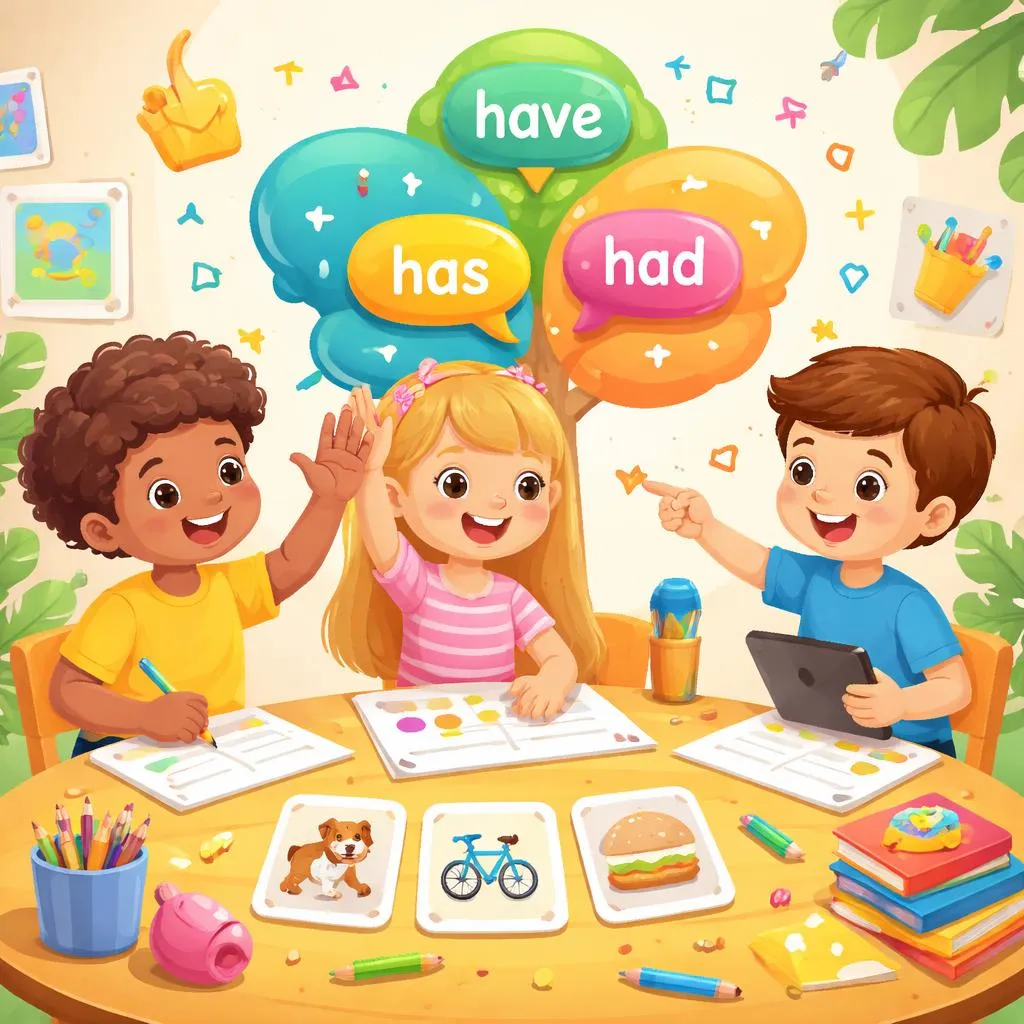

Welcome to our grammar workshop! Today, we are unlocking the secrets of a very useful verb. We are going to learn all about "verb have conjugation". Conjugation means changing the verb to match who we are talking about. The verb "to have" is essential for talking about things we own or things we do. Let's discover how to use it correctly in every situation.
Meaning The verb "to have" has two main jobs. First, it shows possession. This means owning something. "I have a book" means the book is mine. Second, it acts as a helper verb (auxiliary). We use it to form other tenses, like the present perfect. "I have eaten" means I finished eating at some time before now. For young learners, understanding the meaning of possession is the perfect first step. It connects directly to their world: their toys, their family, their feelings.
Conjugation Conjugation is about making the verb fit the subject. The "verb have conjugation" changes between have and has in the present tense.
The basic rule is simple:
Use have with the subjects I, you, we, they.
Use has with the third person singular subjects: he, she, it.
We also need to know the past tense form had, which we use for all subjects. The future tense uses will have. Learning which form to use with each subject (I, you, he, she, it, we, they) is the core of conjugation. This rule makes our sentences sound correct and natural.
Present tense In the present tense, we use "verb have conjugation" to talk about what is true now.
We use have or has to show current possession. "You have a nice smile." "She has a red backpack." "They have a big garden."
We also use it to talk about family and relationships. "I have two sisters." "He has a friendly teacher."
We use it to describe characteristics. "This room has two windows." "Cats have sharp claws."
For actions we do regularly, especially with meals. "We have lunch at school." The present tense helps us describe our daily lives.
Past tense When we talk about yesterday or last year, we use the past tense. The past tense of "to have" is had. We use had for all subjects.
For past possession: "I had a blue bike when I was little." "They had a great time at the zoo."
For past states or relationships: "She had long hair last year." "We had a different teacher before."
The negative form is did not have (didn't have). "He didn't have his lunchbox yesterday." Using the past tense helps us tell stories about things that are finished.
Future tense To talk about tomorrow or next year, we use the future tense. We use the helping verb will with the base form have.
The structure is: Subject + will have + object. This works for every subject.
Examples: "I will have a birthday party in July." "She will have a new baby brother soon." "They will have a holiday next month."
The negative is will not have (won't have). "I won't have my old backpack next year." This tense is great for making plans and promises.
Questions Asking questions with the verb "to have" often uses the auxiliary verbs do and does.
In the present tense: Do/Does + subject + have + ...?
Do you have a pencil?
Does he have a dog?
Do they have any questions?
To answer, we use: "Yes, I do." / "No, I don't." or "Yes, she does." / "No, she doesn't."
For past tense questions, we use did. "Did you have fun yesterday?" The answer: "Yes, I did." or "No, I didn't." This structure is very common and important for conversation.
Other uses The verb "to have" is also important in other common expressions.
We use it for obligation: "have to" which means "must." "I have to finish my homework." "She has to go to bed."
It is the helper verb for the present perfect tense. "I have seen that movie." "He has lost his tooth." This connects past actions to the present.
We use it in many fixed phrases. "Have a good day!" "Have fun!" "Have a seat." These are used every day.
Learning tips Here are some tips to master "verb have conjugation". First, memorize the golden rule: He, She, It HAS. A simple chant can help.
Practice with what is around you. Look at your classroom. "I have a desk. Maria has a red crayon. We have a kind teacher." This makes it real.
Use fill-in-the-blank exercises. "My cat ____ four paws. My friends ____ new bikes." This reinforces the rule.
For questions, practice switching statements. "You have a brother." becomes "Do you have a brother?" This builds question fluency.
Educational games "Do You Have It?" Bingo: Create bingo cards with pictures of common items (ball, book, apple, dog). The caller asks, "Does anyone have a picture of a ball?" Players with that picture mark their card. This practices listening and the question form.
"Family Survey": Give students a simple survey chart. They walk around asking classmates, "Do you have a sister?" "Do you have a pet?" They record answers with ticks or crosses, then report: "Three people have a sister."
"Time Tense Sort": Prepare sentence cards in present ("I have a snack"), past ("I had a snack"), and future ("I will have a snack"). Have students sort them onto three labeled mats. This clarifies the different time frames.
Understanding "verb have conjugation" is a superpower for English. It lets you talk about what you own, what you did, and what you will do. Start by describing what you have right now. Pay attention to stories and how they use had. With a little practice, choosing "have," "has," or "had" will become easy. You are building strong grammar skills for all your conversations. Keep practicing and enjoy your learning journey