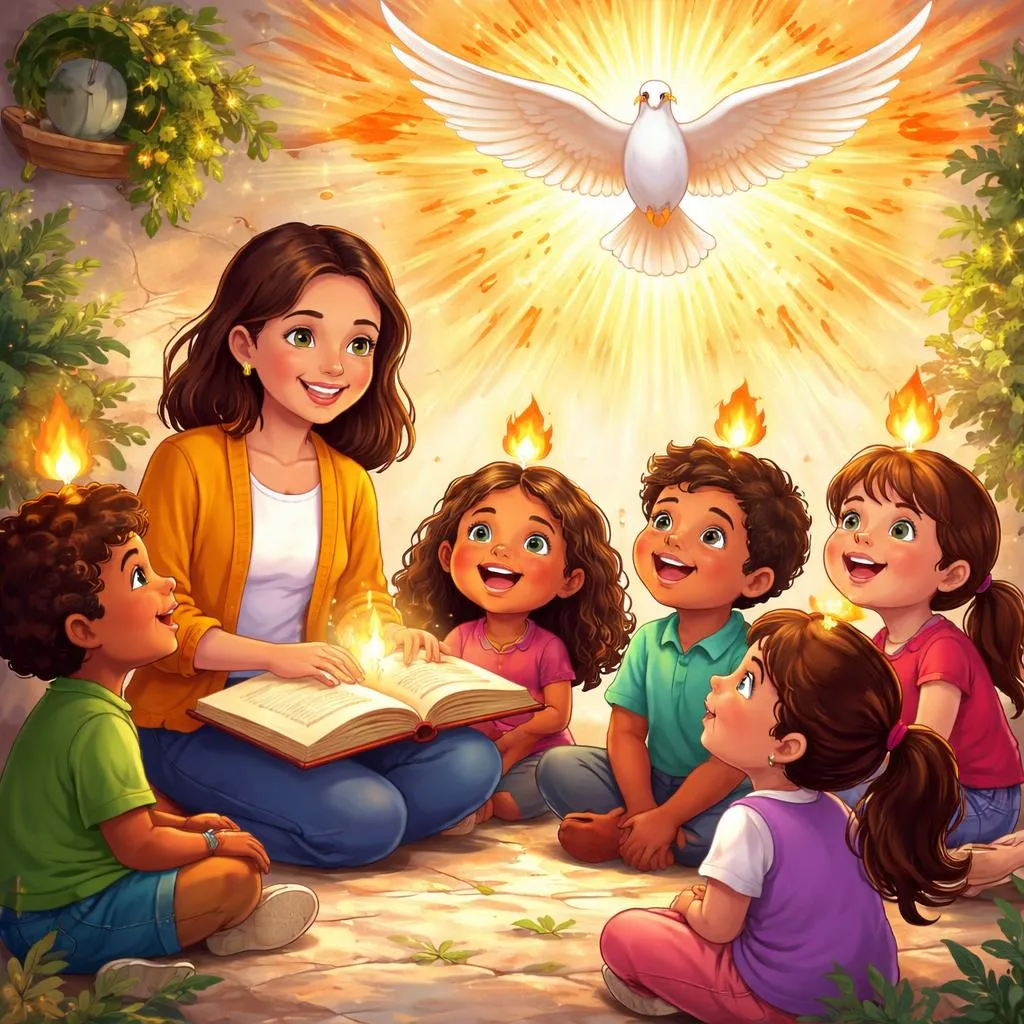

What Is the Children's Story for Pentecost? Let us explore this important Bible story together. The children's story for Pentecost comes from the book of Acts in the New Testament. It tells what happened fifty days after Jesus rose from the dead. The disciples were gathered together in a house in Jerusalem. They were waiting just as Jesus had told them to do. Suddenly a sound like a mighty wind filled the house. Flames of fire appeared and rested on each person there. They were all filled with the Holy Spirit completely. Then they began to speak in different languages. People from many countries were in Jerusalem for a festival. They heard the disciples speaking in their own languages. Everyone was amazed and wondered what this meant. Peter stood up and explained what was happening. This was the gift of the Holy Spirit Jesus promised. About three thousand people believed and were baptized that day.
Meaning and Purpose of the Pentecost Story This story carries deep meaning about God's presence with believers. The Holy Spirit came to live inside followers of Jesus. This fulfilled Jesus' promise not to leave them alone. The wind and fire showed God's power in visible ways. Wind represents the Spirit's invisible but real presence. Fire represents God's purifying and empowering presence. The different languages showed the gospel is for everyone. People from every nation could hear God's message. This reversed the Tower of Babel where languages divided people. Now language became a way to unite people in faith. The story also marks the birthday of the Christian church. Before this day, followers were just a small group. After Pentecost, they became a movement that grew rapidly.
Main Characters in the Pentecost Story We can identify several important figures in this narrative. The disciples were the main followers of Jesus. They had been with him throughout his ministry. Peter emerged as the leader who explained what happened. He preached boldly to the crowd gathered outside. The crowd included Jewish people from many nations. They had come to Jerusalem for the harvest festival. Some mocked, thinking the disciples were drunk early. Others were curious and wanted to understand. The Holy Spirit is the central character of this story. Not a person you can see, but God's presence and power. Three thousand new believers joined the church that day. They became part of God's family through baptism.
Vocabulary Learning from the Pentecost Story The Pentecost story introduces important spiritual vocabulary. Pentecost means the fiftieth day after Passover. It was a Jewish harvest festival originally. Holy Spirit means the third person of the Trinity, God's presence with us. Wind represents the Spirit's invisible but powerful movement. Fire represents God's purifying and empowering presence. Tongues means languages in this context, not body parts. The disciples spoke in languages they had not learned. Disciple means a follower or student of Jesus. Apostle means someone sent out with a special mission. Baptism means the ritual of washing with water as sign of faith. Harvest means gathering crops, also used for people coming to faith. We can teach these words with picture cards showing examples. Use them in sentences about the story events.
Phonics Points in the Pentecost Story The Pentecost story provides useful phonics practice with biblical language. Pentecost has the short E and short E and short O. Spirit has the SP blend and short I and short I. Wind has the short I and ND blend. Fire has the long I and silent E. Tongues has the T sound and UNG and S. Language has the short A and short A and GE. Disciple has the short I and long I and final le. Apostle has the short A and short O and final le. Baptism has the short A and short I and M sound. Harvest has the HAR blend and short E and ST blend. Place names offer valuable sound patterns. Jerusalem has the soft G and short U and short U. Galilee has the short A and long I. Judea has the long U and long E. We can focus on one sound pattern from each section. Find all words with that sound in the Pentecost story. Write them on flame or dove shapes for practice.
Grammar Patterns in the Pentecost Narrative The Pentecost story models useful grammar for young readers naturally. Past tense carries the main historical narrative throughout. "The disciples gathered together in one place." Present tense appears in applications and faith statements. "The Holy Spirit lives within believers today." Future tense shows promises and hope ahead. "God will give the Spirit to all who ask." Questions explore events and their meaning deeply. "What was that strange sound?" "Why could we understand them?" Commands appear in Peter's preaching and God's direction. "Repent and be baptized." "Go and tell the good news." Descriptive language paints the scene vividly. "The mighty, rushing wind filled the whole house where they were sitting." Prepositional phrases describe locations and movements. "In the house, from heaven, upon each one." We can point out these patterns during reading.
Daily Life Connections Through the Pentecost Story The Pentecost story connects to children's experiences in meaningful ways. Feeling scared or alone happens to everyone sometimes. The disciples felt better knowing the Spirit was with them. Learning new things can feel hard and frustrating. The Holy Spirit helps believers understand and remember. Speaking in front of others can be frightening. Peter became brave enough to speak to thousands. Being part of a group feels good and important. The early church shared everything and helped each other. Different languages appear all around us today. We hear Spanish, Chinese, and other languages spoken. The story shows God loves people who speak all languages. We can point out these connections during reading. "Have you ever felt scared to do something hard?" "The Spirit helped them be brave just like God helps you."
Learning Activities for the Pentecost Story Many activities deepen understanding of Pentecost themes. Create wind art by blowing paint through straws on paper. Watch how the wind creates unique patterns and designs. Make flame headbands with red, orange, and yellow paper. Wear them while acting out the Pentecost story. Practice saying "Jesus loves you" in different languages. Learn greetings from languages represented in class. Create a birthday cake for the church's birthday. Decorate with flames and celebrate Pentecost together. Make a list of ways the Holy Spirit helps people. Bravery, wisdom, comfort, and guidance can be listed. Create a mobile with dove, wind, and flame symbols. Hang it as reminder of the Holy Spirit's presence. These activities make the Pentecost story tangible and memorable.
Printable Materials for Pentecost Learning Printable resources support deep engagement with the Pentecost story. Create sequencing cards showing major story events. Wind sound, flames appear, speak languages, crowd gathers, Peter preaches, people baptized. Design character cards for each person in the story. Disciples, Peter, crowd from many nations included. Make vocabulary cards with Pentecost words and definitions. Pentecost, Spirit, wind, fire, tongues, baptism included. Create a world map showing countries represented at Pentecost. Locate where people came from originally. Design a flame template for writing ways the Spirit helps. Write one way on each flame and display together. Make a birthday of the church coloring page. Decorate with flames and words about Pentecost. These printables structure Pentecost learning activities effectively.
Educational Games About Pentecost Games make Pentecost learning playful and interactive. Play "Pentecost Charades" acting out story elements. Wind, fire, speaking languages, Peter preaching appear. Create "Language Match" pairing common phrases in different languages. "Hello" in Spanish, French, German, Chinese matched. Play "Spirit Says" like Simon Says with Holy Spirit actions. "Spirit says be brave." "Spirit says help someone." Design "Pentecost Bingo" with story elements on cards. Wind, fire, tongues, Peter, crowd, baptism included. Play "Who Am I?" guessing characters from clues. "I preached to the crowd after the Spirit came. Who am I?" Create "Gift Relay" racing to share good news like disciples. Pass along the message "Jesus loves you" to others. These games build Pentecost knowledge through active participation.
Teaching About the Holy Spirit The Holy Spirit can be difficult for children to understand. The Spirit is not visible like a person you can see. Bible symbols help explain who the Spirit is. Wind represents the Spirit's invisible but real presence. You cannot see wind but you see what it does. Fire represents the Spirit's power to change and purify. A dove represents the Spirit's peace and gentleness. The Spirit helps believers in many practical ways. The Spirit gives courage when facing hard situations. The Spirit gives wisdom to know right from wrong. The Spirit gives comfort when feeling sad or scared. The Spirit helps people understand God's Word better. These explanations make the Spirit more understandable for children.
The Birthday of the Church Pentecost is often called the birthday of the Christian church. Before this day, followers were just a small group. They met together but had not yet grown rapidly. After the Spirit came, everything changed completely. Peter preached and three thousand people believed. The church grew from dozens to thousands in one day. People shared everything they had with each other. They met together daily for teaching and fellowship. They ate together and prayed together constantly. This community became the model for all churches since. Children can celebrate this birthday like their own. The church continues today because of what started then. Every believer is part of this ongoing story always.
The Gift of Languages The miracle of languages at Pentecost carries deep meaning. People from fifteen different regions heard the message. Parthians, Medes, Elamites, and Mesopotamians were there. Judea, Cappadocia, Pontus, and Asia heard too. Phrygia, Pamphylia, Egypt, and Libya were represented. Visitors from Rome, Crete, and Arabia also heard. Each heard the disciples speaking in their own language. This showed the gospel is for every nation equally. No language is more special to God than another. God speaks to people in their heart language always. This message continues in Bible translation work today. Translators work to bring Scripture to every language. Children can learn that God loves all languages equally.
The Courage of Peter Peter's transformation at Pentecost is remarkable to notice. Before this day, Peter had denied even knowing Jesus. He was afraid of a servant girl's question. Now he stood before thousands and preached boldly. He accused them of killing Jesus, God's Son. This took enormous courage and confidence. What changed Peter so completely? The Holy Spirit filled him with power. The Spirit gave him words to say and courage to speak. Children facing their own fears can remember Peter. The same Spirit that helped Peter helps believers today. They can pray for courage when they feel afraid. God will give them what they need, just like Peter.