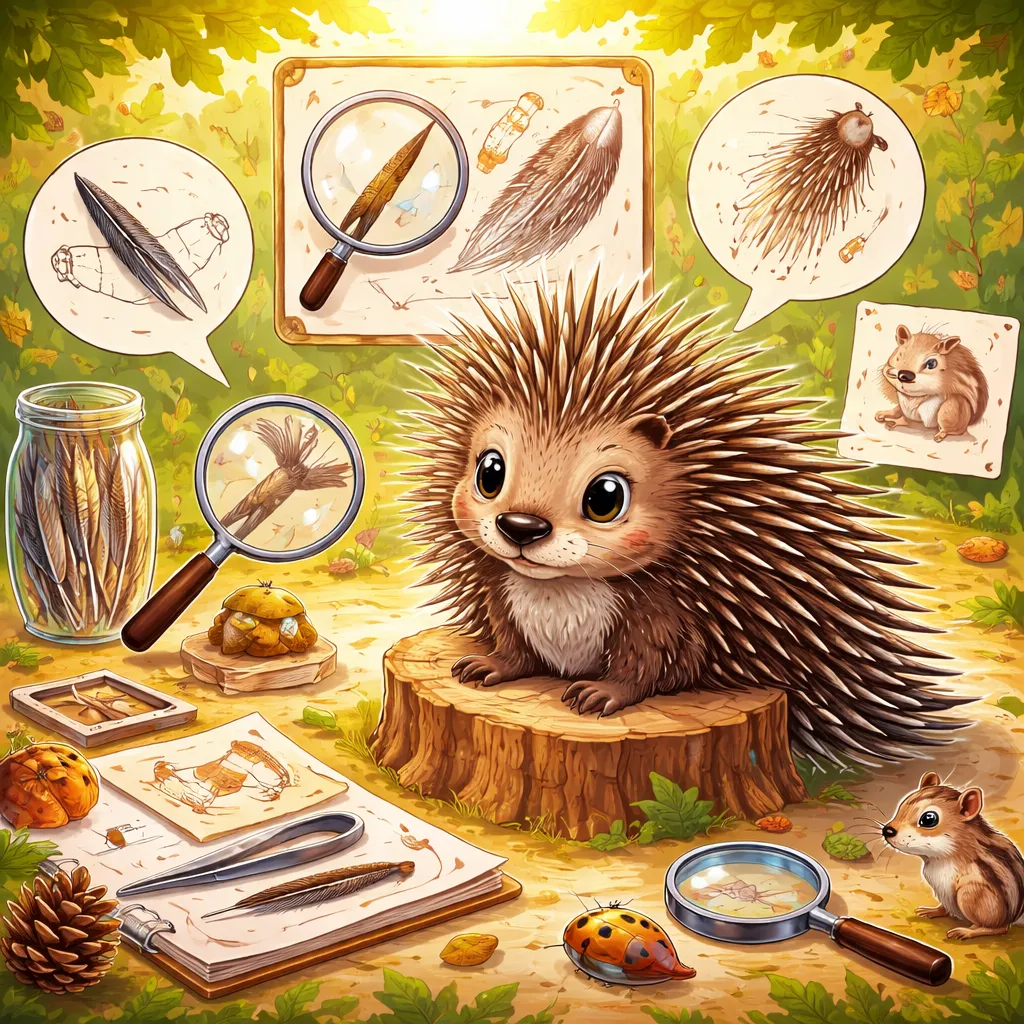

Have you ever seen a picture of a porcupine? It looks like a walking pincushion! With their coat of thousands of sharp quills, porcupines are one of the most unique animals in the forest. They are not aggressive, but they are very well protected. Learning about porcupines is a fascinating adventure that takes us to the trees and forests of North America and other parts of the world. Let’s walk carefully and begin our journey of learning about porcupine protection and habits.
English Language Learning
Vocabulary and Spelling
Our prickly friend is called a porcupine.
The word "porcupine" is a noun. A noun names a person, place, or thing. So, a porcupine is a thing—a well-protected, living animal.
Spelling "porcupine" is a bit long: P-O-R-C-U-P-I-N-E. The 'P' starts the word, the 'O' and 'R' are in the middle, and it ends with 'U-P-I-N-E'. P-O-R-C-U-P-I-N-E spells porcupine.
Sound and Pronunciation
Let’s say the word correctly. It sounds like this: /ˈpɔːr.kjə.paɪn/.
We can say it in three clear parts. First, say "por". It rhymes with "or". Next, say "kyuh". It’s a quick, soft sound. Last, say "pine". It sounds just like the tree, a pine tree!
Now, put it together! "Por" "kyuh" "pine". Porcupine! Great job!
The word "porcupine" has three beats, or three syllables. Clap three times: Por-cu-pine. It’s a fun, spikey-sounding word.
Related Words
Learning about porcupines is more fun with new words! Here are some important ones.
Body Part: The sharp, needle-like hairs on a porcupine’s back are called quills. A baby porcupine is called a porcupette.
Action: Porcupines love to gnaw on wood and bark to wear down their ever-growing teeth.
Home: A porcupine’s resting spot, often in a hollow log or a cave, is called a den.
A Famous Saying
People sometimes say: "As prickly as a porcupine."
This means someone is easily annoyed or hard to get close to. It comes from the porcupine’s sharp quills that make it hard to touch. It reminds us that everyone has their own way of protecting themselves, and sometimes we need to be gentle and respectful.
Say the saying with me: "As prickly as a porcupine." It’s a way to describe someone who is feeling defensive.
Now you know the word "porcupine"! Are you ready to learn about their amazing defense system? Let’s walk from words to wonderful knowledge!
Animal Knowledge
Who Are They? – Family and Group
What kind of animal is a porcupine? Porcupines are mammals. They have hair (quills are modified hairs!), are warm-blooded, and mother porcupines feed their babies milk.
They are part of the rodent family. Their cousins are mice, rats, beavers, and capybaras. There are two main groups: Old World porcupines and New World porcupines.
What Do They Look Like? – Amazing Bodies
Porcupines are about the size of a small dog or a large cat. They are usually brown, gray, or black. Their most famous feature is their coat of 30,000 quills!
Their quills are their super defense! Each quill is a sharp, hollow hair with tiny barbs on the end. The quills are not poisonous, but they are very hard to pull out. Porcupines cannot shoot their quills, but the quills detach easily when touched.
Porcupines have special adaptations. They have strong legs and curved claws for climbing trees. Their teeth, like all rodents, never stop growing, so they must chew on hard things. They have a good sense of smell and hearing.
Where Do They Live and How? – Home and Habits
Porcupines live in North America, South America, Africa, Europe, and Asia. Their homes are forests, grasslands, and deserts. They are very adaptable and can live in many climates.
Porcupines are herbivores. This means they only eat plants. In winter, they eat tree bark and needles. In summer, they eat leaves, herbs, and flowers. They are nocturnal, which means they are most active at night.
Porcupines are mostly solitary, meaning they like to be alone. They are excellent climbers and spend a lot of time in trees. They are not very fast, so their quills are their main protection. A group of porcupines is called a prickle.
A Porcupine’s Life Story – Growing Up
A baby porcupine is called a porcupette. Porcupines are mammals, so porcupettes are born live from their mother. A mother usually has one porcupette at a time.
The mother porcupine is a caring parent. The porcupette is born with soft quills that harden within an hour! The mother feeds it milk and teaches it what to eat. The father does not help.
Porcupettes are born with their eyes open and can climb trees within a few days. They drink milk for a few months but start eating plants very soon. They stay with their mother for about six months before going off on their own.
How Do They "Talk"? – Communication
Porcupines are usually quiet, but they can make sounds. They grunt, whine, and moan. A baby porcupette will squeak for its mother.
They use their quills and body to talk. If a porcupine feels threatened, it will turn its back, raise its quills, and shake its tail. This is a clear warning that says, "Stay away, or you’ll get stuck!"
Their best senses are their sense of smell and hearing. They have a good nose to find food. Their ears are good at hearing danger approach, so they have time to give a warning.
Are They Okay? – Taking Care of Them
Most porcupine species are doing well and are not endangered. But in some places, their numbers are going down because of habitat loss and road accidents.
The main threats are cars, loss of their forest homes, and sometimes people or predators trying to attack them (and getting a face full of quills!). Porcupines can also get into trouble by gnawing on things people own, like tool handles or buildings.
You can be a porcupine friend! You can learn about them and teach others that they are gentle animals who just want to be left alone. You can be a careful driver, especially at night in forest areas. Never try to touch or bother a porcupine.
Life Connections and Inspiration
How to Be With Them – Safety and Love
Porcupines are wild animals with a powerful defense. We must always admire them from a safe and respectful distance.
The most important rule is: Look, don’t touch, and give them space. If you see a porcupine in the wild, stay calm and back away slowly. Never try to pet or chase a porcupine. Keep dogs on a leash in porcupine country, as dogs often get quills in their nose. If a porcupine turns its back and raises its quills, that is your sign to leave.
We show our love by letting them be wild. We can protect the forests and natural areas where they live. A happy porcupine is a porcupine that feels safe and undisturbed.
Super Qualities We Learn from Them
Porcupines teach us wonderful things. One super quality is peaceful self-defense. Porcupines do not attack. They simply present their quills as a warning. They teach us that the best defense is often to stand your ground calmly and clearly, without being aggressive.
Another quality is self-reliance and quiet strength. Porcupines are mostly solitary and can take care of themselves. They are not fast or flashy, but they are strong in their own way. This reminds us that we can be strong, independent, and confident in our own unique abilities.
Think about it: How can you stand up for yourself in a calm and clear way? How can you be more self-reliant in your daily life, like taking care of your own belongings or homework?
Take Action! – Your "Porcupine Protection" Project
Let’s do a fun and creative activity! Your project is to create a 3D porcupine with safe "quills."
You will need: a paper plate, brown or gray paint, a clothespin, googly eyes, and safe "quills" like toothpicks (with blunted tips), cotton swabs (with the cotton removed from one end), or short pieces of straw. Paint the paper plate and let it dry. This is the porcupine’s body. Glue on googly eyes. Use the clothespin as feet so it can stand. Now, carefully poke your safe "quills" into the back of the paper plate. You’ve made a porcupine! Remember, real quills are much sharper, so we use safe materials.
Closing
Learning about porcupine protection is a wonderful adventure! We learned the word "porcupine" and how to say its three-part name. We discovered amazing facts about their thousands of quills, their warning behavior, and their life as solitary foragers. We know that porcupines are peaceful, self-reliant animals who are an important part of the forest. You can use your new words to teach others the true story of these prickly friends. You can use your knowledge to be a safe and respectful wildlife watcher. The animal world is full of peaceful and strong teachers. Always remember to respect wildlife from a safe distance, defend yourself calmly, and be confident in your own unique strengths. Keep exploring with curiosity, stand your ground with quiet confidence, and be a friend to all creatures. Your thoughtful actions and respectful mind make you a true friend to the amazing porcupine.