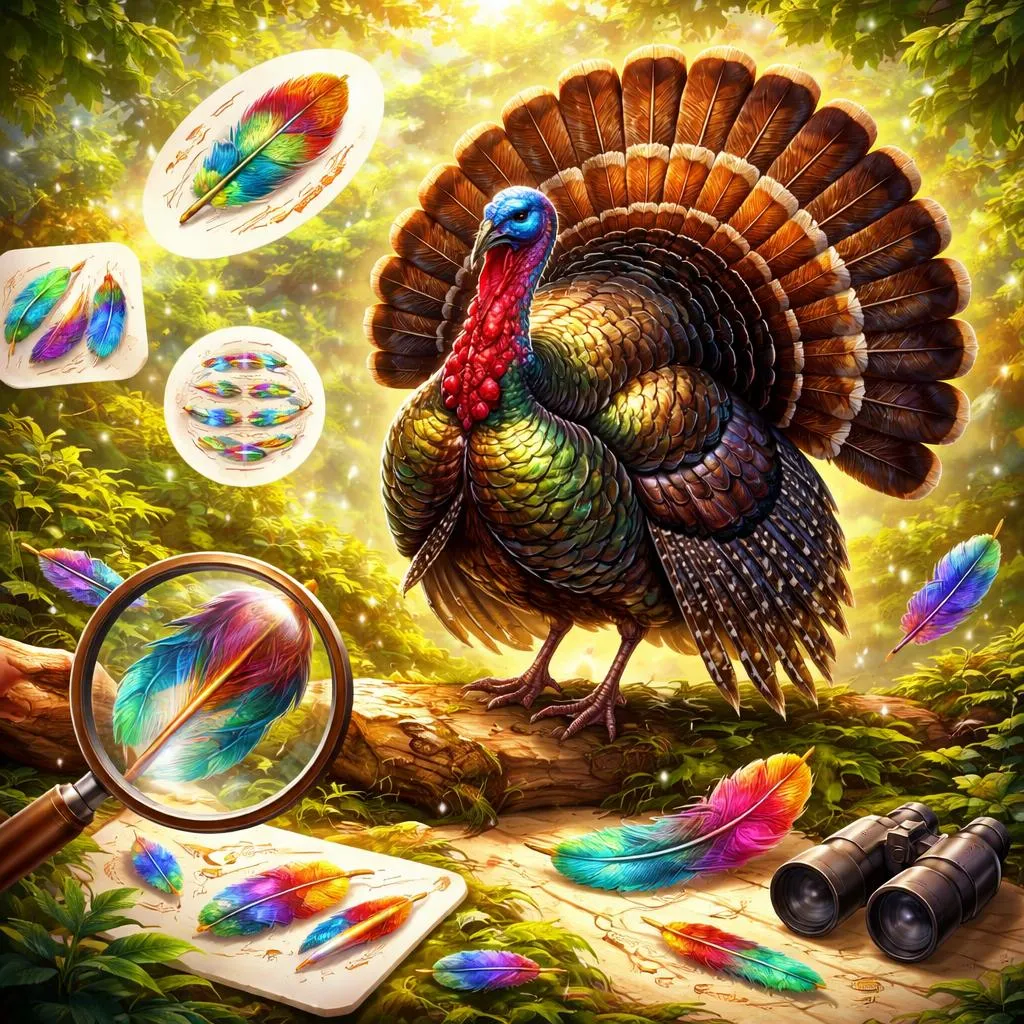

Have you ever seen a large bird with a fan-shaped tail and a funny, wobbly red piece of skin on its face? That’s a turkey! Turkeys are famous birds, especially during holiday feasts, but they are also interesting wild animals. Learning about turkeys is a fascinating adventure that takes us to forests and farms. Let’s begin our journey of learning about turkey facts and features.
English Language Learning
Vocabulary and Spelling
Our large, feathered friend is called a turkey.
The word "turkey" is a noun. A noun names a person, place, or thing. So, a turkey is a thing—a living bird. The male is called a tom, and the female is a hen.
Spelling "turkey" is straightforward: T-U-R-K-E-Y. The 'T' starts the word, the 'U' and 'R' are in the middle, and it ends with 'K-E-Y'. T-U-R-K-E-Y spells turkey.
Sound and Pronunciation
Let’s say the word correctly. It sounds like this: /ˈtɝː.ki/.
We can say it in two clear parts. First, say "ter". It rhymes with "her". Next, say "key". It sounds just like the key for a door.
Now, put it together! "Ter" "key". Turkey! Great!
The word "turkey" has two beats, or two syllables. Clap your hands twice: Tur-key. It’s a simple, clear word.
Related Words
Learning about turkeys is more fun with new words! Here are some important ones.
Body Parts: The red, fleshy skin hanging from a turkey’s beak is called a snood. The loose skin on the neck is the wattle.
Sound: The loud call a male turkey makes is a gobble.
Group: A group of turkeys is called a rafter or a flock.
A Famous Saying
People sometimes say: "Talk turkey."
This means to talk seriously and honestly about something important. It’s a fun way to say, "Let’s get down to business." It reminds us that clear, honest talk is good.
Say the saying with me: "Talk turkey." It’s a useful phrase.
Now you know the word "turkey"! Are you ready to gobble up some amazing facts? Let’s strut from words to wonderful knowledge!
Animal Knowledge
Who Are They? – Family and Group
What kind of animal is a turkey? Turkeys are birds. They are warm-blooded, have feathers, and lay eggs.
They are part of the pheasant family, called Phasianidae. Their wild cousin is the Wild Turkey. The turkey on the farm is a domesticated bird.
What Do They Look Like? – Amazing Bodies
Wild turkeys are large birds, about the size of a big dog. They have dark, shiny feathers with a beautiful bronze-green glow. Male turkeys, or toms, are most famous for their large, fan-shaped tails and their bright red heads.
When a tom is excited, he fans out his tail feathers and puffs up his body to look big and impressive. This is called strutting. The fleshy snood and wattle on their head and neck can change color with their mood.
Turkeys have special adaptations. They are strong runners and can fly short distances, especially wild turkeys. They have excellent eyesight. Their heads are almost featherless, which helps them stay clean in dusty areas.
Where Do They Live and How? – Home and Habits
Wild turkeys live in North and Central America. Their homes are forests, woodlands, and grasslands. They like areas with trees for roosting at night. Farm turkeys live in barns and pastures.
Turkeys are omnivores. This means they eat both plants and animals. They eat seeds, nuts, berries, insects, and even small frogs. They scratch the ground with their feet to find food, just like chickens.
Wild turkeys are social and live in flocks. They are active during the day. They spend their time foraging for food, dust bathing, and roosting in trees at night for safety. Farm turkeys are cared for by people.
A Turkey’s Life Story – Growing Up
A baby turkey is called a poult. Turkeys are birds, so poults hatch from eggs. A hen lays about 10 to 12 eggs in a ground nest and sits on them for about 28 days.
The mother turkey is a very protective parent. She leads her poults to food and keeps them warm. Poults can walk and feed themselves soon after hatching, but they need their mother for protection.
Poults are born with soft, fuzzy feathers. They grow very quickly. In a few weeks, they start growing their adult feathers. They stay with their mother for several months. A turkey becomes an adult in about one year.
How Do They "Talk"? – Communication
Turkeys talk with many sounds. The most famous is the male’s gobble, which can be heard from far away. Hens make a soft "cluck" or "yelp" to talk to their poults.
They use a lot of body language. A tom’s strut and fanned tail is a display to attract females or to show he is in charge. They also use their snood and wattle to show feelings.
Their best sense is their incredible eyesight. They can see in color and have a very wide field of view to spot danger. Their hearing is also very good.
Are They Okay? – Taking Care of Them
Wild turkey populations are now doing well in many areas after being in danger in the past. Some types of farm turkeys are very common.
The main threats for wild turkeys are losing their forest homes and sometimes being hunted. For farm turkeys, it is important they are treated kindly and have enough space, food, and water.
You can be a turkey friend! You can learn about wild turkeys and respect them in nature. If you visit a farm, you can be gentle and quiet around the turkeys. You can support farmers who treat their animals with care.
Life Connections and Inspiration
How to Be With Them – Safety and Love
Turkeys are large birds. Wild turkeys are just that—wild. Farm turkeys are used to people but still deserve respect.
For wild turkeys, the rule is: Watch from a distance. Never try to touch or feed a wild turkey. If a turkey approaches you, it’s best to back away slowly. Do not chase them.
For farm turkeys, be calm and gentle. Move slowly and let the turkey get used to you. Always listen to the farmer’s instructions. Remember, turkeys are living creatures that feel stress and fear.
We show our love by respecting all animals, whether they are wild on a mountain or living on a farm.
Super Qualities We Learn from Them
Turkeys teach us wonderful things. One super quality is confidence and showing your best. When a tom turkey struts, he shows off his feathers with confidence. He teaches us that it’s okay to be proud of our own unique qualities and to show them to the world in a positive way.
Another quality is community and vigilance. Turkeys live in flocks and watch out for each other for safety. They are very alert. This reminds us to be good members of our own community, to look out for our friends and family, and to be aware of our surroundings.
Think about it: What is a special quality you have that you can be proud of? How can you be a vigilant and helpful member of your family or classroom?
Take Action! – Your "Turkey Tail" Project
Let’s do a colorful and creative activity! Your project is to design and create your own turkey tail fan.
On a large piece of paper, draw the shape of a turkey’s fanned-out tail. Color it with beautiful patterns—use browns, bronzes, greens, and even a little red. You can glue on real feathers or cut feather shapes from colored paper. Attate it to a stick or wear it as a mask. When you show your tail fan, strut proudly like a turkey and tell one fact you learned. This celebrates the turkey’s beauty and your new knowledge.
Closing
Learning about turkey wonders is a colorful and fun adventure! We learned the word "turkey" and how to say its two-part name. We discovered amazing facts about their impressive tail fans, their loud gobbles, and their life in a flock. We know that turkeys are confident, social birds that deserve our respect and kindness. You can use your new words to share the true story of these impressive birds. You can use your knowledge to be a respectful observer of wildlife and a compassionate consumer. The animal world is full of confident and vigilant teachers. Always remember to respect all creatures, be proud of your own unique feathers, and be a watchful and caring member of your community. Keep exploring with curiosity, strut with confidence in your learning, and be a friend to the wild and the farm. Your thoughtful actions and proud spirit make you a true friend to the amazing turkey.