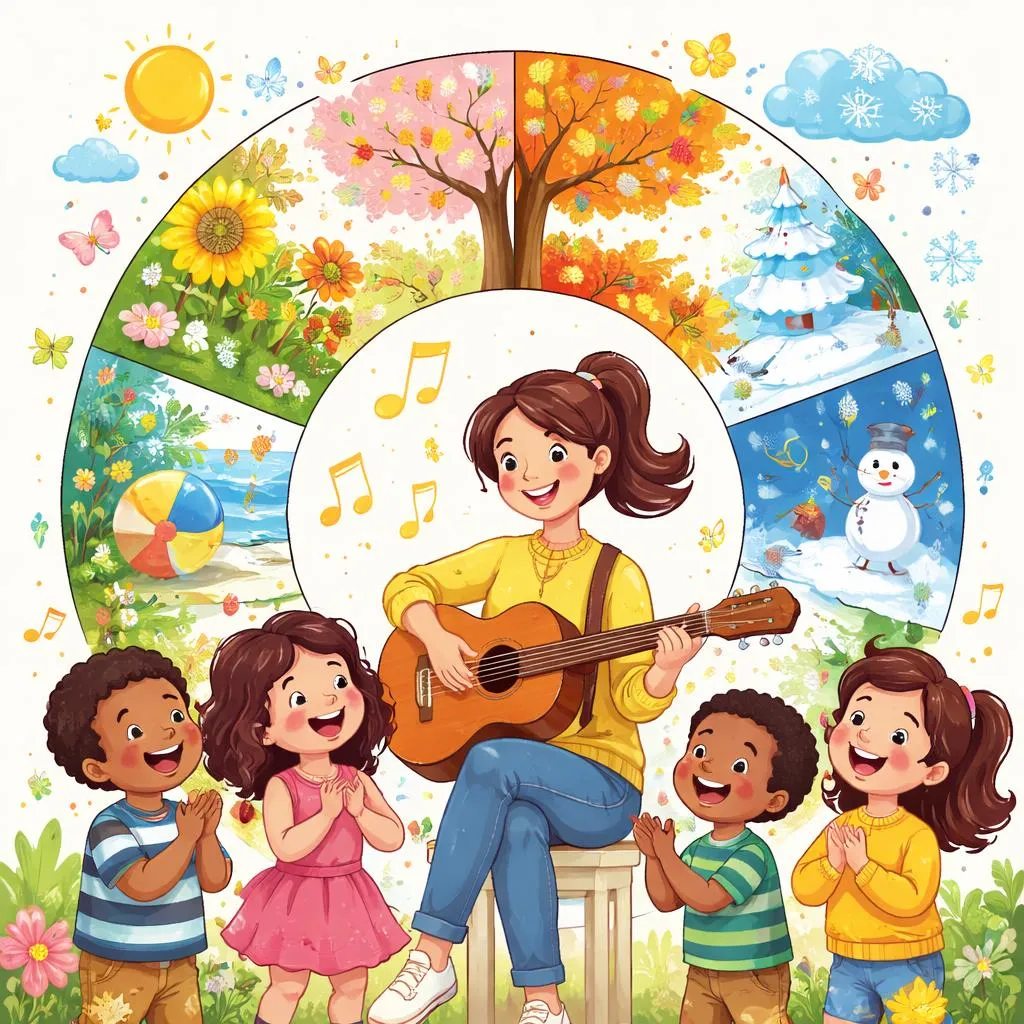

Teaching the concept of a year can be challenging for young minds. Twelve months is an abstract idea. Four seasons can be confusing. But music changes everything. A good year song organizes time into a melody. It turns a calendar into a chorus. As teachers, we can use these songs to help children understand the cycle of the year. Let's explore how to bring the rhythm of the months and seasons into our classroom.
What is a Year Song? A year song is a learning song that teaches the months of the year or the seasons. There are many versions. Some list all twelve months in order. Some group months by season. Some add holidays or weather patterns. The common goal is to help children memorize the sequence of the year.
These songs use melody and rhythm as memory aids. When we sing the months, we are not just reciting a list. We are creating a musical pattern in the brain. This pattern helps children recall the order later. A good year song turns time into something we can sing and dance to.
The Lyrics of a Typical Year Song Let's look at a common version of a months song.
January, February, March, April, May, and June. July, August, September, October, November, December. These are the twelve months of the year. Now let's sing them all again, right here!
Another version connects months to seasons.
In January and February, it is cold, Winter winds blow strong and bold. March and April bring the spring, Birds start to sing and flowers spring.
May and June are warm and bright, Summer days are long with light. July and August, hot sun glows, Time for swimming, everyone knows.
September, October, fall is here, Leaves turn colors, autumn cheer. November and December, year is done, Winter holidays have begun!
These different approaches give us options. We can choose a simple year song for beginners or a more detailed one for advanced learners.
Vocabulary Learning: Words from the Song A year song introduces essential time vocabulary.
January: The first month of the year.
February: The second month, often cold and short.
March: The third month, when spring begins.
April: The fourth month, known for spring showers.
May: The fifth month, when flowers bloom.
June: The sixth month, beginning of summer.
July: The seventh month, hot and sunny.
August: The eighth month, still warm.
September: The ninth month, start of school and fall.
October: The tenth month, with falling leaves.
November: The eleventh month, getting colder.
December: The twelfth month, with winter holidays.
Seasons vocabulary also appears.
Winter: The cold season with snow in many places.
Spring: The season when plants grow and flowers bloom.
Summer: The warmest season, with long days.
Fall / Autumn: The season when leaves change color and fall.
These words form the foundation of calendar understanding. A good year song introduces them in a memorable way.
Phonics Points: Sounds in the Song A year song offers many phonics opportunities.
The "J" Sound: January, June, and July all start with the /j/ sound. We practice this sound. We feel how our mouth makes the sound.
The "F" Sound: February starts with the /f/ sound. We feel our top teeth on our bottom lip.
The "M" Sound: March, May, and months start with /m/. We feel our lips press together.
The "S" Sound: September starts with /s/. We feel the air hiss out.
The "O" Sound: October starts with the short /o/ sound. We feel our mouth open.
The "N" Sound: November and December start with /n/. We feel our tongue on the roof of our mouth.
Rhyming in Seasons Songs: Season songs often use rhymes. Cold and bold. Spring and sing. Bright and light. Glows and knows. Here and cheer. Done and begun. These rhymes build phonemic awareness.
The repetition in a year song gives us many chances to hear and practice these sounds.
Grammar Patterns: Language in the Song A year song introduces several grammar concepts.
Proper Nouns: The names of the months are proper nouns. In English, we always capitalize them. As we write the lyrics on the board, we point out the capital letters. "Look, January starts with a big J."
Prepositions of Time: We use specific words with months and seasons. We say "in January" and "in winter." We do not say "on January." We can practice this pattern. "My birthday is in May." "School starts in September."
Adjectives: Songs often use adjectives to describe months and seasons. Cold winter, warm spring, hot summer, colorful fall. We can talk about how adjectives describe nouns.
Conjunctions: Songs use words like "and" to connect ideas. "January and February" "March and April" This shows how we list things.
The simple structure of a year song makes it perfect for introducing these grammar concepts in a natural context.
Learning Activities: Bringing the Year to Life Here are some activities to deepen the learning experience.
Activity 1: Month by Month Art We create twelve large cards, one for each month. As we learn the year song , we add pictures to each card. For January, we add snow. For July, we add a sun. For October, we add a pumpkin. Over time, we build a visual calendar that stays on the wall.
Activity 2: Birthday Line-Up We ask each child which month their birthday is in. We then line them up in month order. All the January birthdays stand together. Then February, and so on. We can count how many birthdays are in each month. This makes the months relevant to their own lives.
Activity 3: Season Sorting We collect pictures from magazines or draw simple images. Snowmen, flowers, beaches, falling leaves. Students sort the pictures into the four seasons. This connects the year song to real-world observations.
Activity 4: Calendar Making Each month, we create a simple calendar together. We write the name of the month at the top. We fill in the dates. We mark special days like birthdays and holidays. This ongoing project connects the song to the practical tool we use to track time.
Printable Materials: Visuals for the Classroom Printables support the lesson and provide independent practice.
Month Posters: We create a set of twelve posters. Each poster has the name of the month, a simple picture, and the number of the month. We display these around the room. We point to them as we sing our year song.
Season Sorting Cards: We create cards with pictures representing each season. Students sort them into four groups: winter, spring, summer, fall.
Calendar Template: We provide a blank calendar template for one month. Students can write the name of the current month at the top. They can fill in the dates.
Coloring Page: We provide a coloring page showing all four seasons in one picture. Students can color each section according to the season.
Educational Games: Making Learning Playful Games turn the year song into an interactive experience.
Game 1: Month Name Race We divide the class into two teams. We say a fact about a month. "This month has New Year's Day." The teams must guess the month (January). The first team to say the correct month gets a point. This game builds associations and recall.
Game 2: What Month Comes Next? We start singing the year song. Suddenly, we stop. We point to a student. They must say the next month in the sequence. We sing, "January, February, March, April, May, and..." and then we stop. The student must say "June." This quick game builds automatic recall.
Game 3: Season Freeze Dance We play music. Students dance like it is summer. When the music stops, we call out a season. Students freeze in a pose that represents that season. Shivering for winter. Wiping sweat for summer. This connects movement to the seasons.
Game 4: Month Match-Up We create two sets of cards. One set has month names. One set has pictures representing those months. Snow for January. Flowers for April. Sun for July. Leaves for October. Students match the month card to the picture card.
Game 5: Create a New Verse We challenge students to create a new verse for the year song. What happens in their favorite month? "In December, snowflakes fall, building snowmen, one and all." This extends creativity and language skills.
By using these strategies, we transform a simple learning song into a rich educational experience. We explore vocabulary, phonics, grammar, and the cycle of time. The year song becomes the soundtrack to our calendar learning. It helps us mark the passage of days, months, and seasons together.