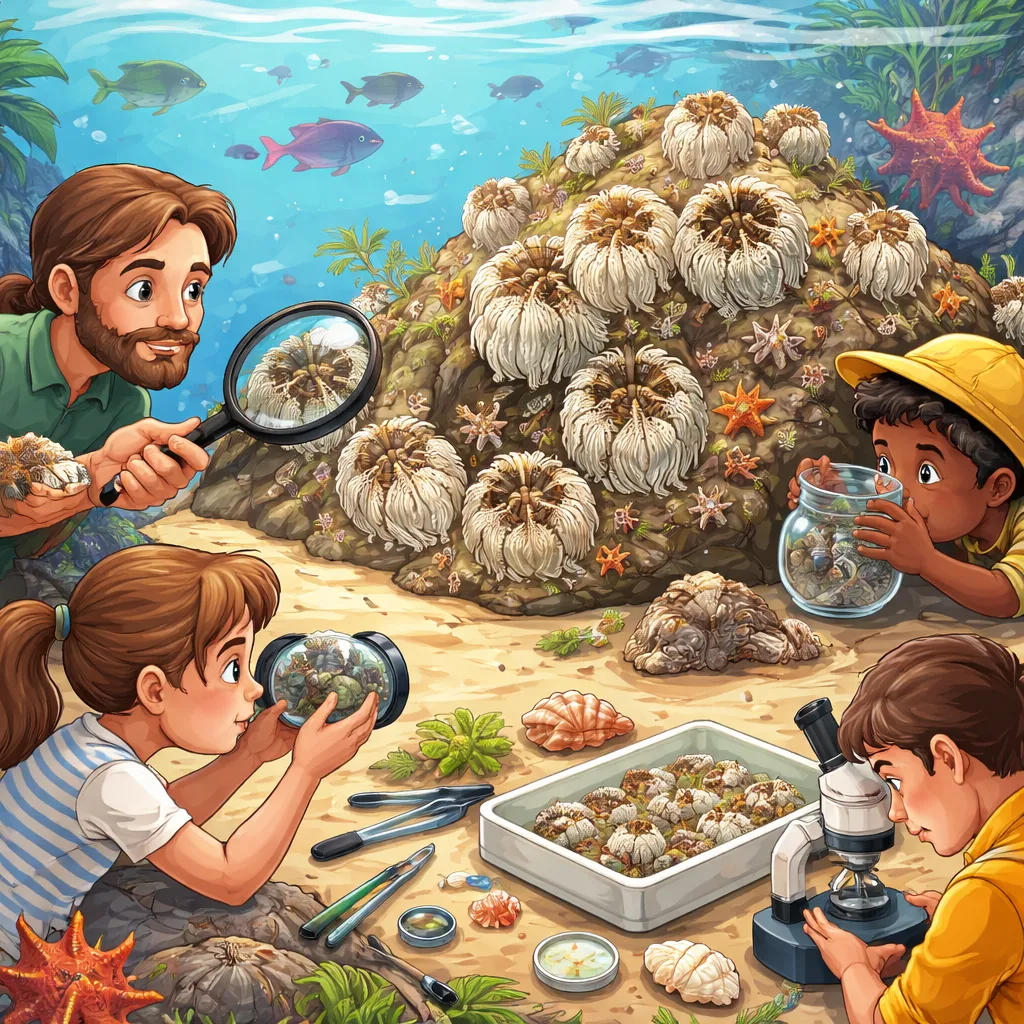

Some animals swim through the ocean. Others attach themselves to rocks and never move again. The barnacle does the latter. It looks like a tiny white volcano glued to a rock. For children, learning about Barnacle opens a window to one of the most misunderstood creatures of the seashore. Parents and children can explore this hidden crustacean together. No boat is needed. Just a trip to the shore or a moment of curiosity about the small white bumps on coastal rocks.
The barnacle does not look like an animal. But inside its hard shell, a creature lives. Let us begin our discovery.
What Is This Animal?
A barnacle is a small crustacean that lives inside a hard shell. It attaches itself to rocks, docks, boats, and even whales. The shell is made of calcium plates. The barnacle glues itself to a surface and never moves again. Inside, it lies on its back. It kicks food into its mouth with feathery legs.
Barnacles live in oceans around the world. They thrive in the intertidal zone, the area between high and low tide. They can survive being out of water when the tide goes out. They close their shells tightly to hold in moisture.
Children often find barnacles puzzling. They look like shells. They feel like rocks. But they are animals. Learning about Barnacle becomes an exploration of how some animals give up movement for a safe, anchored life.
English Learning About This Animal
Let us begin with the word “barnacle.” It is pronounced /ˈbɑːrnəkl/. Say it with your child: bar-na-cle. Three syllables. The first part sounds like “bar.” The second part sounds like “nuh.” The third part sounds like “kul.” The word has been used in English for hundreds of years.
When learning about Barnacle in English, we meet words about attachment and feeding. Here are a few to share.
Crustacean – a group of animals including crabs, shrimp, and barnacles.
Cirri – the feathery legs that barnacles use to feed.
Cement – the strong glue barnacles use to attach.
Intertidal – the area between high and low tide.
Use these words in simple sentences. “Barnacles are crustaceans.” “They use cirri to catch food from the water.” These sentences help children understand the barnacle’s unique body and behavior.
Here is a proverb that fits the barnacle. “A rolling stone gathers no moss.” Barnacles do not roll. They attach firmly. They stay in one place. This teaches children that stability has value. Sometimes staying put allows you to grow.
Another meaningful thought comes from poet William Blake. He wrote, “To see a world in a grain of sand.” A single barnacle holds a world of wonder. Its hidden life reminds children that small, overlooked things often hold great secrets.
Animal Facts and Science Knowledge
Barnacles belong to the subphylum Crustacea. This group includes crabs, lobsters, and shrimp. Barnacles are crustaceans, not mollusks. Their relatives walk on the seafloor. Barnacles took a different path. They attached themselves to surfaces and stopped moving.
Barnacles begin life as tiny larvae. They float in the ocean. They look like small shrimp. They swim and drift. When they find a suitable surface, they attach head-first. They secrete a powerful cement. This glue is one of the strongest natural adhesives known. Once attached, the barnacle undergoes metamorphosis. It builds its shell and never moves again.
Inside the shell, the barnacle lies on its back. It extends feathery legs called cirri. These legs kick through the water. They catch plankton and tiny food particles. The barnacle pulls the legs back into the shell and scrapes off the food. This feeding happens whenever the tide covers them.
Barnacles have both male and female reproductive organs. They cannot move to find mates. Instead, they extend a long tube to transfer sperm to nearby barnacles. This adaptation allows them to reproduce without leaving their spot.
Some barnacles attach to whales, sea turtles, and ships. These hitchhikers travel the oceans. Whale barnacles are specialized species that only grow on certain whales. They do not harm the whale. They simply use it as a moving home.
Barnacles can live for several years. Their shells grow as they age. Each year adds a new layer. Scientists can count these layers to determine a barnacle’s age.
How to Interact With This Animal Safely
Barnacles are wild animals. They are not dangerous, but their shells can be sharp. If you walk on rocks covered in barnacles, wear shoes. The shells can cut skin. Children should learn to step carefully on rocky shores.
If your family explores tide pools, observe barnacles where they are. Do not pry them off rocks. Removing barnacles kills them. Their cement holds so strongly that removing them tears their bodies.
When the tide goes out, barnacles close their shells. You may see them as tiny white bumps. If you watch quietly when the tide returns, you can see them open. Their cirri extend and kick. This is a magical moment for children to witness.
Never use sharp objects to open barnacles. They are living creatures. Respect their home. If you find empty barnacle shells on the beach, you may collect them. These are the shells left after the animal died.
Teach children that barnacles on boats and docks are not pests. They are animals living their lives. If removal is necessary, it should be done by adults using proper methods.
What Can We Learn From This Animal
Barnacles teach us about finding a place and staying. They choose a spot. They attach. They build their lives there. Children can learn that committing to a place, a community, or a goal has value. Growth happens when you stay and build.
Barnacles also show us that appearances can be deceiving. They look like small rocks or shells. Inside, they are complex animals. Children can learn that what you see on the surface is not the whole story. People and animals have hidden depths.
Another lesson is adaptation. Barnacles gave up movement. They developed strong glue, tube feet for mating, and feathery legs for feeding. They adapted to a fixed life. Children can learn that adapting to circumstances is a form of strength.
Barnacles teach us about patience. They wait for the tide. They wait for food to drift by. They wait for a mate. Children can learn that waiting is part of life. Good things come when we are ready and open.
Fun Learning Activities
Turn learning about Barnacle into hands-on exploration. Here are a few simple ideas.
Make a Barnacle Craft
Roll small pieces of clay into cone shapes. Press them onto a rock or cardboard. Let your child paint them white or gray. Talk about how barnacles attach to surfaces.
Create a Feeding Game
Have your child sit on the floor with a small bowl. Give them a spoon or tweezers. Scatter small items like beans or beads. Ask them to scoop or pick up the items without moving from their spot. Explain that barnacles feed without moving.
Write a Stationary Story
Ask your child to imagine being a barnacle attached to a rock. The tide comes and goes. You cannot move. What do you see? What do you feel? Write or draw the story together. Use new words like cirri, cement, and intertidal.
Play the Attachment Game
Take turns being a barnacle larva looking for a home. Find a spot and freeze. Tap your feet like cirri feeding. Explain that once barnacles attach, they never move again.
Watch and Wonder
Find a short video of barnacles feeding under water. Watch together. Pause and ask open questions. “What do you notice about their legs?” “Why do you think they kick like that?” Let your child share observations freely.
Learning about Barnacle takes us to the rocky shore where waves crash and tides rise and fall. It is a world of hidden animals living in plain sight. The barnacle looks like a rock. It acts like a rock. But inside, a tiny crustacean kicks its legs, catches food, and lives a full life. As parents and children explore together, they build language, knowledge, and a shared appreciation for the overlooked wonders of the coast. The barnacle closes its shell as the tide retreats, waiting for the water to return. And in that patient waiting, young learners discover something true—that sometimes the most remarkable lives are lived in the smallest, quietest places.