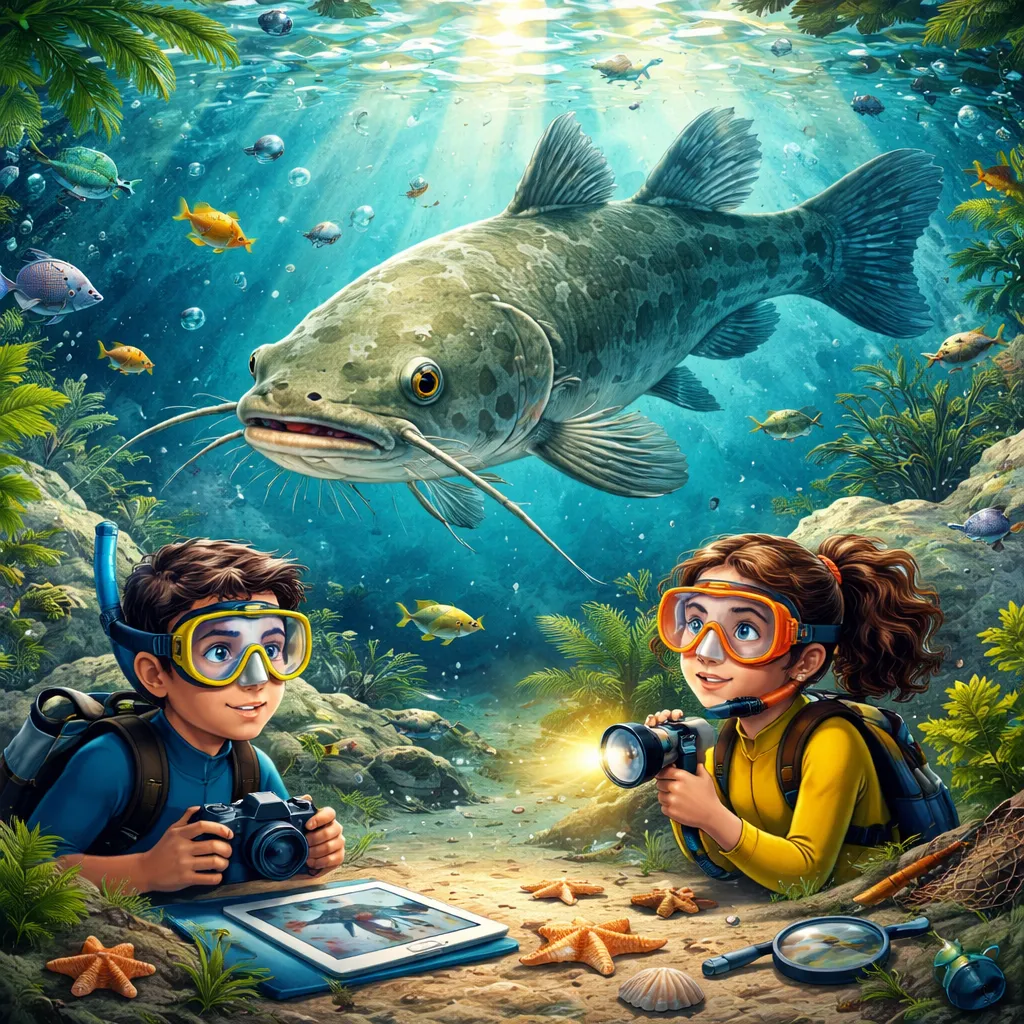

Some fish wear bright colors. Others swim in fast schools. But the catfish takes a different path. It rests quietly at the bottom. It uses whiskers to taste the water. For children, learning about Catfish opens a door to the hidden world beneath the surface. This fish does not try to stand out. Yet it holds surprising secrets. Parents and children can explore these secrets together. No special equipment is needed. Just curiosity and a willingness to look closely.
The catfish is not a single fish. It is a large family with thousands of members. Some live in rivers. Others live in lakes or ponds. They come in many shapes and sizes. Let us begin our discovery.
What Is This Animal?
A catfish is a fish with a flat head and long, whisker-like feelers. These feelers are called barbels. They look like a cat’s whiskers. That is how the fish got its name. Most catfish do not have scales. Their skin is smooth and often covered with a protective layer.
Catfish live mostly in fresh water. You can find them in rivers, streams, and lakes around the world. Some species live in the ocean. They prefer murky water where they can hide. Their eyes are small. They do not rely on sight. Instead, they use their barbels and sense of smell to find food.
Children often find catfish interesting because they look unusual. Their shape is sturdy. Their whiskers make them easy to recognize. Learning about Catfish helps children appreciate animals that live in quiet, overlooked places.
English Learning About This Animal
Let us begin with the name. “Catfish” is a compound word. It combines “cat” and “fish.” Say it slowly: cat-fish. The pronunciation is /ˈkætˌfɪʃ/. The first part rhymes with “hat.” The second part rhymes with “wish.” You can clap once for each syllable. Cat. Fish. Two claps. This helps young learners feel the rhythm of the word.
When learning about Catfish in English, we discover useful words. Here are a few to share.
Barbel – the whisker-like organ near the mouth.
Bottom-dweller – an animal that lives on the floor of a body of water.
Scavenger – an animal that eats leftover or decaying matter.
Spine – a sharp, stiff part used for protection.
Use these words in short sentences. “The catfish uses its barbels to find food.” “A catfish is a bottom-dweller.” These sentences are easy to repeat. They build vocabulary naturally.
Here is a proverb that connects to the catfish. “Still water runs deep.” This means calm surfaces often hide great depth. Catfish live in still, murky water. Yet they have strong senses and survival skills. The proverb teaches children that quiet things can hold great value.
Another saying comes from writer Mark Twain. He said, “The secret of getting ahead is getting started.” Catfish spend much time resting. But when they move, they move with purpose. This reminds children that even small steps forward matter.
Animal Facts and Science Knowledge
Catfish are ray-finned fish. They belong to the order Siluriformes. There are over 3,000 species. They live on every continent except Antarctica. This makes them one of the most widespread fish families.
Most catfish have no scales. Their skin is smooth and covered with taste buds. In fact, a catfish has taste buds all over its body. It can taste food just by touching it. This ability helps it find meals in dark or muddy water.
Catfish are omnivores. They eat insects, small fish, plants, and dead matter. Many are scavengers. They help keep waterways clean by eating what others leave behind. This role is important for a healthy ecosystem.
Some catfish grow very large. The Mekong giant catfish can reach nearly ten feet long. Others stay small enough to fit in a home aquarium. Many catfish have sharp spines on their fins. They use these spines for defense. When threatened, they lock the spines outward. This makes them hard to swallow.
Catfish are most active at night. They have excellent senses of smell and touch. Their barbels contain special cells that detect chemicals in the water. Even in complete darkness, a catfish knows what is nearby.
How to Interact With This Animal Safely
In the wild, catfish are generally harmless to humans. They prefer to stay hidden. If you see a catfish in a river or pond, observe it quietly. Do not try to catch it with your hands. Some catfish have sharp spines on their fins. A surprised catfish may extend these spines. A spine prick can be painful.
If your family enjoys fishing, teach children how to handle catfish with care. Use a wet cloth or gloves to hold the fish. Support the body. Avoid squeezing. If the fish has spines, keep your fingers away from them. Release the fish gently back into the water.
In an aquarium setting, many catfish species make peaceful pets. They are bottom-dwellers. They need a tank with hiding places like caves or driftwood. Keep the water clean. Feed them sinking pellets or vegetables. Never overfeed. Leftover food can dirty the water.
Teach children that catfish are living creatures, not toys. They need quiet environments. Loud noises and sudden movements can stress them. Caring for a pet catfish teaches responsibility. It also shows children that even simple animals deserve respect.
Never release aquarium catfish into local rivers or ponds. This can harm native wildlife. Always research before bringing a pet home. Responsible choices protect animals and their habitats.
What Can We Learn From This Animal
Catfish teach us the value of using all our senses. They do not rely on sight alone. They taste, touch, and smell their way through the world. Children can learn to use their own senses more fully. Listen carefully. Notice small details. Feel textures. These skills build awareness and focus.
Catfish also show us that every creature has a role. They are scavengers. They clean up what others leave behind. This teaches children that helping in small ways matters. You do not need to be the biggest or brightest to make a difference.
Patience is another lesson. Catfish wait quietly. They do not chase. They let food come to them. This reminds children that waiting can be wise. Not everything needs immediate action. Sometimes the best choice is to stay still and observe.
Adaptability is also important. Catfish live in murky water, clear water, warm places, and cold places. They adjust to their surroundings. Children can learn to adapt too. New situations become easier when we stay calm and use our strengths.
Fun Learning Activities
Turn learning about Catfish into a playful experience. Here are a few simple ideas.
Make a Whisker Craft
Cut a fish shape from paper. Glue short pieces of yarn or string to the front for barbels. Let your child decorate the body with colors or patterns. Talk about why catfish need their whiskers.
Create a Bottom-Dweller Story
Ask your child to imagine a day in the life of a catfish at the bottom of a river. What does it see? What does it find to eat? Draw or write the story together. Use new words like barbel, scavenger, and spine.
Play a Sensory Game
Blindfold your child with a soft cloth. Place a few safe objects like a smooth stone, a dry leaf, and a piece of fabric on a tray. Ask them to feel each object and guess what it is. Explain that catfish use touch to explore their world.
Pretend to Swim
Lie on the floor and pretend to be a catfish resting at the bottom. Slowly move your arms like fins. Use your fingers to wiggle like barbels. Ask your child how it feels to move slowly and stay low.
Watch and Wonder
Find a short video of catfish in a river or aquarium. Watch together. Pause and ask open questions. “What do you notice about its whiskers?” “Why do you think it stays near the bottom?” Let your child lead the conversation.
Learning about Catfish takes us into a quieter part of nature. It shows that animals do not need to be loud or fast to be amazing. They find their own way to survive and thrive. As parents and children explore together, they build language, knowledge, and a shared sense of wonder. The catfish rests at the bottom, whiskers gently moving. And in that calm moment, young learners discover something lasting—a deeper appreciation for the hidden world just below the surface.