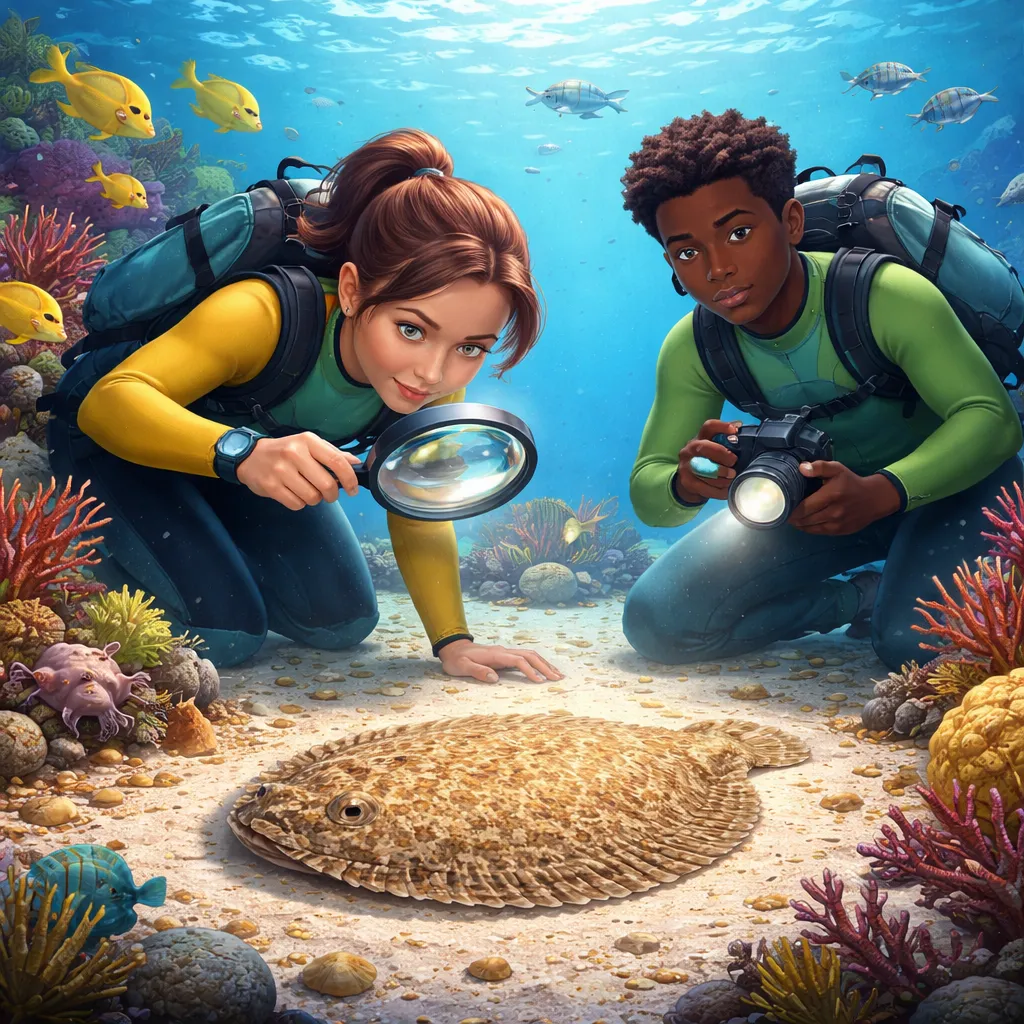

Some fish swim upright. Others drift with the current. The flounder does something entirely different. It lies flat on the ocean floor. Its body blends into the sand. For children, learning about Flounder opens a window to the art of disguise and adaptation. Parents and children can explore this unique fish together. No scuba gear is needed. Just a sense of wonder and a willingness to look closely at the sandy bottom.
The flounder is not an ordinary fish. It begins life looking like any other fish. Then something remarkable happens. Its body changes. Let us begin our discovery.
What Is This Animal?
A flounder is a flat fish with both eyes on one side of its head. Its body is oval and flattened. It swims with one side facing up and one side facing down. The upper side blends with the seafloor. The underside is pale and smooth.
Flounder live on the ocean floor in coastal waters. They prefer sandy or muddy bottoms. They bury themselves partially in the sediment. Only their eyes peek out. This hiding spot keeps them safe from predators. It also helps them ambush prey.
Children often find flounder fascinating because of their unusual shape. Both eyes on one side? A body that lies flat? These features spark curiosity. Learning about Flounder becomes an exploration of how animals adapt to their environment.
English Learning About This Animal
Let us begin with the word "flounder." It is pronounced /ˈflaʊndər/. The first part sounds like "flown" with a "d" instead of "n." The second part sounds like "der." Say it together: floun-der. Two syllables. The "ou" makes the same sound as in "round."
When learning about Flounder in English, we meet words about hiding and changing. Here are a few to share.
Camouflage – colors or patterns that help an animal blend in.
Flatfish – a type of fish with a flattened body.
Sediment – sand, mud, or small particles on the ocean floor.
Larva – an early stage of development for many animals.
Use these words in simple sentences. "Flounder use camouflage to hide." "They rest on the sediment." These sentences help children connect words to real behaviors.
Here is a proverb that fits the flounder's world. "Still waters run deep." Flounder live in quiet, shallow waters. Yet they have a hidden depth. Their transformation from a normal-looking larva to a flatfish is one of nature's wonders. The proverb teaches children that quiet places and creatures often hold surprising secrets.
Another meaningful thought comes from naturalist Rachel Carson. She wrote, "The edge of the sea is a strange and beautiful place." Flounder live in that edge. They rest where sand meets water. This reminds children that the shoreline holds endless discoveries.
Animal Facts and Science Knowledge
Flounder are flatfish. They belong to the order Pleuronectiformes. This group includes halibut, sole, and plaice. There are over 700 species of flatfish. Flounder live in oceans around the world, mostly in temperate and tropical waters.
Flounder begin life like ordinary fish. They hatch from eggs as tiny larvae. Their bodies are upright. Their eyes are on opposite sides of their heads. They swim near the surface. As they grow, something remarkable happens. One eye begins to migrate. It moves across the top of the head to join the other eye.
This transformation takes days or weeks. The fish then settles to the bottom. It now swims with both eyes on the upper side. The underside becomes pale. The upper side develops colors and patterns that match the seafloor. This metamorphosis is one of nature's most dramatic changes.
Flounder are carnivores. They eat small fish, shrimp, worms, and crustaceans. They lie buried in the sand, waiting. When prey swims close, they rise quickly and strike. Their flat shape allows them to hide effectively.
Most flounder live alone. They are bottom-dwellers. They do not form schools. Their lifestyle is solitary and patient. Some species migrate seasonally to deeper water or to spawning grounds.
Flounder can change color to match their surroundings. Special cells in their skin allow this adaptation. A flounder on sand may look pale. A flounder near dark rocks may appear darker. This ability helps them stay hidden.
How to Interact With This Animal Safely
In the wild, flounder are harmless to humans. They spend most of their time buried in sand. If you walk along a sandy shoreline, you may be near flounder without knowing it. They will not bother you. They will stay still and hope you pass.
If your family enjoys fishing, flounder are a common catch. Teach children to handle them with care. Use wet hands. Support the body. Remove hooks gently. If you release the fish, return it to the water quickly. Flounder have sensitive skin. Gentle handling matters.
When exploring tide pools or shallow waters, walk carefully. Shuffle your feet rather than stomping. This movement alerts fish and crabs. They can move away safely. It also protects you from stepping on hidden animals.
Never try to dig up a flounder you see buried. Disturbing resting fish causes stress. Watching from a distance is best. If you want a closer look, wait quietly. The flounder may swim away on its own. Respect its space.
Teach children that the ocean floor is a home, not a playground. Moving rocks and digging holes can harm the animals that live there. Observing without touching protects the habitat.
What Can We Learn From This Animal
Flounder teach us about adaptation. They start life one way and become something completely different. This transformation shows children that change is natural. Growing up means becoming new versions of ourselves. That is not something to fear.
Flounder also show us the power of blending in. They do not need bright colors or loud movements. They succeed by being quiet and still. Children can learn that being unnoticed sometimes has value. Watching and listening before acting can be wise.
Another lesson is patience. Flounder lie in the sand for hours. They wait for food to come to them. They do not chase. This teaches children that waiting is not wasted time. Being still and aware can lead to good things.
Flounder teach us about finding our place. They live on the bottom. They do not try to swim in the middle of the ocean. They thrive where they belong. Children can learn that finding where you fit best is important. You do not have to be like everyone else.
Fun Learning Activities
Turn learning about Flounder into hands-on fun. Here are a few simple ideas.
Make a Flounder Mask
Cut a paper plate in half. Draw two eyes on one side of the plate. Let your child decorate the other side with sand-colored paint or glue real sand. Talk about why flounder have both eyes on one side.
Create a Camouflage Game
Cut a fish shape from paper. Hide it in a room against a matching color. Let your child find it. Explain that flounder hide the same way on the ocean floor. Use the word camouflage.
Write a Transformation Story
Ask your child to imagine being a baby flounder floating near the surface. One eye begins to move. What does it feel like? Write or draw the story together. Use new words like larva, metamorphosis, and sediment.
Pretend to Be a Flatfish
Lie on the floor on your belly. Flatten your body. Keep very still. Ask your child to pretend they are buried in sand. Only their eyes move. This movement activity builds imagination and calm focus.
Watch and Wonder
Find a short video of flounder swimming or changing color. Watch together. Pause and ask open questions. "What do you notice about how it moves?" "Why do you think it changes color?" Let your child share observations freely.
Learning about Flounder takes us to the sandy edges of the sea. It is a world where hiding is survival and patience is power. This flat fish begins life in the open water and finds its home on the bottom. As parents and children explore together, they build language, knowledge, and a shared appreciation for nature's quiet masters. The flounder rests in the sand, both eyes watching. And in that stillness, young learners discover something true—that sometimes the most remarkable things are found when we take the time to look closely at the places others overlook.