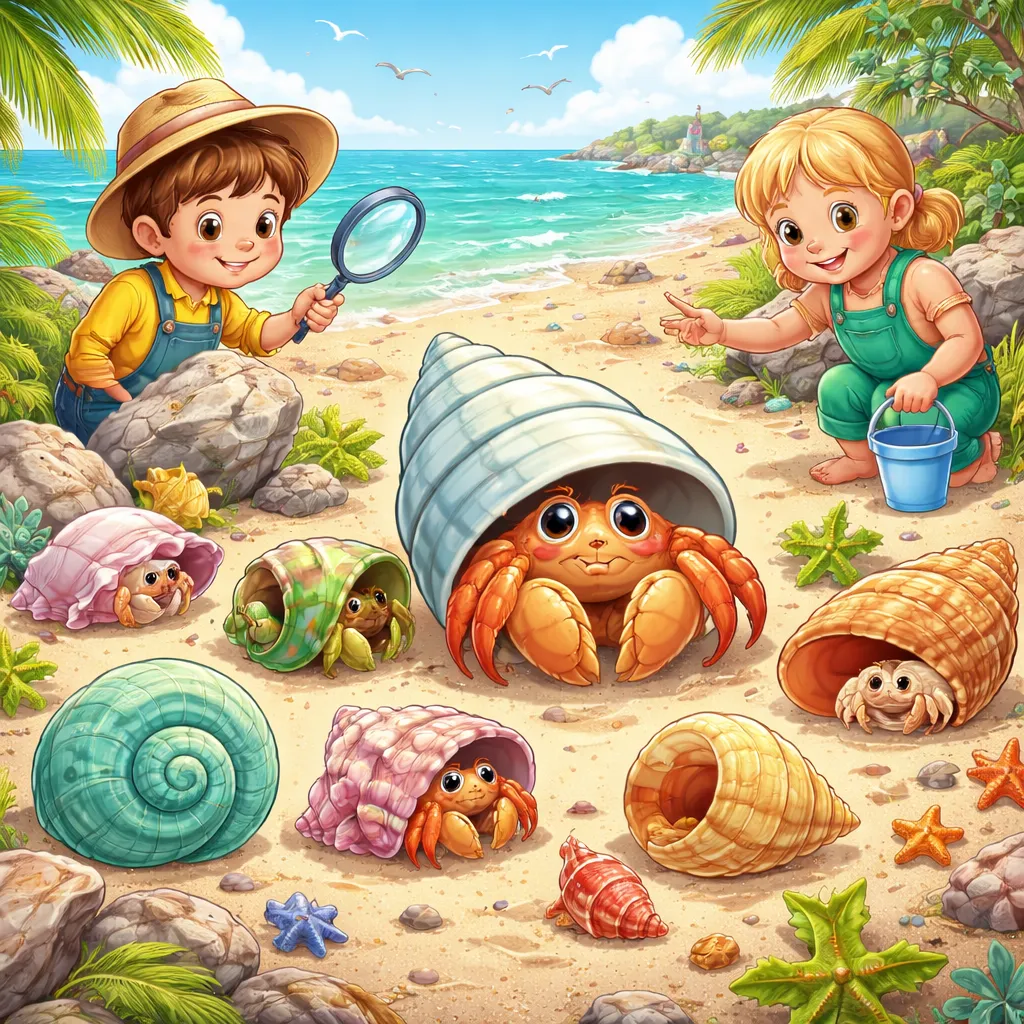

Some animals grow their own shells. Others borrow shells from creatures that came before. The hermit crab does the latter. It carries its home on its back. When it grows too big, it finds a new one. For children, learning about Hermit Crab opens a window to the clever ways animals adapt. Parents and children can explore this fascinating crustacean together. No beach trip is required. Just curiosity about a creature that knows the value of a good home.
The hermit crab is not truly a hermit. It lives with others. It swaps shells. It explores. Let us begin our discovery.
What Is This Animal?
A hermit crab is a crustacean with a soft, curled abdomen. Unlike other crabs, it does not grow its own hard shell. It uses empty snail shells for protection. Its body fits perfectly inside the spiral. Its strong claws block the entrance when danger approaches. Only its eyes and legs stick out.
Hermit crabs live on sandy shores, rocky coasts, and in shallow waters around the world. Some species live entirely on land. Others live in the ocean. All need shells to survive. Without a shell, their soft bodies are vulnerable to predators and the elements.
Children often find hermit crabs delightful. They watch them switch shells. They see them peek out with curious eyes. Learning about Hermit Crab becomes a lesson in homes, growth, and community.
English Learning About This Animal
Let us begin with the name “hermit crab.” It is pronounced /ˈhɜːrmɪt kræb/. Say it with your child: her-mit crab. Two words. Three syllables in hermit. The word “hermit” means someone who lives alone. But hermit crabs actually live in groups. The name comes from their habit of living alone in borrowed shells.
When learning about Hermit Crab in English, we meet words about homes and growth. Here are a few to share.
Abdomen – the soft, curled back part of the hermit crab.
Gastropod – a type of snail that makes spiral shells.
Molting – the process of shedding the old exoskeleton to grow.
Carapace – the hard front part of the hermit crab’s body.
Use these words in simple sentences. “The hermit crab’s abdomen is soft and curled.” “It molts to grow larger.” These sentences help children understand the crab’s life cycle.
Here is a proverb that fits the hermit crab. “Home is where the heart is.” For the hermit crab, home is the shell it carries. It may change shells many times. But wherever it goes, its home goes with it. This teaches children that home is about comfort and safety, not just a place.
Another meaningful thought comes from author Antoine de Saint-Exupéry. He wrote, “What is essential is invisible to the eye.” The hermit crab’s soft body is hidden inside the shell. What matters most—its safety, its growth—is not what we see first. This reminds children that what is inside matters more than the outside.
Animal Facts and Science Knowledge
Hermit crabs belong to the superfamily Paguroidea. They are crustaceans. Their relatives include crabs, lobsters, and shrimp. There are over 1,100 species. Some live in the ocean. Some live on land. Land hermit crabs still need water to keep their gills moist.
Hermit crabs have a hard front part called the carapace. This protects their head and front legs. Their abdomen is soft and spiraled. It fits perfectly into empty snail shells. The crab uses its back legs to grip the inside of the shell. It can pull itself deep inside when threatened.
Hermit crabs grow by molting. They shed their old exoskeleton. A new, larger one forms underneath. After molting, the crab is soft and vulnerable. It needs a larger shell. This is when hermit crabs often swap shells with each other.
Hermit crabs are omnivores. They eat small animals, algae, and decaying matter. On land, they eat fruit, leaves, and insects. In the ocean, they scavenge for food. They help clean their habitats.
Hermit crabs are social animals. They live in groups. They communicate with each other. When a large shell becomes available, crabs gather. They line up by size. Each crab moves into the next larger shell. This shell exchange chain is one of nature’s most fascinating cooperative behaviors.
Some hermit crabs form relationships with sea anemones. They attach anemones to their shells. The anemone’s stinging tentacles protect the crab. The anemone gets food scraps and transport. This partnership benefits both.
How to Interact With This Animal Safely
Hermit crabs are gentle animals. They do not bite. They may pinch if frightened. Their claws are strong. If you handle a hermit crab, hold it gently. Let it crawl on your open palm. Do not squeeze. Do not pull it from its shell.
If your family keeps hermit crabs as pets, provide proper care. They need a tank with both land and water areas. They need extra shells of different sizes. They need fresh and salt water. They need humidity and warmth. Never keep a hermit crab in a small plastic cage without proper conditions.
Never take hermit crabs from the wild to keep as pets. Wild populations need shells and space. Many hermit crabs sold in stores are taken from nature. If you choose to have pet hermit crabs, adopt them from rescue organizations or buy from responsible sources.
At the beach, observe hermit crabs where they live. Watch them crawl. Watch them switch shells. Do not pick them up unless necessary. Return them to their habitat after observing.
Teach children that hermit crabs depend on empty shells. Do not collect every shell you find on the beach. Leave some for hermit crabs. Without shells, they cannot survive.
What Can We Learn From This Animal
Hermit crabs teach us about finding the right fit. They try on shells. They move to larger ones when they grow. They know when a home no longer serves them. Children can learn that it is okay to outgrow things. Finding what fits you at each stage of life is important.
Hermit crabs also show us the value of sharing. They line up for shells. Each takes the next size. They do not fight. They cooperate. Children can learn that sharing resources helps everyone. Taking turns, helping others, and working together make communities stronger.
Another lesson is protection. Hermit crabs carry their homes with them. They are always prepared. Children can learn that taking care of yourself means having what you need. A safe place, trusted people, and self-awareness are forms of protection.
Hermit crabs teach us about growth. They molt. They shed old skins. They emerge soft and new. Then they find larger shells. Children can learn that growth often feels uncomfortable at first. But new space, new skills, and new stages are part of becoming who you are.
Fun Learning Activities
Turn learning about Hermit Crab into hands-on discovery. Here are a few simple ideas.
Make a Shell Home
Give your child several empty snail shells of different sizes. Let them arrange shells from smallest to largest. Talk about why hermit crabs need bigger shells as they grow.
Create a Shell Swap Game
Use cups or containers of different sizes. Pretend each is a shell. Have your child move from the smallest to the largest. Explain that hermit crabs swap shells when they grow.
Write a Home Story
Ask your child to imagine being a hermit crab searching for a new shell. What does the perfect shell feel like? How do you find it? Write or draw the story together. Use new words like abdomen, molting, and gastropod.
Play the Crab Crawl
Crouch down and walk sideways like a hermit crab. Carry a small bag or container on your back like a shell. Move slowly. This movement game builds imagination and body awareness.
Watch and Wonder
Find a short video of hermit crabs swapping shells or crawling on the beach. Watch together. Pause and ask open questions. “What do you notice about how they move?” “Why do you think they line up like that?” Let your child share observations freely.
Learning about Hermit Crab takes us to sandy shores and tide pools. It is a world of borrowed homes and shared resources. This small crab carries its house on its back. It swaps shells when needed. It grows and changes. As parents and children explore together, they build language, knowledge, and a shared appreciation for the wisdom of small creatures. The hermit crab peeks out from its shell, antennae waving, ready to explore. And in that curious glance, young learners discover something lasting—that finding the right home, knowing when to grow, and sharing with others are lessons carried by a tiny crab on a sandy shore.