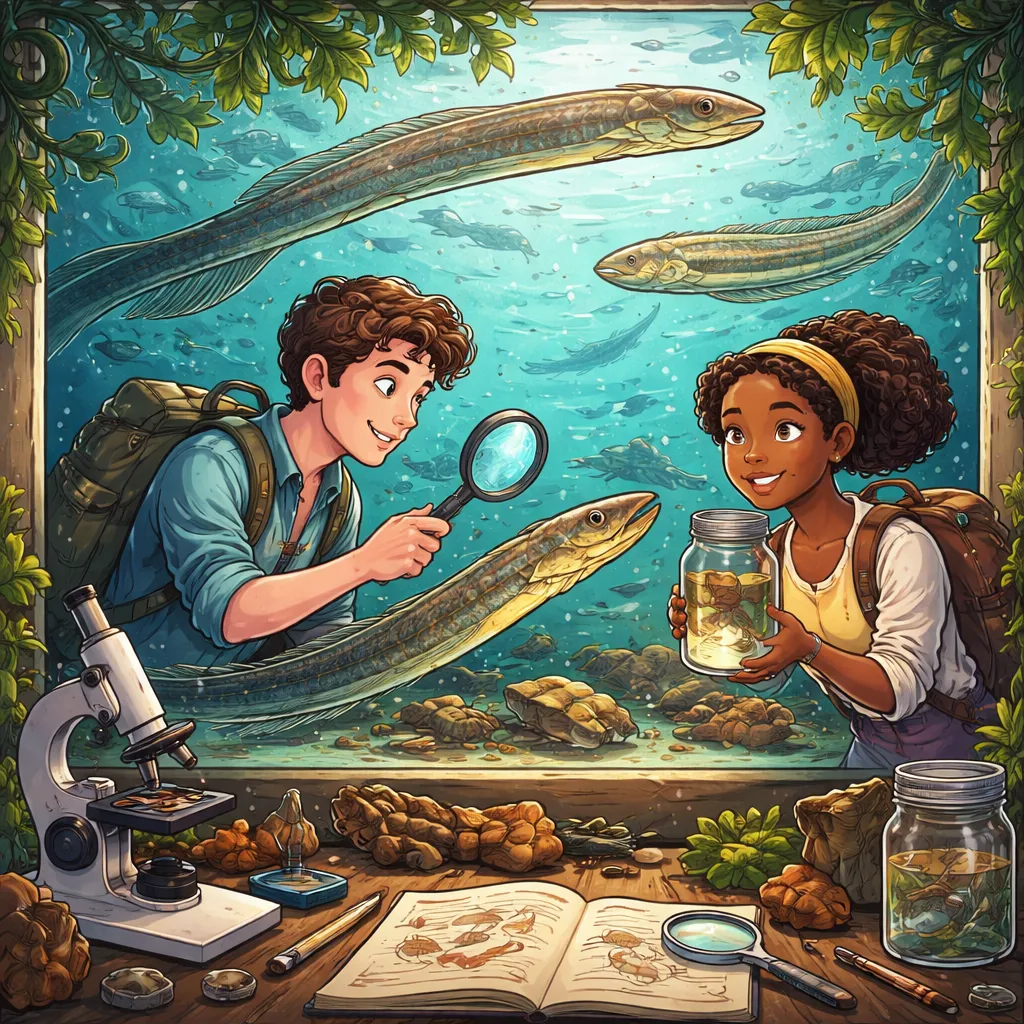

Some animals have changed little over millions of years. The lamprey is one of them. It swims in oceans and rivers much as its ancestors did before dinosaurs walked the earth. For children, learning about Lamprey opens a window to ancient life and the history of our planet. Parents and children can explore this primitive creature together. No time machine is needed. Just curiosity about one of the oldest living fish on Earth.
The lamprey looks different from most fish we know. Its body is long and smooth. Its mouth is round and filled with teeth. Let us begin our journey into the world of this ancient survivor.
What Is This Animal?
A lamprey is a jawless fish with a long, eel-like body. Its skin is smooth and scaleless. Its most striking feature is its mouth. The mouth is a round disc lined with rows of sharp teeth. Inside the mouth sits a rasping tongue. Lampreys use this mouth to attach to other fish and feed.
Lampreys live in oceans and freshwater rivers around the world. Some species spend their lives entirely in fresh water. Others hatch in rivers, migrate to the sea, and return to fresh water to reproduce. Their life cycle has remained unchanged for hundreds of millions of years.
Children often find lampreys strange and fascinating. Their ancient appearance sparks questions about how life evolved. Learning about Lamprey becomes a lesson in Earth’s deep history and the diversity of fish.
English Learning About This Animal
Let us begin with the word “lamprey.” It is pronounced /ˈlæmpriː/. Say it with your child: lam-pree. Two syllables. The first part rhymes with “ham.” The second part rhymes with “tree.” The word comes from Latin roots meaning “stone licker.” This name refers to how lampreys attach to rocks and other surfaces.
When learning about Lamprey in English, we meet words about ancient features. Here are a few to share.
Jawless – without a hinged jaw.
Parasite – an animal that lives on or inside another animal and feeds from it.
Ammocoete – the larval stage of a lamprey.
Suction – the force that pulls something into a space.
Use these words in simple sentences. “Lampreys are jawless fish.” “The young lamprey is called an ammocoete.” These sentences help children understand the fish’s unique biology.
Here is a proverb that connects to the lamprey’s ancient nature. “Old ways are best.” Lampreys have survived for over 360 million years. Their way of life works. This teaches children that sometimes things that have lasted a long time have wisdom worth respecting.
Another meaningful thought comes from naturalist Charles Darwin. He wrote, “It is not the strongest of the species that survives, nor the most intelligent, but the one most responsive to change.” Lampreys have changed little, yet they adapted to fill a specific role in nature. This reminds children that finding your place matters more than being the strongest.
Animal Facts and Science Knowledge
Lampreys belong to the class Petromyzontida. They are among the most primitive living vertebrates. Vertebrates are animals with backbones. Lampreys have a backbone made of cartilage, not bone. They lack true jaws and paired fins. Their skeleton is simple compared to most modern fish.
There are about 40 species of lamprey. Some are parasitic. Some are not. Parasitic lampreys feed on the blood and body fluids of other fish. They attach with their sucker-like mouth. Their rasping tongue creates a wound. They feed for weeks or months before detaching. Non-parasitic lampreys do not feed as adults. They live only to reproduce and then die.
Lampreys begin life as ammocoetes. These larvae live buried in river mud. They filter tiny food particles from the water. This stage lasts several years. Then the lamprey undergoes metamorphosis. It transforms into an adult. In parasitic species, the adult develops teeth and the rasping tongue.
Lampreys are anadromous in many species. They travel from the ocean to freshwater rivers to spawn. They build nests in gravel. Both males and females work to move stones with their mouths. They attach to rocks and pull. After spawning, most lampreys die. This life cycle mirrors that of salmon.
Lampreys have no scales. Their skin has a layer of mucus that protects them. They have seven gill openings on each side of their head. These openings look like small circles. They give lampreys a distinctive appearance.
How to Interact With This Animal Safely
Lampreys are wild animals. They are not dangerous to humans in most cases. They do not seek out people to attach to. However, their mouths are designed for suction and rasping. If a lamprey attaches to skin, it can cause a wound. Do not handle lampreys with bare hands.
If you see lampreys in a river or stream, observe from a distance. Do not try to catch them. Do not touch them. Their slime coat protects them. Handling can remove this coat and harm the fish.
In some regions, lampreys are considered invasive species. The sea lamprey entered the Great Lakes of North America and caused damage to native fish populations. Scientists work to control their numbers. If you live in an affected area, follow local guidelines about lamprey management.
Lampreys are not suitable pets. They require specialized habitats and feeding. Their parasitic nature makes them difficult to keep. Most families should enjoy lampreys through observation in nature or at public aquariums.
Teach children that all animals, even ancient ones, deserve respect. Lampreys have survived for millions of years. They play a role in their ecosystems. Observing them without disturbing them is the best way to appreciate them.
What Can We Learn From This Animal
Lampreys teach us about resilience. They have survived ice ages, asteroid impacts, and countless changes to Earth. Their basic design worked then and works now. Children can learn that simplicity can be a strength. You do not need to be complicated to endure.
Lampreys also show us the value of adaptation. Their larvae live in mud and filter food. Adults swim freely and some become predators. This two-stage life allows them to use different resources at different times. Children can learn that changing with the seasons of life is natural.
Another lesson is about finding your niche. Lampreys fill a specific role. They clean injured fish by feeding on dead tissue. Their presence helps maintain balance. This teaches children that everyone has a role. Small actions contribute to the whole.
Lampreys also remind us of deep time. They swam in oceans before trees grew on land. Thinking about this vast history helps children understand that our world has changed greatly. We are part of a long story.
Fun Learning Activities
Turn learning about Lamprey into creative exploration. Here are a few simple ideas.
Make a Round Mouth Craft
Draw a lamprey shape on paper. Cut out a separate circle for the mouth. Let your child draw rows of small teeth inside the circle. Attach it to the lamprey’s head. Talk about why the mouth is shaped this way.
Create a Life Cycle Story
Ask your child to imagine being a tiny lamprey larva buried in mud. Then one day, you change into an adult. What happens next? Write or draw the journey together. Use new words like ammocoete, metamorphosis, and parasite.
Play the Attachment Game
Take turns being a lamprey and a fish. The lamprey gently places a hand on the fish’s arm. The fish pretends to swim away slowly. This movement game builds understanding through play. Explain that real lampreys attach firmly and do not harm humans.
Build a Timeline
Draw a long line on paper. Mark 360 million years ago at one end. Mark today at the other. Place the lamprey near the ancient end. Add dinosaurs, mammals, and humans. Talk about how long lampreys have been on Earth.
Watch and Wonder
Find a short video of lampreys spawning or swimming. Watch together. Pause and ask open questions. “What do you notice about how they move?” “Why do you think they have no scales?” Let your child share observations freely.
Learning about Lamprey takes us back to the earliest days of vertebrate life. It is a journey through deep time. This ancient fish carries the memory of oceans long gone. As parents and children explore together, they build language, knowledge, and a shared appreciation for Earth’s oldest creatures. The lamprey swims in dark water, its round mouth searching for stones to move, for nests to build. And in that ancient motion, young learners discover something humbling—that life has been swimming, adapting, and surviving for far longer than we can imagine, and every creature has a story written in the oldest rocks.