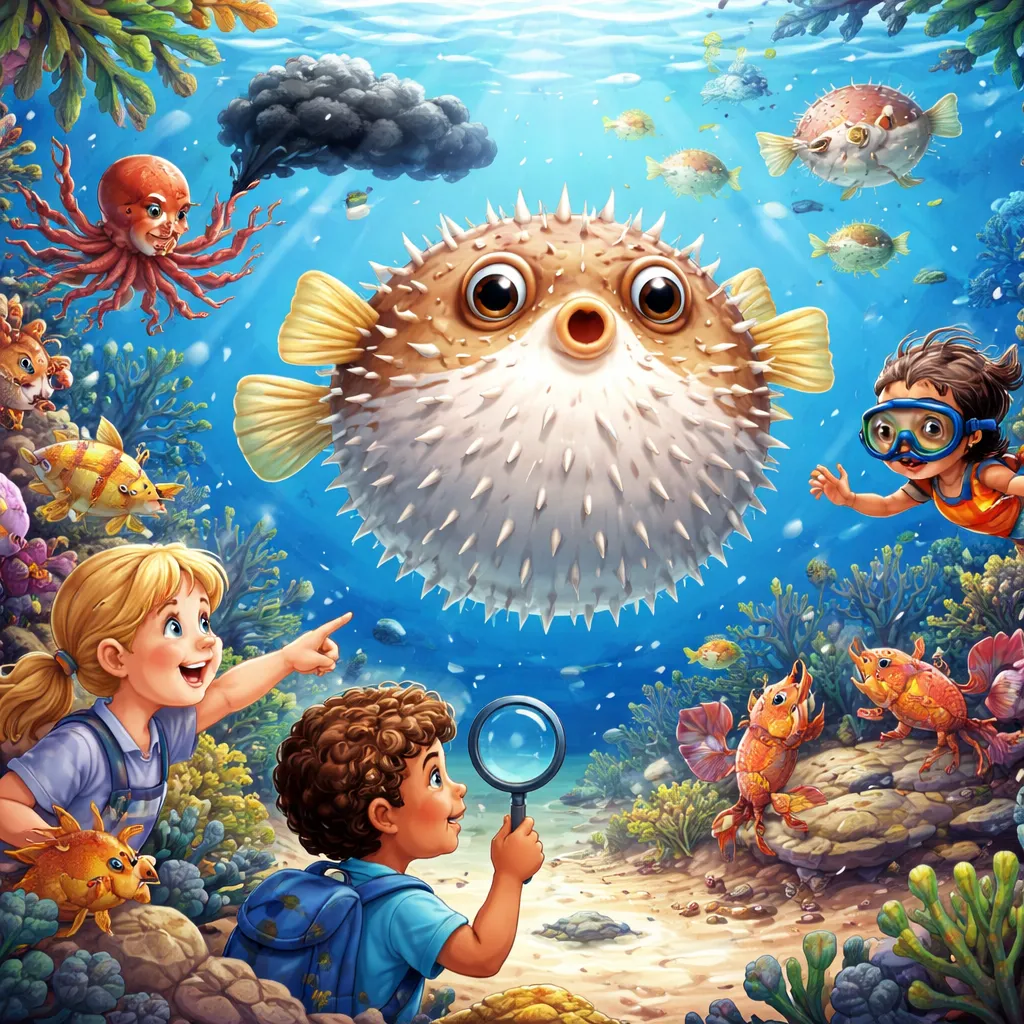

Some fish swim fast to escape danger. Others hide in rocks. The pufferfish does something extraordinary. It transforms. In an instant, it becomes a spiny, round ball that predators cannot swallow. For children, learning about Pufferfish opens a world of clever survival tricks and remarkable adaptations. Parents and children can explore this unusual fish together. No ocean travel is needed. Just curiosity about one of nature’s most creative creatures.
The pufferfish looks ordinary most of the time. But when threatened, it shows its true power. Let us begin our discovery.
What Is This Animal?
A pufferfish is a fish with a stretchy body and the ability to inflate. Its skin often has small spines. When relaxed, it swims slowly like any other fish. When frightened, it swallows water rapidly. Its body swells into a round shape. Spines stick out. Predators find it hard to bite and impossible to swallow.
Pufferfish live in warm ocean waters around the world. Some species live in brackish water or freshwater. They stay near coral reefs, seagrass beds, and sandy bottoms. Their slow swimming style makes them easy targets. Their inflation defense makes them dangerous prey.
Children often find pufferfish delightful. The way they puff up seems almost magical. Learning about Pufferfish becomes a study of how animals protect themselves without running away.
English Learning About This Animal
Let us begin with the word “pufferfish.” It is pronounced /ˈpʌfərˌfɪʃ/. Break it into two parts: puff-er-fish. The first part rhymes with “stuff.” Say it slowly: puff. Then add -er. Then fish. Pufferfish. The name describes exactly what it does. It puffs.
When learning about Pufferfish in English, we meet words about protection and change. Here are a few to share.
Inflate – to fill with air or water to become larger.
Toxin – a poisonous substance.
Spine – a sharp, pointed part of an animal’s body.
Defense – something that protects against attack.
Use these words in simple sentences. “The pufferfish inflates to scare predators.” “Its toxin keeps it safe.” These sentences help children understand how the fish survives.
Here is a proverb that fits the pufferfish. “Appearances can be deceiving.” A small, slow fish may seem helpless. But it holds powerful defenses. This teaches children that people and animals are not always what they seem at first glance.
Another meaningful thought comes from author Terry Pratchett. He wrote, “It is better to be a live coward than a dead hero.” Pufferfish do not fight. They do not run. They use a clever trick to survive. This reminds children that wisdom and cleverness are forms of strength.
Animal Facts and Science Knowledge
Pufferfish belong to the family Tetraodontidae. The name means “four teeth.” Their teeth are fused into beak-like plates. These plates help them crush hard shells. There are over 120 species of pufferfish. Most live in tropical and subtropical oceans.
Pufferfish contain a powerful toxin called tetrodotoxin. This poison is found in their skin, organs, and sometimes spines. One pufferfish carries enough toxin to kill many adult humans. Most predators learn to avoid pufferfish after one bad experience. The toxin does not harm the pufferfish itself.
When threatened, pufferfish gulp water into their stomachs. Their bodies stretch to several times their normal size. Spines that usually lie flat stand up. This transformation happens in seconds. It startles predators and makes the pufferfish nearly impossible to swallow.
Pufferfish are omnivores. They eat algae, small crustaceans, mollusks, and coral. Their strong beaks crack open clams and snails. They use their front teeth to scrape food from rocks.
Most pufferfish are solitary. They move slowly and deliberately. They do not form schools. Their lifestyle is quiet and independent. At night, some species bury themselves in sand to rest.
Pufferfish are also known for their art. Male pufferfish create elaborate circular patterns on the seafloor to attract mates. These geometric designs are among the most complex structures made by any fish.
How to Interact With This Animal Safely
Pufferfish are wild animals. They are not aggressive. They do not seek out humans. But their toxin is deadly. Never touch a pufferfish in the wild. Never try to pick one up. Even dead pufferfish can carry toxin on their skin.
If you see a pufferfish while snorkeling or diving, keep a respectful distance. Do not try to scare it into inflating. Forcing inflation causes stress. It uses energy the fish needs for survival. Observe quietly. Let the fish stay relaxed.
In some parts of the world, people eat pufferfish as a delicacy called fugu. Only specially trained and licensed chefs can prepare it. They remove the toxic parts with extreme care. This is not something to try at home. Explain to children that some foods are only safe when prepared by experts.
If your family visits an aquarium, you may see pufferfish in tanks. Follow the rules. Do not tap the glass. Do not put hands in the water. Watch and learn. Aquarium staff care for these fish with great knowledge and caution.
What Can We Learn From This Animal
Pufferfish teach us that strength comes in many forms. They are not fast. They are not strong swimmers. But they have a unique defense that works. Children can learn that being different can be powerful. You do not have to be like everyone else to be safe and strong.
Pufferfish also show us the value of setting boundaries. When something threatens them, they puff up. They make themselves bigger. They say, “Stay back.” Children can learn that it is okay to set boundaries. Speaking up when something feels wrong is a form of protection.
Another lesson is preparation. Pufferfish carry their defense with them at all times. They do not have to run and find a weapon. They are always ready. This teaches children that being prepared matters. Learning skills, knowing facts, and staying aware help in difficult moments.
Pufferfish also teach us not to judge by appearance. A slow, small fish can be one of the most protected creatures in the ocean. People and situations are often deeper than they first appear.
Fun Learning Activities
Turn learning about Pufferfish into playful discovery. Here are a few simple ideas.
Make an Inflatable Pufferfish
Cut a fish shape from paper. Fold it in half. Glue the edges except for a small opening. Let your child decorate it with spots and spines. Gently blow into the opening to make it puff. Talk about how pufferfish fill with water, not air.
Create a Defense Story
Ask your child to imagine being a small fish in the ocean. A big predator approaches. What do you do? Write or draw a story about using cleverness to stay safe. Use new words like inflate, toxin, and defense.
Play the Pufferfish Game
Take turns pretending to be a predator and a pufferfish. When the predator approaches, the pufferfish puffs up by spreading arms wide. The predator pretends to be surprised and swims away. This movement game builds understanding through play.
Design a Warning Sign
Ask your child to draw a sign that warns others about pufferfish. What picture would show danger? What words would you use? This activity connects art with safety awareness.
Watch and Wonder
Find a short video of a pufferfish inflating or creating a sand circle. Watch together. Pause and ask open questions. “What do you notice about how it changes shape?” “Why do you think it makes patterns in the sand?” Let your child share observations freely.
Learning about Pufferfish takes us into a world where cleverness matters more than speed. This small fish carries a powerful secret. It inflates. It warns. It survives. As parents and children explore together, they build language, knowledge, and a shared appreciation for nature’s creative solutions. The pufferfish drifts slowly through warm water, quiet and unassuming. But in that round, spiny form, young learners discover something valuable—that true strength often hides in plain sight, waiting for the moment it is needed most.