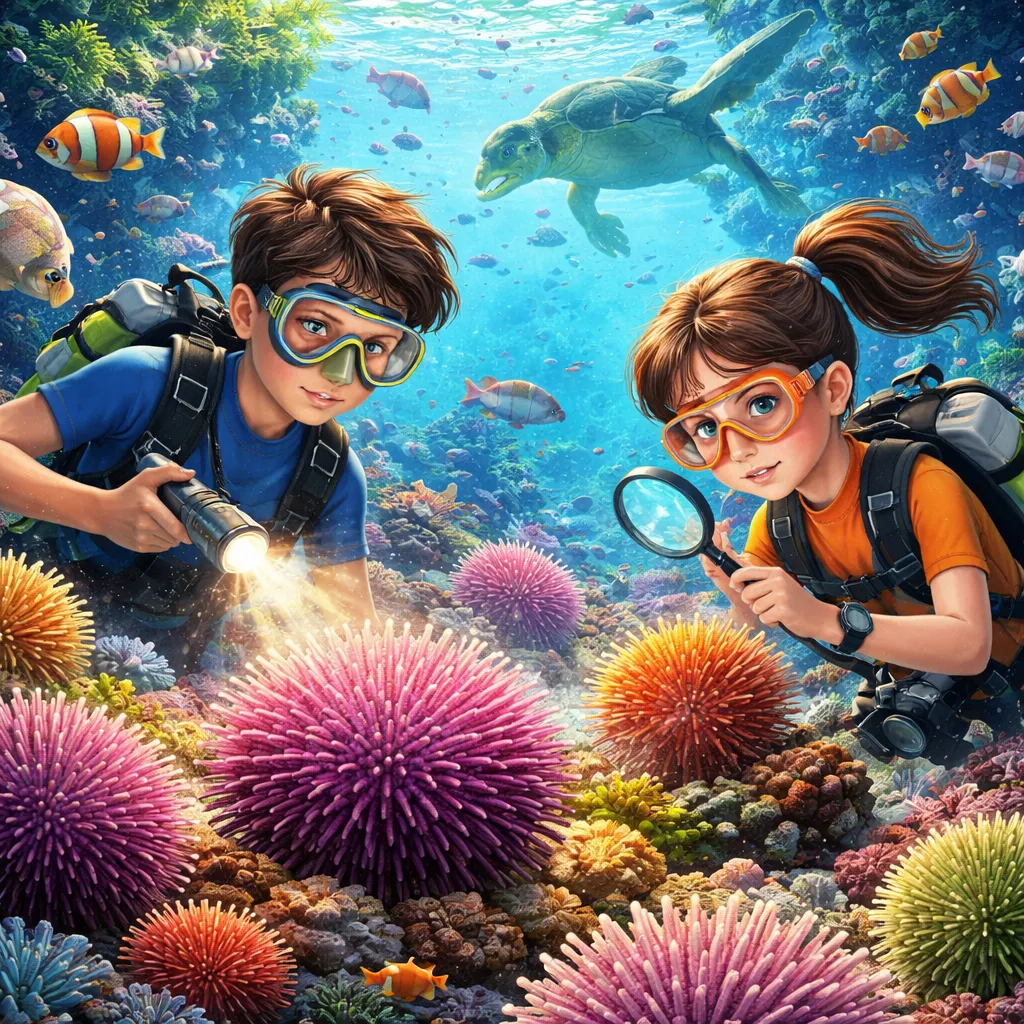

Some animals move fast. Others hide in shells. The sea urchin does something different. It moves slowly on tiny tube feet. It wears a suit of spines. For children, learning about Sea Urchin opens a door to the hidden world of spiny creatures that live just below the ocean’s surface. Parents and children can explore this remarkable animal together. No diving gear is needed. Just curiosity about a creature that looks like a living pincushion.
The sea urchin is not a plant. It is an animal. It belongs to a group of creatures that have lived in the oceans for hundreds of millions of years. Let us begin our discovery.
What Is This Animal?
A sea urchin is a round, spiny animal that lives on the ocean floor. Its body is a hard shell called a test. The test is covered in long, movable spines. These spines protect the urchin from predators. Some spines are sharp. Some are blunt. Some contain venom.
Sea urchins live in oceans around the world. They dwell on rocky reefs, seagrass beds, and sandy bottoms. They cling to rocks using tube feet. These tiny, sticky feet extend between the spines. They help the urchin move and hold on in strong currents.
Children often find sea urchins fascinating because of their spiny appearance and slow movement. Learning about Sea Urchin becomes an exploration of how animals without bones or shells protect themselves and thrive.
English Learning About This Animal
Let us begin with the name “sea urchin.” It is pronounced /siː ˈɜːrtʃɪn/. Say it with your child: sea ur-chin. Two words. Three syllables. The word “urchin” once meant “hedgehog.” People named this animal after the hedgehog because both have spines. The sea urchin is sometimes called the “hedgehog of the sea.”
When learning about Sea Urchin in English, we meet words about structure and movement. Here are a few to share.
Spine – a sharp, pointed structure used for protection.
Tube foot – a small, flexible appendage used for movement and attachment.
Test – the hard, round shell of a sea urchin.
Aristotle’s lantern – the complex jaw structure inside a sea urchin.
Use these words in simple sentences. “Sea urchins use their spines for protection.” “Tube feet help them move slowly across rocks.” These sentences help children understand the animal’s body and abilities.
Here is a proverb that fits the sea urchin. “Slow and steady wins the race.” Sea urchins move very slowly. But they have survived for millions of years. This teaches children that speed is not the only path to success. Patience and consistency matter.
Another meaningful thought comes from naturalist Jacques Cousteau. He said, “The sea, once it casts its spell, holds one in its net of wonder forever.” The sea urchin is part of that spell. Its strange beauty invites children to look closer at the ocean’s smallest creatures.
Animal Facts and Science Knowledge
Sea urchins belong to the phylum Echinodermata. This group includes starfish, sand dollars, and sea cucumbers. The name means “spiny skin.” There are over 900 species of sea urchins. They live in all oceans, from shallow tide pools to deep seafloor.
The sea urchin’s body is spherical. It has five-part symmetry. This means its body divides into five equal sections. Look closely at a sea urchin test. You will see a five-pointed star pattern. This symmetry is common among echinoderms.
Inside the test lives the sea urchin’s mouth. It faces downward toward the ocean floor. The mouth contains a complex jaw called Aristotle’s lantern. This structure has five teeth that work together. The urchin uses these teeth to scrape algae off rocks. It can also chew through hard surfaces.
Sea urchins are herbivores in most species. They eat algae and seaweed. Some species eat slow-moving animals like sponges. Their grazing keeps algae from overgrowing coral reefs. Healthy sea urchin populations help maintain balanced ecosystems.
Sea urchins reproduce by releasing eggs and sperm into the water. Females can release millions of eggs at once. Larvae drift in the ocean currents. They grow and transform into tiny urchins. These young urchins settle on the seafloor and grow into adults.
Some sea urchins have venomous spines. The flower urchin carries toxin that can cause pain. Most species are harmless to touch but still sharp. Their spines can break off in skin if stepped on.
How to Interact With This Animal Safely
Sea urchins are wild animals. They are not aggressive. But their spines can cause injury. If you visit rocky shores or tide pools, watch where you step. Sea urchins often hide in crevices and under rocks. Stepping on one can push spines into the skin.
If your family explores tide pools, wear water shoes or sandals. Look before you place your hands or feet. Do not pick up sea urchins. Their spines are sharp. Some break off easily. Removing broken spines from skin requires medical attention.
Never throw rocks or disturb sea urchins. They are living creatures. Their spines protect them. Respect their space. Observe them where they are. If you want a closer look, watch from above the water. Do not remove sea urchins from their habitat.
In some places, people collect empty sea urchin tests after the animal has died. These white, hollow shells are beautiful. They show the five-part symmetry clearly. Only collect empty tests. Never take a living sea urchin from the ocean.
In public aquariums, you may see sea urchins in touch tanks. Follow the staff’s guidance. Some aquariums allow gentle touching with one finger. Touch only the spines, never the tube feet. Always wash hands before and after.
What Can We Learn From This Animal
Sea urchins teach us about protection. They carry their defenses with them. Their spines surround them completely. Children can learn that having boundaries is important. Protecting yourself does not mean being aggressive. It means being prepared.
Sea urchins also show us the value of teamwork. Their tube feet work together. Hundreds of tiny feet move in coordination. This allows the urchin to climb, hold, and move. Children can learn that working together accomplishes what one alone cannot.
Another lesson is balance. Sea urchins graze on algae. They keep reefs healthy. Without them, algae can smother coral. This teaches children that every creature has a role. Small actions contribute to the health of the whole community.
Sea urchins teach us about slow persistence. They move only inches per day. Yet they survive storms, currents, and predators. Children can learn that progress does not need to be fast. Steady effort over time leads to success.
Fun Learning Activities
Turn learning about Sea Urchin into hands-on exploration. Here are a few simple ideas.
Make a Spine Craft
Draw a circle on paper. Let your child glue short toothpicks or pieces of spaghetti around the circle to represent spines. Talk about why spines protect the sea urchin.
Create a Tube Foot Game
Give your child a pair of tweezers. Place small objects on a tray. Ask them to pick up the objects using the tweezers. Explain that tube feet work like tiny gripping tools.
Write a Slow Journey Story
Ask your child to imagine being a sea urchin moving across a rock. What do you see? What do you eat? How do you stay safe? Write or draw the story together. Use new words like test, tube foot, and Aristotle’s lantern.
Play the Hold Fast Game
Place a smooth surface like a cookie sheet on the floor. Ask your child to try to hold onto it with their hands. Explain that tube feet help sea urchins hold onto rocks in waves. This movement game builds understanding through play.
Watch and Wonder
Find a short video of a sea urchin moving or feeding. Watch together. Pause and ask open questions. “What do you notice about how it moves?” “Why do you think it has so many spines?” Let your child share observations freely.
Learning about Sea Urchin takes us to the rocky ocean floor. It is a world of slow movement and hidden life. This spiny creature has no eyes, no brain like ours, no fast escape. Yet it thrives. It cleans reefs. It protects itself with spines and tube feet. As parents and children explore together, they build language, knowledge, and a shared appreciation for the small creatures that keep the ocean healthy. The sea urchin clings to a rock, spines swaying in the current. And in that slow, steady grip, young learners discover something true—that even the smallest, slowest animals have their place, and protection comes in many forms.