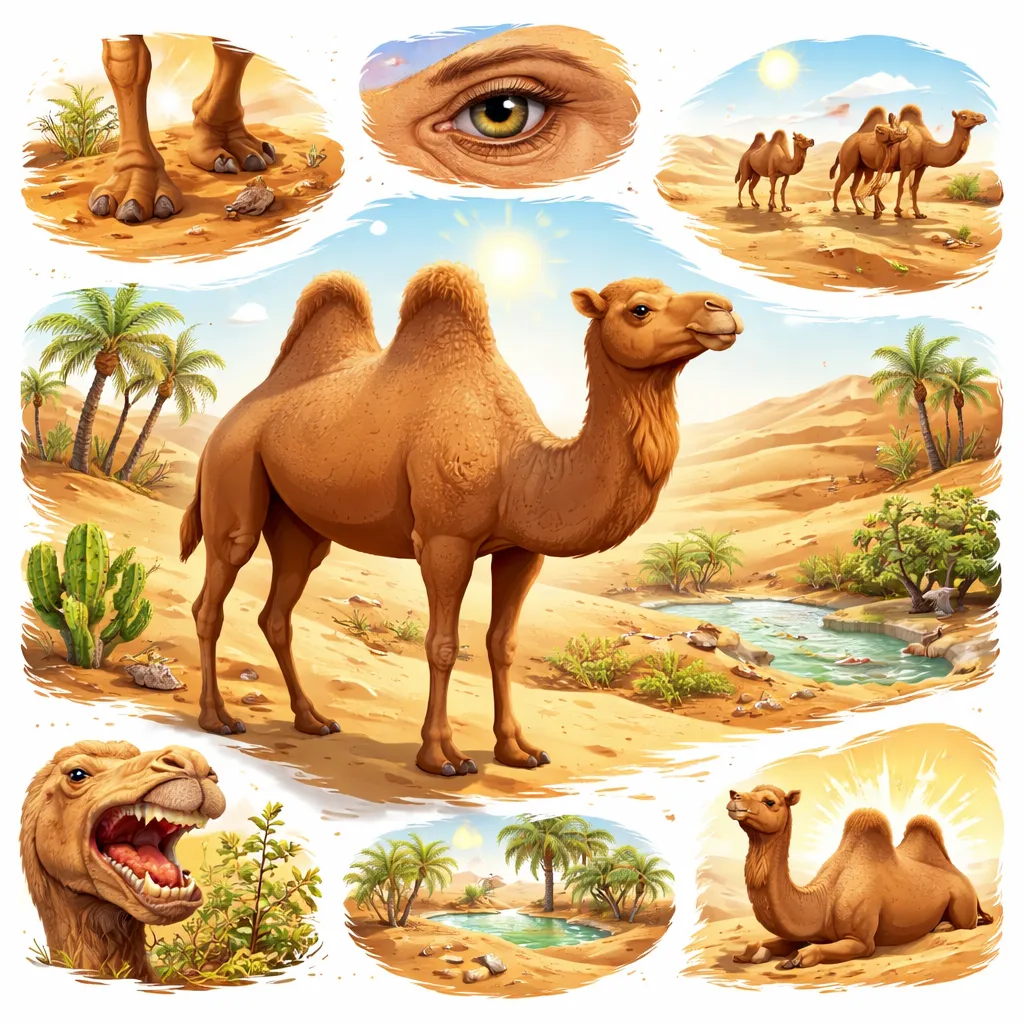

Have you ever seen a camel in a picture, at the zoo, or in a movie about deserts? With its long legs, funny split-toe feet, and one or two humps on its back, the camel is a famous desert traveler. Learning about camels takes us on a journey across sandy dunes and dry lands. Let’s saddle up our curiosity and begin learning about camel survival and strength!
English Language Learning
Vocabulary and Spelling
Our desert champion is called a camel.
The word "camel" is a noun. A noun names a person, place, or thing. So, a camel is a thing—a strong, living animal.
Spelling "camel" is straightforward: C-A-M-E-L. The 'C' starts the word, like a camel starting a journey. The 'A' and 'M' are in the middle, and it ends with 'E-L'. C-A-M-E-L spells camel.
Sound and Pronunciation
Let’s say the word correctly. It sounds like this: /ˈkæm.əl/.
We can say it in two clear parts. First, say "kam". It rhymes with "ham" or "jam". Next, say "ul". It’s a soft sound, like the end of "tunnel".
Now, put it together! "Kam" "ul". Camel! Great job!
The word "camel" has two beats, or two syllables. Clap your hands twice: Cam-el. It’s a steady, marching kind of word.
Related Words
Learning about camels is more fun with new words! Here are some important ones.
Body Parts: The famous mound on a camel’s back is called a hump. A camel’s long, curved neck helps it reach high and low. Its feet have soft, wide pads to walk on sand.
Group: A group of camels traveling together is called a caravan.
Action: Camels love to chew their food. They are ruminants, which means they chew cud.
A Famous Saying
There is a wise old saying: "The straw that broke the camel’s back."
This means a small thing that causes a big problem after many other small problems. It’s like adding one last straw to a heavy load. It teaches us that even small things can add up, so we should be mindful and helpful.
Say the saying with me: "The straw that broke the camel’s back." It’s a reminder to be kind and not overburden others.
Now you know the word "camel"! Are you ready to trek into some amazing desert facts? Let’s journey from words to wonderful knowledge!
Animal Knowledge
Who Are They? – Family and Group
What kind of animal is a camel? Camels are mammals. They have hair, are warm-blooded, and mother camels feed their babies milk.
They are part of the camelid family. Their cousins are llamas, alpacas, guanacos, and vicuñas. There are two main types: the Dromedary (one hump) and the Bactrian (two humps).
What Do They Look Like? – Amazing Bodies
Camels are large animals, about as tall as a basketball hoop! They have long legs, a long curved neck, and a hump (or two) on their back. Their fur can be brown, beige, or gray.
Their most famous feature is their hump. A common myth is that it stores water. It actually stores fat! The body uses this fat for energy when food is scarce. This lets the camel go for a long time without eating.
Camels have special adaptations for desert life. They have two rows of long eyelashes and can close their nostrils to keep out sand. Their thick lips are tough enough to eat prickly plants. Their wide, padded feet stop them from sinking in the sand.
Where Do They Live and How? – Home and Habits
Dromedary camels live in hot deserts, like the Sahara in Africa and the Middle East. Bactrian camels live in cold deserts, like the Gobi in Asia. They are built for extreme places.
Camels are herbivores. This means they only eat plants. They eat grass, grains, and thorny desert plants. They are ruminants, so they chew, swallow, and then bring the food back up to chew again (chewing cud).
Camels are social and live in herds. They are most active during the day. They are famous for carrying heavy loads and people for long distances across deserts. A group of camels is called a caravan or a flock.
A Camel’s Life Story – Growing Up
A baby camel is called a calf. Camels are mammals, so calves are born live from their mother. A mother camel usually has one calf at a time.
The mother camel takes great care of her calf. The calf can stand and walk very soon after birth. The mother feeds it milk for about a year. The calf stays with its mother for several years.
Calves are born without a hump. The hump grows as the calf starts to eat solid food and store fat. A camel becomes an adult at about five years old and can live for 40 to 50 years.
How Do They "Talk"? – Communication
Camels are not very loud, but they do communicate. They make groans, moans, and bellows. A mother camel hums to her calf.
They use body language a lot. They may nudge each other with their heads. A camel may spit when it is annoyed or feels threatened—this is a mix of stomach contents and saliva!
Their best senses are their eyesight and sense of smell. They have excellent eyes to see far across the flat desert. Their strong sense of smell helps them find water and food.
Are They Okay? – Taking Care of Them
Wild Bactrian camels are critically endangered. This means there are very few left. Dromedary camels are mostly domesticated and not endangered, but their wild cousins are gone.
The main threats to wild camels are hunting, loss of their desert homes, and competition with farm animals for food and water. Droughts also make life very hard.
You can be a camel friend! You can learn and tell others about wild camels. You can support groups that protect desert habitats. Saving water at home is a great way to help, as it teaches us to value this precious resource, just like camels do.
Life Connections and Inspiration
How to Be With Them – Safety and Love
Camels are large, powerful animals. We must treat them with respect and caution, whether they are wild or domesticated.
For domesticated camels: Always listen to the handler. Move slowly and calmly. Do not shout or make sudden moves. Pet them gently if allowed, but avoid their head and legs. Never stand directly behind a camel.
For wild camels: Observe from a very long distance. Never try to approach or feed them. We admire them through binoculars or in documentaries.
We show our love by respecting their strength and supporting the protection of the wild spaces they call home.
Super Qualities We Learn from Them
Camels teach us wonderful things. One super quality is endurance and preparation. Camels can travel long distances in harsh conditions because they are prepared—they store energy in their humps. This teaches us to be prepared, to endure challenges, and to keep going even when things are tough.
Another quality is adaptability and resilience. Camels thrive in places where few animals can. They adapt to heat, cold, and lack of food and water. They remind us to be resilient, to adapt to changes, and to make the best of our situation.
Think about it: How can you be prepared for a long day or a big task? How can you be resilient and adapt when things don’t go as planned?
Take Action! – Your "Desert Caravan" Project
Let’s do a fun activity! Your project is to create a desert diorama with a camel caravan.
Find a shoebox. Use yellow paper or sand to create a desert floor. Make tiny paper pyramids or dunes. Draw, color, and cut out several camels. Tape them to craft sticks and place them in a line to form a caravan. You can add a small sun and a paper water oasis. Tell a story about where your caravan is going. What are the camels carrying? How do they survive the hot day? This shows their amazing journey.
Closing
Learning about camel journeys is a fantastic adventure! We learned the word "camel" and how to say its two-part name. We discovered amazing facts about their energy-storing humps, their desert adaptations, and their life in caravans. We know that camels are enduring, resilient animals who need our help to protect their wild cousins. You can use your new words to share stories about these ships of the desert. You can use your knowledge to appreciate how animals adapt to extreme environments. The animal world is full of tough and prepared travelers. Always remember to respect all animals, be prepared for your own adventures, and adapt to life’s changes with resilience. Keep exploring with curiosity, endure through challenges, and be a friend to our planet. Your thoughtful actions and strong spirit make you a champion, just like the camel.