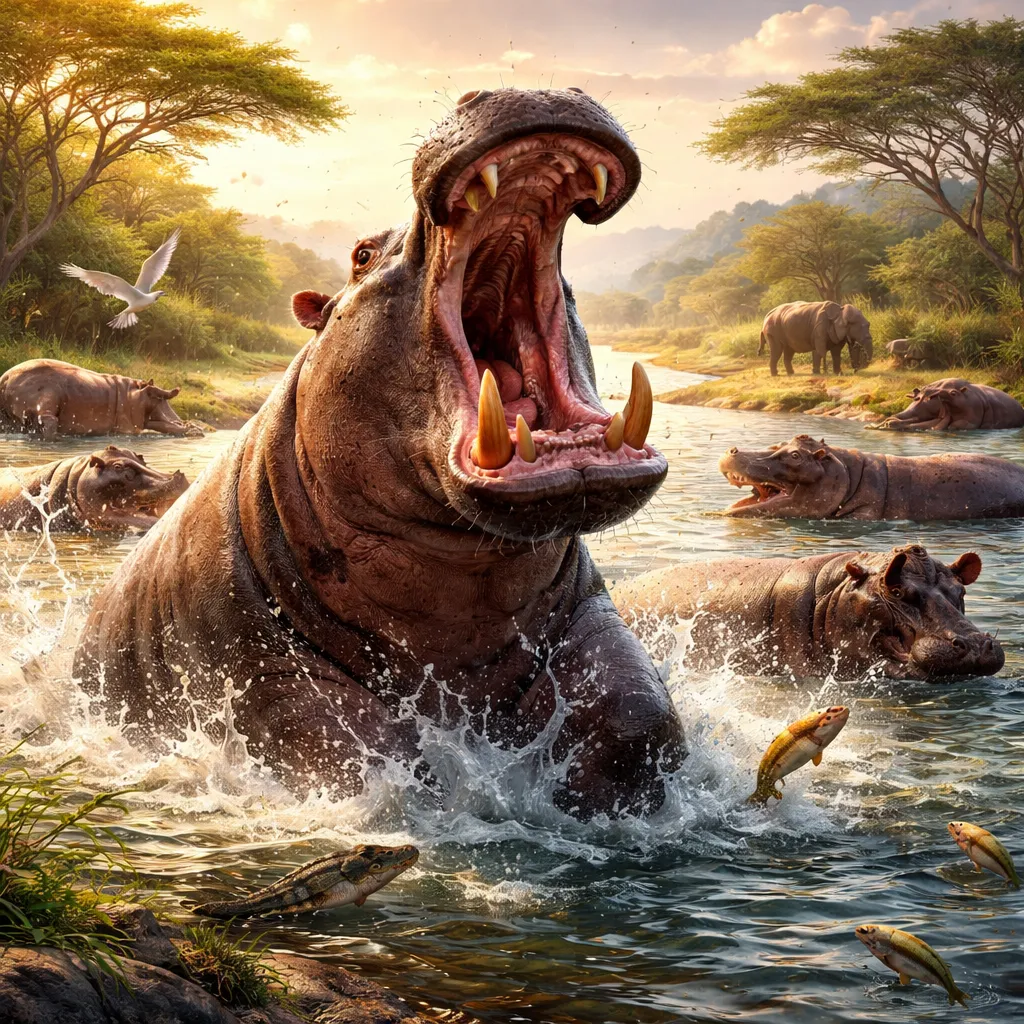

Have you ever seen a hippopotamus at the zoo, resting in the water with just its eyes, ears, and nose showing? Hippos are huge, round animals that spend most of their time in rivers and lakes. They might look slow and sleepy, but they are very strong and fast. Learning about hippos is a wet and wild adventure that takes us to the rivers of Africa. Let’s dive in and start learning about hippo power and secrets!
English Language Learning
Vocabulary and Spelling
Our river giant is called a hippopotamus, but we usually say hippo for short.
The word "hippo" is a noun. A noun names a person, place, or thing. So, a hippo is a thing—a very large, living animal.
The full name is fun to spell: H-I-P-P-O-P-O-T-A-M-U-S. It’s a long word! The short name is easier: H-I-P-P-O. H-I-P-P-O spells hippo.
Sound and Pronunciation
Let’s say the short name correctly. It sounds like this: /ˈhɪp.oʊ/.
We can say it in two clear parts. First, say "hip". It rhymes with "lip" or "ship". Next, say "oh". It’s the sound you make when you understand something, "oh!"
Now, put it together! "Hip" "oh". Hippo! Great!
The word "hippo" has two beats, or two syllables. Clap your hands twice: Hip-po. It’s a fun, bouncy word.
Related Words
Learning about hippos is more fun with new words! Here are some important ones.
Group: A group of hippos is called a bloat or a pod.
Baby: A baby hippo is called a calf.
Action: Hippos love to wallow in water and mud to stay cool and protect their skin.
A Famous Saying
While there isn’t a famous old saying, there is a fun fact phrase: "Hippos are river horses."
The name "hippopotamus" actually comes from ancient Greek words meaning "river horse"! This reminds us that hippos spend most of their life in the water, just like horses are known for land.
Say the phrase with me: "Hippos are river horses." It’s a cool way to remember where they live!
Now you know the word "hippo"! Are you ready to splash into some amazing facts? Let’s swim from words to wonderful knowledge!
Animal Knowledge
Who Are They? – Family and Group
What kind of animal is a hippo? Hippos are mammals. They have skin, are warm-blooded, and mother hippos feed their babies milk.
They are part of their own special family. Their closest living relatives are actually whales and dolphins! Isn’t that surprising? This shows they are very adapted to water.
What Do They Look Like? – Amazing Bodies
Hippos are enormous! They are the third-largest land mammal, after elephants and rhinos. They have a huge, round body, short legs, and a massive head. Their skin is hairless and grayish-purple.
Their most famous features are their huge mouths and teeth. A hippo’s mouth can open incredibly wide, showing long, sharp teeth called tusks. Their eyes, ears, and nostrils are on top of their head so they can see, hear, and breathe while mostly underwater.
Hippos have special adaptations for water life. Their skin makes a special oily red substance that acts like sunscreen and bug repellent! It makes them look like they are sweating blood, but it’s not blood at all.
Where Do They Live and How? – Home and Habits
Hippos live in Africa. Their home is in and around rivers, lakes, and swamps. They need water deep enough to submerge in and grassy areas to eat.
Hippos are herbivores. This means they only eat plants. They leave the water at night to walk on land and eat grass, sometimes traveling miles. They can eat up to 80 pounds of grass in one night!
Hippos are very social and live in groups called bloats. A bloat is usually led by one large male. They spend the day resting in the water to stay cool. At night, they come out to graze on land.
A Hippo’s Life Story – Growing Up
A baby hippo is called a calf. Hippos are mammals, so calves are born live from their mother. The mother usually has one calf at a time, often in the water.
The mother hippo is a very protective and caring parent. The calf can swim and sink right after birth. It often rides on its mother’s back in the water to rest and stay safe. The mother feeds it milk for about eight months.
Calves are born weighing about 100 pounds! They grow quickly, eating their mother’s milk and then grass. They stay with their mother for several years. A hippo becomes an adult at about 5 to 7 years old.
How Do They "Talk"? – Communication
Hippos are very vocal in the water! They make loud grunts, roars, and honks. Their calls can be heard from far away.
They use their bodies to talk, too. Opening their huge mouth wide is a threat to scare away other hippos or animals. They also use their tails to spread their poop around to mark their territory.
Their best senses are their hearing and smell. They have good ears and a great sense of smell to find food on land at night. Their eyesight is good in the water.
Are They Okay? – Taking Care of Them
Hippos are vulnerable. This means their numbers are going down, and they need our help.
The main threats are people taking their water for farms, losing their land, and being hunted for their meat and ivory teeth. In some places, they also get caught in fishing nets.
You can be a hippo helper! You can learn and tell others about these amazing animals. You can support groups that protect African rivers and wildlife. Saving water at home helps, because all water is connected. Remember, every drop counts for animals and people.
Life Connections and Inspiration
How to Be With Them – Safety and Love
Hippos are very dangerous wild animals. They are responsible for more human deaths in Africa than any other large animal. We must respect them from a very, very safe distance.
The most important rule is: Look, never approach. We only watch hippos in good zoos with deep water and strong barriers, or in nature documentaries. We never, ever try to get close to a wild hippo, on land or in a boat. They are faster than they look and can be very aggressive.
We show our love by protecting the rivers and lakes they call home. We can be voices for clean water and protected wild spaces in Africa.
Super Qualities We Learn from Them
Hippos teach us surprising lessons. One super quality is quiet power and protection. Hippos spend the day resting calmly in the water, but they are incredibly strong and will fiercely protect their family and home. They teach us that true strength doesn’t always need to be shown, but it’s there to protect what’s important.
Another quality is adaptation to two worlds. Hippos are masters of both water and land. They remind us that we can be good at more than one thing and adapt to different situations in our lives.
Think about it: How can you use your quiet strength to protect or help someone? How can you be adaptable, like being good at both playing a sport and creating art?
Take Action! – Your "Hippo Habitat" Project
Let’s do a fun and creative activity! Your project is to create a diorama of a hippo’s river home.
Find a shoebox. Turn it on its side. Paint the bottom half blue for the river. Use brown paper or clay to make the riverbank. Add green paper grass on the land. Draw and cut out a hippo family—a big one and a small calf. You can make them from clay or paper. Place the hippos in the water, with just their eyes and noses showing! Add some paper reeds and a sun in the sky. Label the water and the land. Tell a story about your hippo’s day and night.
Closing
Learning about hippo mysteries is a thrilling adventure! We learned the word "hippo" and how to say its two-part name. We discovered amazing facts about their huge mouths, their watery life, and their powerful families. We know that hippos are strong, social animals who need clean rivers to survive. You can use your new words to share the true story of these river giants. You can use your knowledge to understand why we must protect wild places and water for all creatures. The animal world is full of powerful and surprising teachers. Always remember to respect wildlife from a safe distance, use your strength wisely, and adapt to the world around you. Keep exploring with curiosity, protect what you love, and be a friend to our planet. Your caring actions and respectful mind make you a true friend to the wonderful hippo.