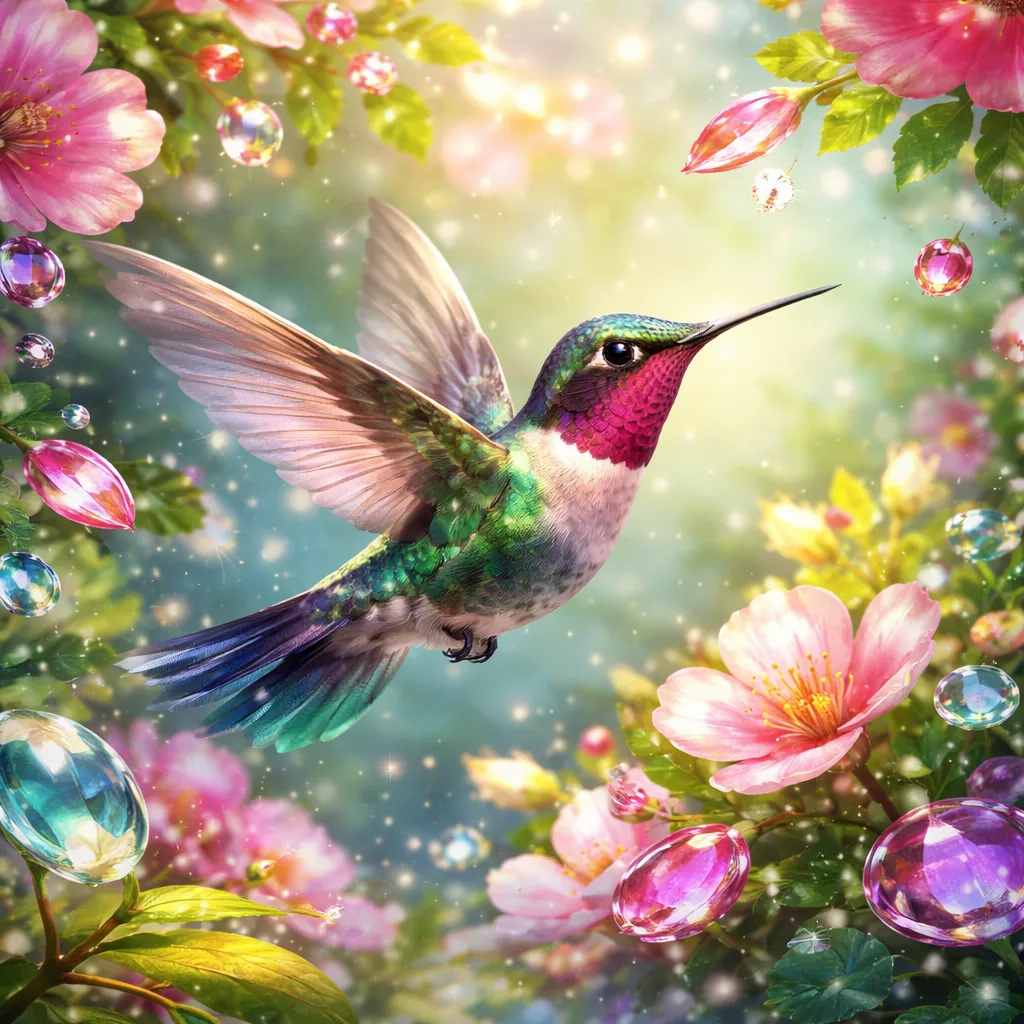

Imagine you’re in a garden, and you see a flash of green and red moving faster than your eyes can follow. It stops in mid-air, drinking from a flower, and you hear a soft buzzing sound. That’s a hummingbird! These tiny, incredible birds are like living helicopters. Learning about hummingbirds is a dazzling adventure that shows us the wonders of speed, color, and flight. Let’s begin our journey of learning about hummingbird magic.
English Language Learning
Vocabulary and Spelling Our tiny, fast friend is called a hummingbird. The word "hummingbird" is a noun. A noun names a person, place, or thing. So, a hummingbird is a thing—a very small, living bird. Spelling "hummingbird" is two words put together: H-U-M-M-I-N-G and B-I-R-D. The first part is "humming", the second is "bird". H-U-M-M-I-N-G-B-I-R-D spells hummingbird.
Sound and Pronunciation Let’s say the word correctly. It sounds like this: /ˈhʌm.ɪŋ.bɝːd/. We can say it in three clear parts. First, say "hum". It rhymes with "gum". Next, say "ming". It rhymes with "sing". Last, say "bird". It rhymes with "heard". Now, put it together! "Hum" "ming" "bird". Hummingbird! Great! The word "hummingbird" has three beats, or three syllables. Clap three times: Hum-ming-bird. It’s a fun, buzzing word.
Related Words Learning about hummingbirds is more fun with new words! Here are some important ones. Action: The way a hummingbird stays in one place in the air is called hovering. Its long, thin mouth is a bill. Food: The sweet liquid in flowers that hummingbirds drink is nectar. They also eat tiny insects. Baby: A baby hummingbird is called a chick.
A Famous Saying People often say: "As busy as a hummingbird." This means someone is very active, fast, and always on the go. It comes from the hummingbird’s non-stop movement as it visits hundreds of flowers each day. It reminds us that being energetic and focused on a task is a great thing. Say the saying with me: "As busy as a hummingbird." Can you be busy in a good way?
Now you know the word "hummingbird"! Are you ready to zoom into some amazing facts? Let’s fly from words to wonderful knowledge!
Animal Knowledge
Who Are They? – Family and Group What kind of animal is a hummingbird? Hummingbirds are birds. They are warm-blooded, have feathers, and lay eggs. They are in their own family, Trochilidae. They are only found in the Americas. There are over 300 different kinds, like the Ruby-throated Hummingbird and the Anna’s Hummingbird. They are the smallest birds in the world.
What Do They Look Like? – Amazing Bodies Hummingbirds are incredibly small. The Bee Hummingbird is as light as a penny! They have shiny, iridescent feathers that look like gems in the sun. Their most famous features are their incredibly fast wings and their long, slender bills. Their wings are their super engines! They can beat 50 to 80 times per second! This lets them hover, fly straight up, down, and even backwards. Their shiny feathers are not colored by pigment but by how light bounces off them, like a soap bubble. Hummingbirds have special adaptations. They have the fastest metabolism of any animal. They must eat almost constantly to fuel their high energy. Their hearts beat over 1,200 times a minute! They have excellent memories and can remember every flower they’ve visited.
Where Do They Live and How? – Home and Habits Hummingbirds live in North, Central, and South America. Their homes are gardens, forests, and meadows with lots of flowers. Some migrate long distances, like from Canada to Mexico. Hummingbirds are nectarivores. This means their main food is nectar from flowers. They also eat tiny insects for protein. They use their long tongues to sip nectar. They visit hundreds of flowers every day. Hummingbirds are mostly solitary and territorial. They are active during the day. They spend their time feeding, chasing other birds away from their favorite flowers, and resting. A group of hummingbirds is called a charm.
A Hummingbird’s Life Story – Growing Up A baby hummingbird is called a chick. Hummingbirds are birds, so chicks hatch from eggs. The mother usually lays two tiny eggs, each the size of a small bean, in a walnut-sized nest. The mother hummingbird does all the work alone. She builds the nest, incubates the eggs, and feeds the chicks. She feeds them a mix of nectar and tiny insects. Chicks are born naked, blind, and very small. They grow quickly. They leave the nest in about three weeks. Their mother teaches them to find food. A young hummingbird is called a fledgling.
How Do They "Talk"? – Communication Hummingbirds are not big singers, but they do make sounds. They chirp, tweet, and some males make buzzing sounds with their tail feathers during dives. Each species has its own sounds. They use dazzling displays to talk. A male will dive and zoom in front of a female to impress her. They are very visual and use their bright colors to send signals. Their best sense is their incredible eyesight. They can see colors we cannot, like ultraviolet light. This helps them find the best flowers. Their hearing is also good.
Are They Okay? – Taking Care of Them Many hummingbird species are doing well, but some are threatened. Their special habitats are at risk. The main threats are loss of flower fields and forests, pesticides that kill the insects they eat, and climate change changing when flowers bloom. Clean windows are also dangerous because they can fly into them. You can be a hummingbird helper! You can plant native, tubular flowers they love. You can put up a clean feeder with sugar water (one part white sugar to four parts water, no dye!). Keep cats indoors. Put stickers on your windows so they don’t fly into the glass.
Life Connections and Inspiration
How to Be With Them – Safety and Love Hummingbirds are wild, tiny, and delicate. We must admire them without causing stress or harm. The rule is: Watch quietly from a distance. You can sit near a feeder or flowers and watch. Never try to touch or catch a hummingbird. If you have a feeder, keep it very clean. Give them space and let them come to you. We show our love by planting gardens full of their favorite flowers and providing clean, safe feeders. We can protect the natural areas they need to survive.
Super Qualities We Learn from Them Hummingbirds teach us amazing lessons. One super quality is incredible energy and focus. A hummingbird uses all its energy to hover and achieve its goal: getting nectar. It teaches us to focus our energy on what we want to achieve and to work hard for it, even if the task seems difficult. Another quality is appreciating small wonders. Hummingbirds are tiny but magnificent. They remind us that the most amazing things often come in small packages. We should slow down and appreciate the small, beautiful details in the world around us. Think about it: How can you focus your energy on one important task today, like a hummingbird focuses on a flower? What is a small, wonderful thing you noticed today that you are grateful for?
Take Action! – Your "Hummingbird Feeder" Project Let’s do a focused and creative activity! Your project is to design and draw a hummingbird-friendly garden. On a large piece of paper, draw a garden. Include tall, tubular flowers in red, orange, and pink. Draw a clean feeder. Add a water mister for them to bathe in. Label the flowers and feeder. Write a sentence about why each part is important for the hummingbirds. This shows how you can plan a space that gives them energy and joy.
Closing Learning about hummingbird wonders is a thrilling and joyful adventure! We learned the word "hummingbird" and how to say its three-part name. We discovered amazing facts about their super-fast wings, their love for nectar, and their life as tiny, energetic fliers. We know that hummingbirds are focused, dazzling birds that need our help to protect their flower-filled homes. You can use your new words to share the magical story of these flying jewels. You can use your knowledge to create a safe haven for them in your own neighborhood. The animal world is full of energetic and wonderful teachers. Always remember to respect wildlife from a safe distance, focus your energy on your goals, and appreciate the small, beautiful things in life. Keep exploring with wonder, move towards your dreams with focus, and be a friend to the wild. Your caring actions and focused energy make you a true friend to the amazing hummingbird.