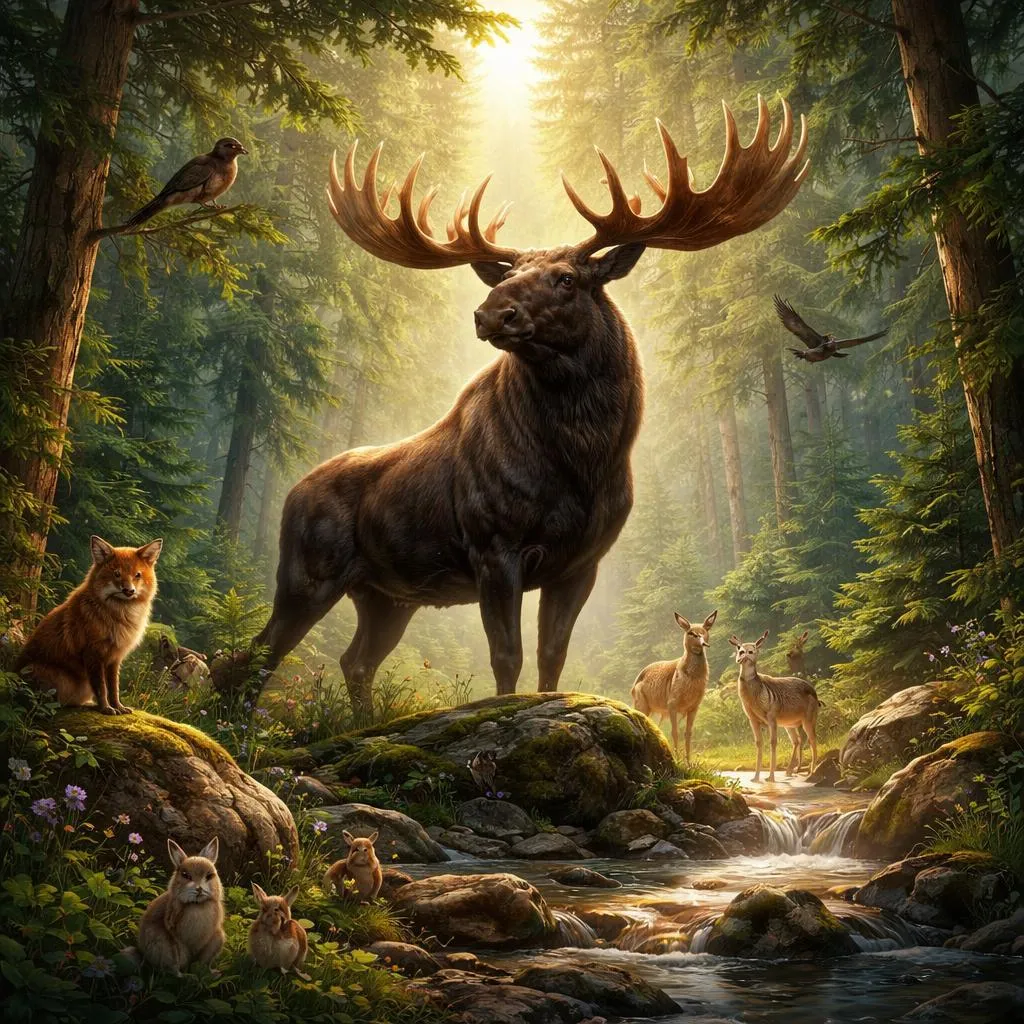

Have you ever seen a picture of a moose standing in a lake or walking through a snowy forest? It is the largest member of the deer family, with huge, flat antlers and a long, droopy nose. Moose are magnificent and powerful animals of the north. Learning about moose takes us on an adventure to cool forests and quiet wetlands. Let’s begin our journey of learning about the majestic moose.
English Language Learning
Vocabulary and Spelling
Our giant forest friend is called a moose.
The word "moose" is a noun. A noun names a person, place, or thing. So, a moose is a thing—a very large, living animal.
Spelling "moose" is fun: M-O-O-S-E. The 'M' starts the word, and it has two 'O's in the middle, like two big, round eyes, and it ends with 'S-E'. M-O-O-S-E spells moose. The plural of moose is also moose!
Sound and Pronunciation
Let’s say the word correctly. It sounds like this: /muːs/.
We can say it in one clear part. First, say "moo". It sounds just like the sound a cow makes! Next, say "s". It’s the hissy sound at the end of "hiss".
Now, blend it together! "Moo" "s". Moose! Great!
The word "moose" has just one beat, or one syllable. Clap your hands once: Moose! It’s a strong, deep-sounding word.
Related Words
Learning about moose is more fun with new words! Here are some important ones.
Body Parts: The huge, branched structures on a male moose’s head are called antlers. The long, hanging skin under its throat is called a bell or a dewlap.
Baby: A baby moose is called a calf.
Home: The cold, northern forests where moose live are called the boreal forest or taiga.
A Famous Saying
While there isn’t a famous old saying, people in North America have a fun phrase: "As big as a moose!"
This is a way to say something is very, very large. It’s a playful comparison that reminds us of the moose’s impressive size and strength.
Say the phrase with me: "As big as a moose!" Can you think of something else that is very big?
Now you know the word "moose"! Are you ready to learn about their amazing life in the north? Let’s walk from words to wonderful forest facts!
Animal Knowledge
Who Are They? – Family and Group
What kind of animal is a moose? Moose are mammals. They have fur, are warm-blooded, and mother moose feed their babies milk.
They are the largest members of the deer family. Their scientific name is Alces alces. In Europe, they are often called "elk," which can be confusing because in North America, elk are a different animal.
What Do They Look Like? – Amazing Bodies
Moose are the tallest land animals in North America! They can be as tall as a basketball hoop. They have long legs, a humped shoulder, and a large, droopy nose and upper lip.
Their most famous feature is the male’s gigantic palmate antlers. These are wide, flat antlers that look like two open hands. Only male moose grow antlers, and they shed them every winter. Their antlers can be wider than a car is long!
Moose have special adaptations for cold and wet places. Their long legs help them walk through deep snow and wade in ponds. Their thick, dark brown fur has hollow hairs that trap heat. Their big nose and upper lip are perfect for grabbing underwater plants.
Where Do They Live and How? – Home and Habits
Moose live in the northern parts of North America, Europe, and Asia. Their home is the boreal forest, near lakes, ponds, and swamps. They need wet areas and lots of plants to eat.
Moose are herbivores. This means they only eat plants. They are browsers, eating leaves, twigs, and bark from trees and shrubs. In summer, they love to eat water plants and will stand in water to reach them.
Moose are mostly solitary, meaning they like to live alone. They are most active at dawn and dusk. They spend their time eating, resting, and moving through the forest. A group of moose is called a herd, but it is rare to see many together.
A Moose’s Life Story – Growing Up
A baby moose is called a calf. Moose are mammals, so calves are born live from their mother. A mother moose, called a cow, usually has one or two calves at a time.
The mother moose is very protective. The calf can stand within a day. The mother feeds it milk and teaches it what to eat. The calf stays with its mother for about a year.
Calves are born with a reddish coat and no spots. They grow quickly and start to eat plants within a few weeks. A young moose stays with its mother until she has a new calf. A moose becomes an adult at about four to five years old.
How Do They "Talk"? – Communication
Moose are usually quiet, but they do make sounds. A mother moose makes a low grunt to talk to her calf. During mating season, males make a deep, groaning call.
They use their bodies a lot. They might lower their heads and flatten their ears to show they are angry. They also use scent to communicate, especially during mating season.
Their best senses are their incredible hearing and sense of smell. Their large ears can turn to catch sounds. Their excellent nose helps them find food and sense danger from far away.
Are They Okay? – Taking Care of Them
Moose populations are generally stable, but they face challenges. In some areas, they are affected by diseases, parasites, and climate change.
The main threats are vehicle collisions, predators like wolves, and habitat loss. Warming temperatures can bring more ticks, which bother the moose and make them sick.
You can be a moose friend! You can learn about them and share their story. You can be careful when driving in areas with moose crossing signs. You can support groups that protect large, wild forests. Remember, keeping wild places healthy helps all animals.
Life Connections and Inspiration
How to Be With Them – Safety and Love
Moose are enormous, powerful wild animals. We must always admire them from a very safe and respectful distance.
The most important rule is: Watch from very far away. If you see a moose in the wild, stay in your car or move away slowly. Never, ever try to approach a moose, especially a mother with a calf. They can charge if they feel threatened. In parks, use binoculars to watch them.
We show our love by protecting the vast, quiet forests and wetlands they need to live. We can be voices for wilderness conservation.
Super Qualities We Learn from Them
Moose teach us amazing things. One super quality is quiet strength and presence. Moose are huge and strong, but they move quietly through the forest. They don’t need to show off. They teach us to be strong and confident in a calm, steady way.
Another quality is adaptation to unique environments. Moose are perfectly built for life in cold, wet forests. They remind us that we can all find our own special place and way to thrive, using our unique strengths.
Think about it: How can you use your own quiet strength? What is your special environment or talent where you feel you belong and can do well?
Take Action! – Your "Moose Habitat" Project
Let’s do a fun and creative activity! Your project is to create a diorama of a moose’s boreal forest home.
Find a shoebox. Paint the inside blue for a pond or lake at the bottom. Use brown paper to make the land around it. Create evergreen trees by rolling green paper into cones or using small twigs. Make a moose from clay or draw and cut one out. Place your moose in the water, eating plants. You can even add small rocks and moss. Label the parts of your habitat: the pond, the trees, and the moose. Tell a story about a day in the life of your moose.
Closing
Learning about the mighty moose is a grand adventure! We learned the word "moose" and how to say its strong, one-syllable name. We discovered amazing facts about their huge antlers, their long legs for wading, and their solitary life in the north. We know that moose are majestic, quiet giants who are a symbol of the wild forest. You can use your new words to teach others about these incredible animals. You can use your knowledge to appreciate and protect the great northern wilderness. The animal world is full of strong and gentle giants. Always remember to observe wildlife from a safe distance, carry yourself with quiet strength, and cherish your own unique place in the world. Keep exploring with wonder, stand tall in your own way, and be a friend to the wild. Your respectful curiosity and calm confidence make you a true friend to the magnificent moose.