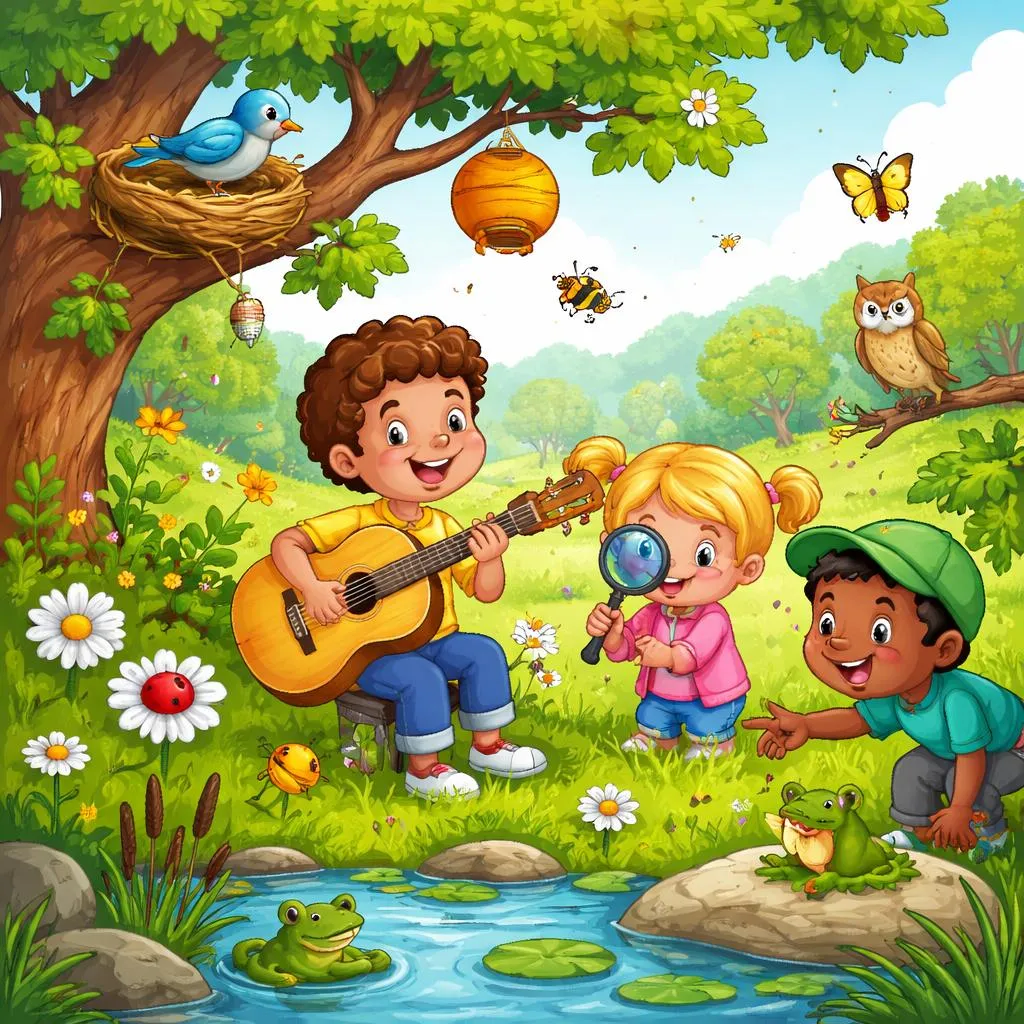

There is a special kind of song that builds upon itself. It adds a new piece with every verse. It invites children to remember and repeat. The song about the tree, the branch, and the nest is one of these gems. The phrase "green grass grows all around" anchors the entire song. It gives us a setting. It gives us a starting point. As teachers, we can use this cumulative song to teach nature vocabulary, sequencing, and memory skills. Let's explore how to bring this rich learning experience to the classroom.
What is the "Green Grass Grows All Around" Rhyme? This is a traditional cumulative song. It is also known as "And the Green Grass Grew All Around." The song tells a story of discovery. It starts with a hole in the ground. In that hole, there is a tree. The tree has a branch. The branch has a twig. The twig has a nest. The nest has an egg. The egg has a bird. The bird has a wing. The story unfolds layer by layer.
The phrase "green grass grows all around" serves as the chorus. It reminds us of the setting. Everything is happening in a beautiful, natural place. The cumulative structure helps children practice sequencing. Each new verse builds on the last. This makes the song both a language lesson and a memory game.
The Lyrics of the Nursery Rhyme Let's look at the structure of the lyrics. We will start from the beginning.
In the hole in the ground, there was a tree, The prettiest tree that you ever did see. And the tree was in the ground, And the green grass grows all around, all around , The green grass grows all around.
And on that tree, there was a branch, The prettiest branch that you ever did see. The branch was on the tree, And the tree was in the ground, And the green grass grows all around, all around, The green grass grows all around.
The pattern continues. We add a new part each time. We always go back through the sequence. We always end with the green grass grows all around. This repetition builds confidence. Children can join in even if they only remember part of the chain.
Vocabulary Learning: Words from Nature This song is rich with nature-themed vocabulary. We can introduce and explore each word.
Hole: An opening in the ground. We can look for holes outside. Ants live in holes.
Tree: A tall plant with a trunk and leaves. We can observe trees near the school.
Branch: A part of a tree that grows out from the trunk. Birds sit on branches.
Twig: A very small, thin branch. Twigs can fall on the ground.
Nest: A home built by birds. Nests are often in trees or bushes.
Egg: A bird comes from an egg. Eggs can be different colors.
Bird: An animal with feathers and wings. Many birds sing songs.
Wing: The part of a bird that helps it fly.
Each word connects to the next. The song builds a web of related vocabulary. The phrase "green grass grows all around" adds another word: grass. This is the simple, green plant that covers the ground. We now have a full set of nature words to teach.
Phonics Points: Sounds in the Song The song offers many opportunities for phonics practice.
The "G" Sound: The word "green" and "grass" both start with the /g/ sound. "Grows" also starts with /g/. We can practice this sound together. We can think of other "g" words like "goat" and "good."
The "R" Sound: "Green," "grass," and "branch" contain the /r/ sound. This sound can be tricky. We practice by stretching it out. "Grrrreen grass."
The "T" Sound: "Tree," "twig," and "nest" contain the /t/ sound. We feel the tip of our tongue touch the roof of our mouth.
The "B" Sound: "Branch" and "bird" start with the /b/ sound. We feel our lips press together. The repetition in the song gives us many chances to hear and produce these sounds. The green grass grows all around chorus provides repeated practice with the /g/ and /r/ sounds.
Grammar Patterns: Building Sentences The song models several useful grammar patterns.
Prepositions: The song is full of prepositions. We have "in the hole," "on that tree," and "around." We can point these out. We can practice using them. "The book is on the desk." "The pencil is in the case."
Descriptive Language: The song uses the phrase "the prettiest." This is a superlative adjective. It means nothing is prettier. We can talk about other "prettiest" things. "That is the prettiest flower."
Sequencing Words: The song uses "and" to connect ideas. It builds a chain. "The branch was on the tree, and the tree was in the ground." This shows how we connect sentences to tell a longer story. The phrase "green grass grows all around" acts as a repeating, comforting conclusion to each verse.
Learning Activities: Bringing the Song to Life Here are some activities to deepen understanding.
Activity 1: Build the Story with Props We gather props or pictures. We need a picture of a hole, a tree, a branch, a twig, a nest, an egg, a bird, and a wing. As we sing each verse, we place the corresponding prop on the board or table. This creates a visual representation of the song's sequence. Children can see the story growing.
Activity 2: Draw the Scene After singing the song several times, we guide students in drawing the scene. We start with the ground and the hole. We add the tree. We add the branch, and so on. They create their own version of the world where green grass grows all around. This connects the song to art and fine motor skills.
Activity 3: Act Out the Song We assign roles to students. One student is the tree. One is the branch (they can hold out their arm). One is the nest (they can cup their hands). One is the egg (they can curl into a ball). As we sing, they arrange themselves in the correct order. This kinesthetic activity makes the song memorable.
Printable Materials: Visuals for the Classroom Printables support the lesson and provide independent practice.
Sequencing Cards: We create a set of picture cards. One card for the hole, one for the tree, one for the branch, and so on. Students can put the cards in the correct order as they sing the song. This reinforces the cumulative structure.
Vocabulary Flashcards: We create flashcards with the key nature words. One side has the word. One side has a picture. We use these for review games.
Coloring Page: We provide a coloring page that shows the entire scene. It has the ground, the tree, the branch, the nest, and the bird. Students can color it. They can write the key phrase "green grass grows all around" at the bottom.
Educational Games: Making Learning Fun Games extend the learning and add an element of play.
Game 1: What Comes Next? We start singing the song. We stop at a certain point. We ask the class, "What comes next?" For example, we sing, "And on that tree, there was a..." and we pause. The class shouts, "Branch!" This game checks their memory of the sequence.
Game 2: Mystery Bag We put small items or pictures from the song into a bag. These could be a small twig, a fake leaf, a picture of a bird, or a plastic egg. A student reaches in and pulls out an item. They must sing the part of the song that matches that item. If they pull out a bird, they sing the verse about the bird.
Game 3: Pass the Picture We give each student a picture card from the song. They walk around the room as we play the music. When the music stops, they find a partner. They must work together to put their two pictures in the correct order. This gets them moving and talking about the sequence.
By using these strategies, we transform a simple folk song into a comprehensive learning unit. We explore vocabulary, phonics, grammar, and sequencing. The beautiful image of green grass grows all around stays with students. It becomes a memory of learning, nature, and fun.