
What Is This Plant?
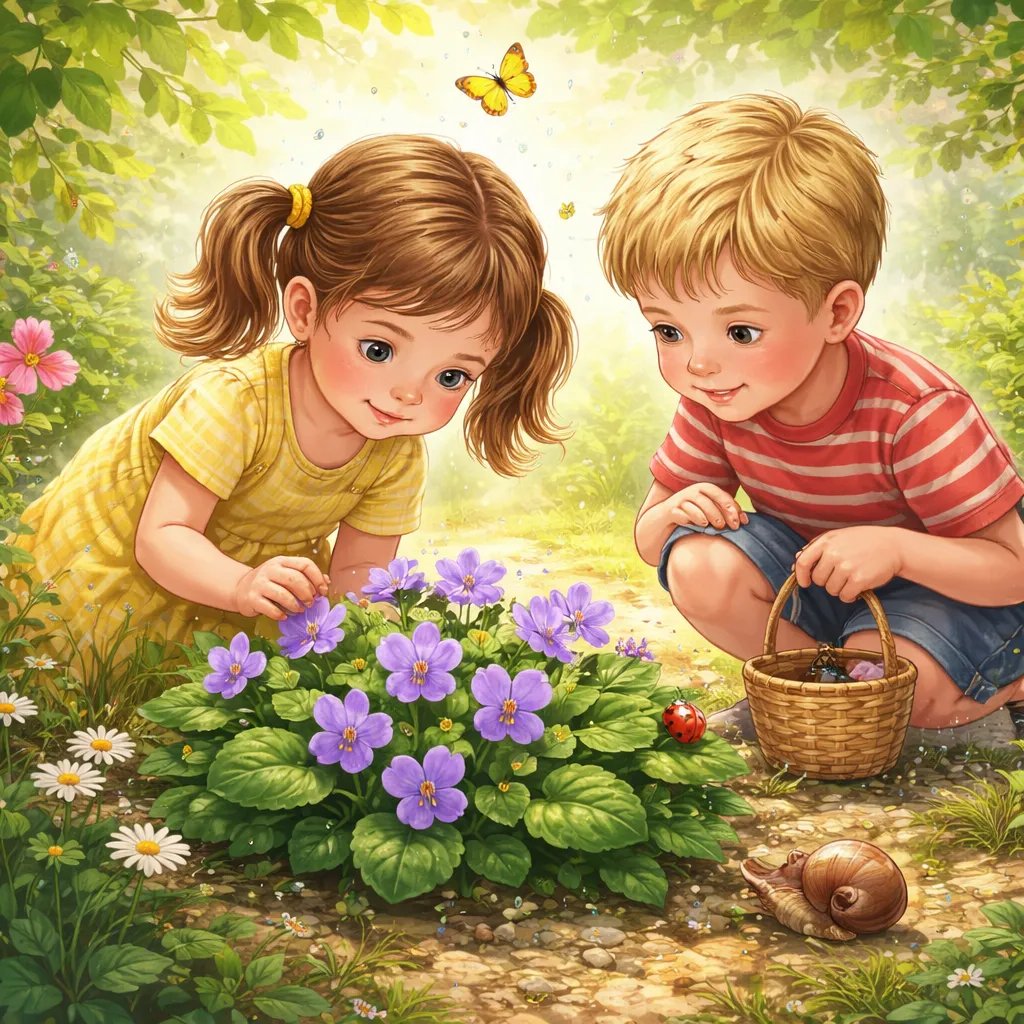
The violet plant is a small, low-growing flower that hides among leaves and grass. It grows close to the ground. The leaves are heart-shaped. They are soft and green. They grow in a small clump. From the center, tiny flowers appear. The flowers have five petals. Two petals point up. Three petals point down. The flowers are usually deep purple or violet. Some are white, blue, or yellow. The center of the flower often has darker lines that guide bees. Violets bloom in early spring. They grow in woodlands, meadows, and gardens. They like shady spots. For children, violets are like little secrets. You have to look down to find them. They hide under larger plants. Finding a violet feels like discovering treasure. Parents can take children to look for violets in spring. Children learn to look closely at the ground. This plant teaches them that small things can be very beautiful.
English Learning About This Plant
The English name “violet” comes from the Latin word “viola.” It means purple. The pronunciation is “vy-o-let.” The International Phonetic Alphabet (IPA) is /ˈvaɪələt/. The word has three syllables. Children can say it: vy-o-let. When we learn about violet plant, we learn words for its parts. The leaf is the heart-shaped, soft green part. The stem is the thin part that holds the flower. The flower is the small, five-petaled blossom. The petal is the soft, colorful part. The root is the thin part underground that takes in water. These words help children describe this delicate plant.
There is a famous poem about violets. The poet William Wordsworth wrote, “A violet by a mossy stone half hidden from the eye.” He described how violets hide and are easy to miss. Another saying goes, “Violets are the eyes of spring.” This means they peek out from the ground to see if spring has come. Parents can share these words with their child. They become gentle lessons about looking closely and finding beauty in quiet places.
Plant Facts and Scientific Knowledge
The violet plant belongs to the genus Viola. There are over 500 species. Violets are native to many parts of the world, including Europe, Asia, North America, and Australia. They are members of the family Violaceae.
Violet flowers have a special structure. They have five petals. The lower petal often has a spur. This is a small tube that holds nectar. The dark lines on the petals are nectar guides. They show bees where to find the sweet reward.
Violets have two types of flowers. The flowers we see in spring are showy. They attract bees and butterflies. Later in summer, violets produce small flowers that never open. These flowers self-pollinate. This ensures seeds even if pollinators did not visit.
Violet leaves are heart-shaped. They grow in a rosette close to the ground. The leaves are edible. They are rich in vitamins. People use them in salads and teas.
Violets have deep symbolic meaning. They represent modesty, faithfulness, and shyness. In the language of flowers, a violet means “I return your love.” Violets are also the state flower of several states in the United States. In ancient Greece, violets were associated with love and fertility.
How to Grow and Care for This Plant
Growing a violet plant is easy for families. Choose a shady or partly shady spot. Violets grow well under trees or in woodland gardens. They like soil that is rich and moist. The soil should drain well.
Plant violet seeds or small plants in spring. Dig a small hole. Place the plant in the hole. Cover with soil. Water well. Children can help by digging small holes and placing the plants.
Water violets regularly. They like consistent moisture. Do not let the soil dry out completely. Mulch around the plants keeps the soil moist.
Violets spread on their own. They send out runners called stolons. These runners grow new plants. Over time, violets form a lovely ground cover. Children can watch new plants appear.
Violets need little care. Remove weeds around them. In fall, you can divide large clumps. Dig up some plants and move them to new spots. This gives you more violets.
Benefits of Growing This Plant
Growing a violet plant brings many gifts to a family. First, it provides early spring color. The purple flowers appear when the garden is still waking up. Second, violets attract early pollinators. Bees come to the flowers on warm spring days.
Violets are edible. Children can learn which parts are safe to eat. The flowers can be added to salads. They make beautiful decorations on cakes. The leaves can be used in teas. This connects gardening to food and cooking.
The plant teaches children to look closely. Violets are small. You have to look down to see them. Children learn that not all beauty is big and showy. Small things matter too.
Violets also make good ground cover. They fill in spaces under trees where grass does not grow well. They create a carpet of green and purple.
What Can We Learn From This Plant
A violet plant teaches children about modesty. The flowers are small. They hide among leaves. They do not show off. Yet they are beautiful. Children learn that they do not need to be the center of attention to be special. Quiet people have beauty too.
Violets also teach about persistence. They grow in shade where other plants struggle. They spread and fill spaces. Children learn that they can grow in difficult places. They can find their way.
Another lesson is about looking closely. Violets are easy to miss. You have to slow down and pay attention. Children learn that the best things are often found when we look carefully. A close look reveals beauty.
Violets also teach about giving. They give nectar to bees. They give beauty to the garden. They give edible flowers to people. Children learn that even small plants can give generously.
Fun Learning Activities
There are many simple activities to help children learn about violet plant. One activity is a violet hunt. In spring, go outside together. Look for violets. Look under trees. Look along paths. See how many you can find. Count them. This builds observation and counting skills.
Another activity is a flower study. Pick one violet. Look at it closely. Count the petals. Look at the dark lines on the lower petal. Use a magnifying glass to see the tiny details. This builds close observation skills.
A nature journal works well for violets. Draw the heart-shaped leaves. Draw the small flower with five petals. Label the parts: leaf, stem, flower, petal. Write the date when you found the first violet. Write where you found it.
For art, try painting violets. Use purple paint. Paint the heart-shaped leaves first. Then paint the small flowers with five petals. Add darker lines on the lower petal. This creates a delicate spring picture.
Vocabulary games are fun too. Write the words violet, leaf, stem, flower, petal, and shade on cards. Say each word. Ask your child to point to the part on the plant. Practice saying violet together. Clap the syllables: vy-o-let.
Finally, try a taste activity. If you have violets that you know are safe, pick a few flowers. Wash them gently. Put them on a salad. Taste them. Describe the flavor. This connects the plant to food and sensory exploration.
Through these activities, children build a deep connection with a small flower that teaches them to look closely. They learn new words, use their senses, and discover the beauty of modest things. The violet plant becomes a symbol of shy beauty and quiet strength. Each time they see violets, they remember to slow down and look. They remember that small things matter. This delicate flower opens a world of careful observation, gentle appreciation, and the simple joy of finding treasure hidden at their feet.