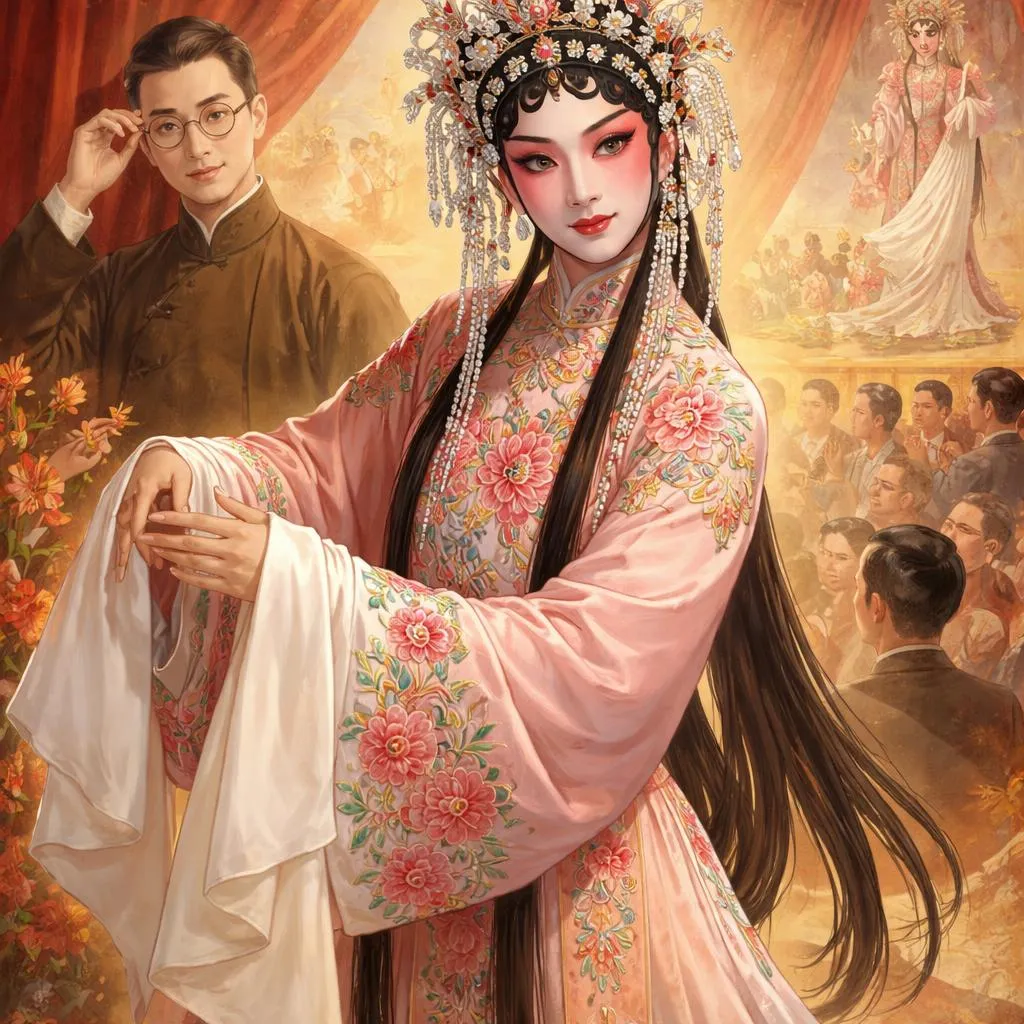

Who Is This Celebrity?
Mei Lanfang was the most famous performer in modern Chinese opera history. He lived from 1894 to 1961. He specialized in dan roles—female characters played by men. He was so convincing that audiences forgot he was male. He created the "Mei School" of performance. He brought Peking opera to the world. He performed in Japan, the United States, and the Soviet Union. Famous actors like Charlie Chaplin and Sergei Eisenstein admired him. His story shows that mastery requires a lifetime of discipline.
Early Life and Childhood
Mei Lanfang was born in 1894 in Beijing, China. His family were opera performers. His grandfather and father were famous dan actors. Young Mei grew up backstage. He watched his father practice and perform every day. He loved the costumes, makeup, and music. He also loved watching shadow puppets. He dreamed of becoming a performer like his father. But his father died when Mei was only 4. His uncle raised him. The family was poor. They often struggled to afford food.
Education and Learning Journey
Mei Lanfang began training at age 8. He studied with the best teachers in Beijing. He trained from 5 AM to 10 PM every day. He learned singing, dancing, acting, and acrobatics. He also learned to play several instruments. He practiced walking in women's shoes with a tiny step. He practiced making women's hand gestures. He had over 50 standard hand positions. He learned to express sadness, joy, anger, and love through eye movements alone. His teachers were harsh. They hit him when he made mistakes. He never complained. He knew that only perfection was acceptable.
How Did They Become Successful?
Mei Lanfang became successful by innovating within tradition. He first performed on stage at age 11. He played a minor female role. By age 20, he was a star in Beijing. But he did not stop learning. He studied women in real life. He watched how they walked, sat, and smiled. He added new movements to the traditional roles. He also added new musical instruments and costumes. He created new plays with stronger plots. Audiences loved his fresh approach. He began traveling to other cities. His fame spread across China. In 1919, he performed in Japan. He was the first Chinese opera star to perform abroad.
Big Ideas and Achievements
Mei Lanfang's biggest achievement was bringing Peking opera to the world. He performed in the United States in 1930. He played in New York, Chicago, San Francisco, and Los Angeles. American audiences had never seen anything like him. They were amazed that a man could play women so convincingly. He became friends with Charlie Chaplin. He met the great actors and directors of Hollywood. In 1935, he performed in the Soviet Union. He met Stanislavsky and Eisenstein. Soviet directors studied his acting methods. They were inspired by how he used gesture and expression instead of realistic sets. He created over 10 new plays and revived many old ones.
Challenges and Difficult Times
Mei Lanfang faced the challenge of war. Japan invaded China in 1937. Japanese officials asked him to perform for them. He refused. He grew a beard to show he was not performing. He could not play female roles with a beard. He stopped performing for nearly eight years. He had no income. He sold his paintings and furniture to survive. He also faced the challenge of aging. He performed until his 60s. Playing young women became harder. He used makeup and costume to hide his age. He also faced the loss of his sons. Two of his sons died young. He continued performing despite his grief.
Fun Facts About the Celebrity
Mei Lanfang loved eating Beijing duck. He had a favorite restaurant that he visited after every performance. He also enjoyed drinking jasmine tea. He never drank alcohol before performing. He said it ruined his voice. He kept a small garden where he grew peonies. He loved painting their petals. He also loved raising pigeons. He kept over 100 pigeons on his roof. He believed watching them fly improved his eye movements for opera. He never wore Western clothes in public. He preferred traditional Chinese robes. He kept a pet parrot that learned to sing parts of his arias.
Why Is This Celebrity Important Today?
Mei Lanfang is the most famous Peking opera performer in history. The "Mei School" is still taught to students. His recordings and films are studied in conservatories. His former home in Beijing is a museum. Thousands of visitors come each year to learn about his life. He also influenced modern Chinese theater. Actors today use his methods of subtle expression. He is remembered for refusing to perform for the Japanese. He chose poverty over collaboration. His beard became a symbol of resistance. He showed that an artist can be a patriot without holding a weapon.
What Can Kids Learn from This Story?
You can learn that training must be intense. Mei practiced 17 hours a day as a child. You can also learn to observe real life. He studied how women walk and smile. You can learn to adapt tradition. He added new elements without breaking the old rules. You can learn to sacrifice for your principles. He refused to perform for eight years rather than serve the enemy. You can also learn that artists can be heroes. His beard was as powerful as a soldier's sword.
Quick Quiz or Practice Time
Let's see what you remember about Mei Lanfang.
Question 1: What type of roles did Mei Lanfang specialize in?
Answer: Dan roles (female characters played by men).
Question 2: What did Mei Lanfang grow to show he would not perform for the Japanese?
Answer: A beard.
Question 3: What food did Mei Lanfang love eating after performances?
Answer: Beijing duck.
Question 4: What pet did Mei Lanfang keep on his roof to improve his eye movements?
Answer: Pigeons (over 100 of them).
Question 5: What famous American actor became friends with Mei Lanfang?
Answer: Charlie Chaplin.
Activity: Practice a simple hand gesture. Hold your hand with fingers together. Then separate each finger slowly. Notice how the meaning changes with each movement. This is how Mei Lanfang expressed emotions through hands. You are practicing dan acting. Draw a picture of Mei Lanfang in his full opera costume with his famous beard.
Mei Lanfang could have performed for the Japanese. They offered him money. They offered him safety. They threatened him if he refused. He could have shaved his beard and played a young woman. No one would have blamed him. Survival is not shame. But Mei said no. He grew a beard. He grew it long, like a ancient scholar. He could not play a woman with a beard. So he did not play at all. He stayed home. He sold his things. He ate simple food. He watched his pigeons fly. He waited. He waited eight years. When the war ended, he shaved his beard. He returned to the stage. He was old. His voice was weaker. His body was stiff. But he performed. The audience wept. They were not crying for the character. They were crying for the man who refused to betray his country. His story teaches us that sometimes the most powerful act is refusal. Sometimes the bravest thing is to do nothing. Sometimes the greatest performance is the one you do not give. Mei Lanfang knew this. He grew his beard. He kept his honor. Now it is your turn. You may never face a war. But you will face choices between comfort and principle. Remember Mei. Grow your own beard. Say no when you must. That is the way of Mei Lanfang. That is your way too. Now go practice your art, and your courage.