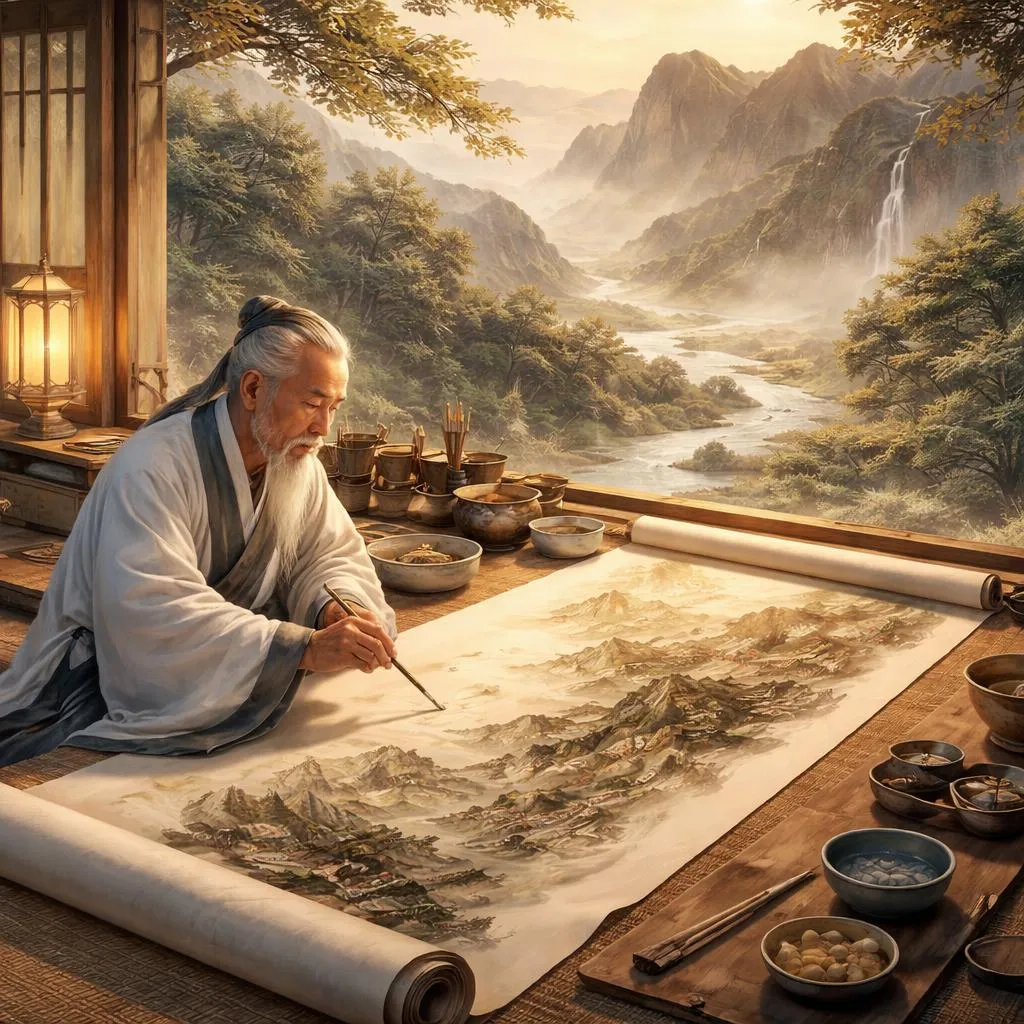

Who Is This Celebrity?
Huang Gongwang was one of the greatest landscape painters in Chinese history. He lived about 700 years ago during the Yuan Dynasty. People call him one of the "Four Masters of the Yuan Dynasty." He spent seven years painting his most famous work. That painting is called "Dwelling in the Fuchun Mountains." It is over 20 feet long. It is considered one of the greatest paintings in Chinese history. His story shows that great art takes time.
Early Life and Childhood
Huang Gongwang was born in 1269 CE in Changshu, Jiangsu Province, China. His original name was Lu Jian. He was adopted by the Huang family when he was young. He grew up in a family of scholars. Young Huang loved painting from a very early age. He also enjoyed reading poetry and history. He dreamed of becoming a government official. The Song Dynasty had fallen. The Mongol Yuan Dynasty ruled China. Many Chinese refused to serve the conquerors. Huang tried anyway. He passed the imperial exams and became a minor official.
Education and Learning Journey
Huang Gongwang studied with the best teachers of his time. He learned the Confucian classics and history. He also studied calligraphy and painting. His most important teacher was Zhao Mengfu, the great master of all arts. Zhao taught Huang how to paint landscapes. He taught him to use the brush like a dancer. He taught him to capture the spirit of mountains, not just their shape. Huang also studied the works of earlier masters. He copied the paintings of Dong Yuan and Juran, great landscape painters of the past. He spent years learning their techniques. Then he developed his own style.
How Did They Become Successful?
Huang Gongwang became successful after he stopped trying to be an official. He was accused of a crime and put in prison. He was innocent. But the experience changed him. After his release, he gave up his government career. He became a Taoist priest and a wandering painter. He traveled through the mountains of Zhejiang Province. He lived in a simple hut by the Fuchun River. He spent his days painting, meditating, and observing nature. He watched how mist moved across the mountains. He noticed how light changed the color of the water. He made friends with scholars and artists. His reputation grew.
Big Ideas and Achievements
Huang Gongwang's biggest achievement was "Dwelling in the Fuchun Mountains." He started the painting around age 70. He did not rush. He painted when he felt inspired. Sometimes he added a few strokes. Sometimes he left it for months. The painting took seven years to complete. The final scroll is over 20 feet long. It shows the landscape along the Fuchun River. The right side shows rolling hills and a fisherman's hut. The middle shows mountains rising in the mist. The left side shows a wide river with boats. There are no bright colors. Only ink on paper. The brushstrokes are loose and free. The painting feels like a real landscape, not a staged one.
Challenges and Difficult Times
Huang Gongwang faced the challenge of living under foreign rule. The Mongol Yuan Dynasty was not Chinese. Many Chinese artists refused to serve them. They painted in a style called "literati painting." This style emphasized personal expression over technical skill. Huang became a master of this style. He also faced the challenge of poverty. He had no government salary. He sold paintings to survive. Sometimes he had no money for paper. He painted on old cloth or bamboo mats. He also faced the challenge of time. He started his masterpiece at age 70. He finished at age 77. He knew he had limited years left. He painted carefully anyway.
Fun Facts About the Celebrity
Huang Gongwang loved eating fresh fish from the Fuchun River. He would catch them himself. He also enjoyed drinking rice wine, but only a small cup each day. He never wore silk. He preferred simple cotton robes. He kept a small garden where he grew bamboo and plum trees. He loved painting them in the snow. He also enjoyed playing a stringed instrument called the qin. He played it while watching the sunset. He never painted at night. He said nature's colors disappeared in darkness. He kept a pet crane that walked beside him on mountain trails.
Why Is This Celebrity Important Today?
Huang Gongwang's "Dwelling in the Fuchun Mountains" is a national treasure. The painting has a dramatic history. In 1650, a collector loved it so much that he ordered it burned so he could be buried with it. His nephew saved the painting from the fire. But the fire had burned the painting into two pieces. One piece is now in the Zhejiang Provincial Museum. The other piece is in the National Palace Museum in Taipei. In 2011, the two pieces were displayed together for the first time in 360 years. Millions of people came to see them. The painting is considered one of the greatest works of Chinese art. Huang's loose, free style influenced generations of painters.
What Can Kids Learn from This Story?
You can learn that great work takes time. Huang spent seven years on one painting. You can also learn that failure can lead to success. Losing his job led him to become a great painter. You can learn to observe nature closely. He watched mist and light for years before painting. You can learn to paint what you feel, not just what you see. His strokes are loose and free, not perfect. You can also learn that old age is not an excuse to stop. He started his masterpiece at 70.
Quick Quiz or Practice Time
Let's see what you remember about Huang Gongwang.
Question 1: What is the name of Huang Gongwang's most famous painting?
Answer: Dwelling in the Fuchun Mountains.
Question 2: How many years did Huang Gongwang spend painting his masterpiece?
Answer: Seven years.
Question 3: How long is Huang Gongwang's famous painting?
Answer: Over 20 feet long.
Question 4: What animal kept Huang Gongwang company on mountain trails?
Answer: A pet crane.
Question 5: What happened to the painting in 1650?
Answer: A collector tried to burn it, and it split into two pieces.
Activity: Find a landscape outside your window. Spend five minutes just looking at it. Notice the shapes of trees and clouds. Then try to draw it from memory. Do not worry about perfect lines. Try to capture the feeling of the scene. This is how Huang Gongwang painted. You are practicing literati painting. Draw a picture of Huang Gongwang sitting by the Fuchun River with his crane.
Huang Gongwang wasted his early years. He studied for imperial exams. He served as a minor official. He got thrown in prison for a crime he did not commit. Then, at age 50, he started over. He became a Taoist priest. He became a wandering painter. He lived in a hut by a river. He ate fish he caught himself. He watched mist rise from the water for twenty years. At age 70, he unrolled a blank scroll. He picked up his brush. He painted a few strokes. Then he stopped. He waited a day. He painted a few more strokes. He waited a month. He painted a few more. Seven years later, he finished. The scroll was over 20 feet long. It showed mountains, rivers, boats, and huts. It showed mist, light, and wind. It showed the spirit of the Fuchun River. It showed the soul of an old man who had finally found his path. His story teaches us that it is never too late. You can start over at 50. You can create a masterpiece at 70. You can find your purpose after failing at everything else. Huang Gongwang did. Now it is your turn. Do not rush. Observe carefully. Paint from the heart. And remember, great things take time. Seven years is not too long for something that will last forever. That is the way of Huang Gongwang. That is your way too. Now go find your Fuchun River. It is waiting.