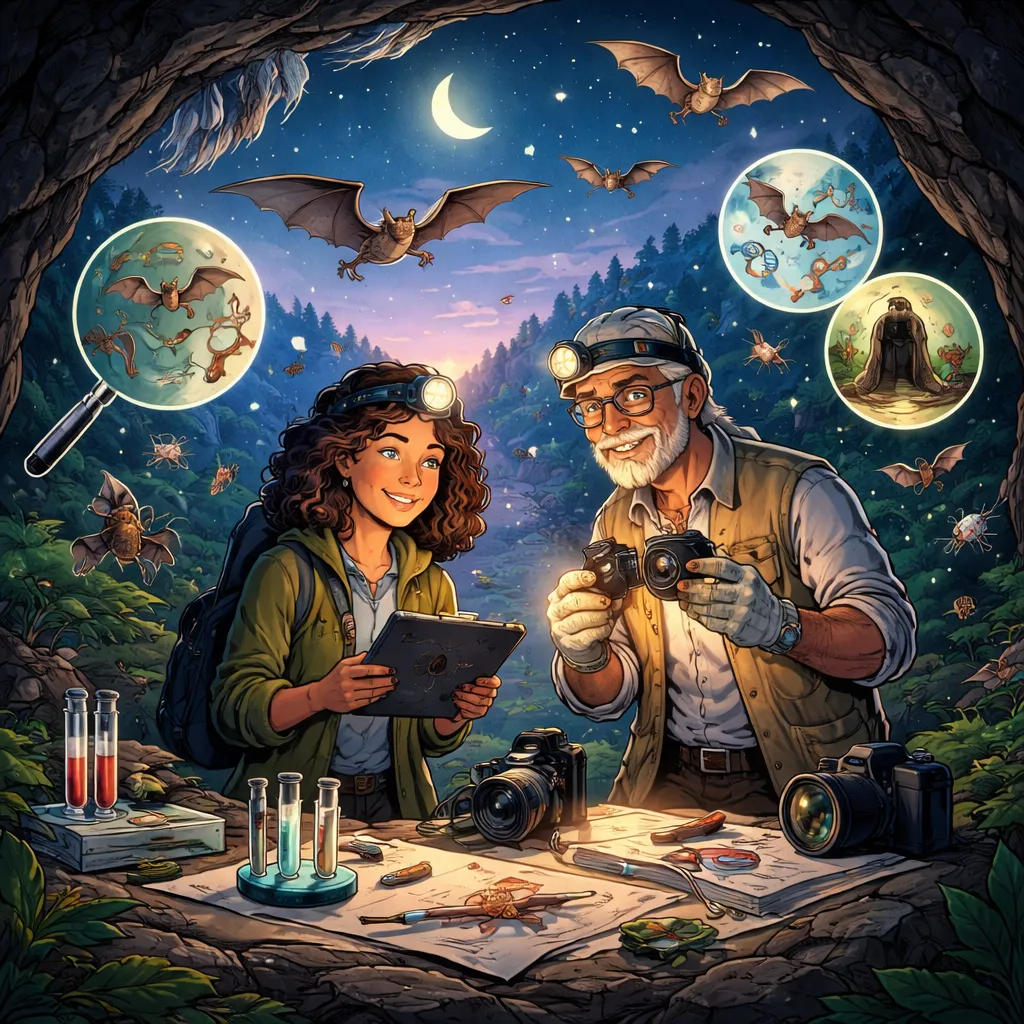

Have you ever seen a shadow flutter in the sky at dusk? It might have been a bat, leaving its home to search for food! Bats are the only mammals that can truly fly, and they are full of amazing secrets. Learning about bats takes us on a journey into the night, to caves, forests, and even our own backyards. Let’s spread our wings of curiosity and start learning about bat wonders.
English Language Learning
Vocabulary and Spelling
Our flying friend is called a bat.
The word "bat" is a noun. A noun names a person, place, or thing. So, a bat is a thing—a unique, flying mammal.
Spelling "bat" is short and swift: B-A-T. The 'B' is at the beginning, like the bat spreading its wings. The 'A' is in the middle, and the 'T' is at the end, like its two feet hanging down. B-A-T spells bat.
Sound and Pronunciation
Let’s say the word correctly. It sounds like this: /bæt/.
We can say it in one quick part. First, say the sound "b". It’s the sound at the start of "ball" or "big". Next, say the short "a" sound like in "cat" or "hat". Last, say "t". It’s the crisp sound at the end of "sit".
Now, blend it together fast! "B" "a" "t". Bat! Perfect!
The word "bat" has just one beat, or one syllable. Clap your hands once: Bat! It’s a quick, snappy word.
Related Words
Learning about bats is more fun with new words! Here are some fascinating ones.
Body Part: A bat’s wing is not like a bird’s. It is a thin layer of skin stretched between its very long fingers, called the wing membrane.
Super Skill: Bats use echolocation. This is a way of seeing with sound! They make high-pitched clicks and listen for the echoes to "see" in the dark.
Home: A place where many bats live together is called a colony. They often rest in a cave, an attic, or a hollow tree.
A Famous Saying
There is a common saying: "Blind as a bat."
This saying is actually not true! Bats are not blind. They can see, but they use their amazing echolocation to hunt in the dark. The saying is just a fun way to say someone can’t see very well.
Say the saying with me: "Blind as a bat." Now you know it’s a myth—bats are fantastic at navigating the night!
Now you know the word "bat"! Are you ready to use your own echolocation to discover bat facts? Let’s fly from words to wonderful knowledge!
Animal Knowledge
Who Are They? – Family and Group
What kind of animal is a bat? Bats are mammals. They have fur, are warm-blooded, and mother bats feed their babies milk.
They belong to their own special order called Chiroptera. This name means "hand-wing" in Greek, because their wings are like hands with long fingers! They are the only mammals that can truly fly.
What Do They Look Like? – Amazing Bodies
Bats come in many sizes, from as small as a bumblebee to as large as a small dog! Most have brown or black fur. Their most amazing feature is their wings.
Their wings are made of a thin, strong skin called a membrane. It stretches between their very long finger bones, all the way to their ankles. This gives them the power of flight.
Bats have special adaptations. Many have large ears to help with echolocation. They sleep upside down, hanging by their feet! Special tendons in their feet lock in place so they don’t fall.
Where Do They Live and How? – Home and Habits
Bats live all over the world except the very coldest places. They rest in caves, trees, under bridges, and in attics. They need safe, dark places to sleep during the day.
Most bats are insectivores. This means they eat insects. One bat can eat thousands of mosquitoes in one night! Other bats eat fruit, nectar, or even fish. Only three species drink blood.
Bats are nocturnal, meaning they are active at night. They are very social and live in large groups called colonies. They spend the night hunting and return to their roost to sleep all day.
A Bat’s Life Story – Growing Up
A baby bat is called a pup. Bats are mammals, so pups are born live from their mother. A mother bat usually has only one pup at a time.
The mother bat is an excellent caregiver. She carries the pup with her when it is very young. She feeds it milk. In large colonies, pups are left in a "nursery" area while the mothers hunt.
Pups are born hairless and blind. They grow quickly, drinking milk for a few weeks. Then they learn to fly and hunt. They stay with their mother for several months until they are independent.
How Do They "Talk"? – Communication
Bats are very chatty, but we can’t hear most of it! They use echolocation to navigate and hunt. They make high-pitched sounds that bounce off objects, telling them what’s ahead.
They also make social sounds like chirps, chatters, and squeaks to talk to each other in the colony. Baby bats call for their mothers with special sounds.
Their most amazing sense is their hearing. Their ears are designed to hear the faintest echoes. Their sense of hearing is their superpower, much more important than their sight at night.
Are They Okay? – Taking Care of Them
Many bat species are in trouble and are endangered. Their numbers are dropping in many places.
The main threats are a sickness called White-nose Syndrome, which disturbs their hibernation, and people destroying their cave and forest homes. They are also sometimes hurt by wind turbines.
You can be a bat hero! You can build or put up a bat house to give them a safe place to live. You can teach others that bats are helpful, not scary. You can avoid exploring caves where bats hibernate, so you don’t wake them. Protecting bats helps control insect pests!
Life Connections and Inspiration
How to Be With Them – Safety and Love
Bats are wild animals and should be admired from a distance. They are not pets.
The most important rule is: Look, don’t touch. Never try to touch or catch a bat. If you find a bat on the ground, tell an adult. Do not touch it yourself, as it might be sick. We can watch them from afar as they fly at dusk.
We show our love by giving them space and providing safe homes like bat houses. We can be bat ambassadors by sharing how cool and helpful they are.
Super Qualities We Learn from Them
Bats teach us incredible lessons. One super quality is navigating with sound. Bats use echoes to find their way in total darkness. This teaches us to use all our senses, to listen carefully, and to find creative ways to solve problems, even when things seem dark.
Another quality is community and teamwork. Bats live in huge colonies and work together. They share warmth and information. This reminds us of the power of community, friendship, and working together for a common goal.
Think about it: How can you be a good listener, like a bat using echolocation? How can you be a helpful member of your own community or classroom?
Take Action! – Your "Bat Detective" Project
Let’s do a fun activity! Your project is to become a bat detective at dusk.
With an adult, find a safe spot outside just as the sun sets. Bring a notebook. Sit quietly and watch the sky. Do you see any quick, fluttering shapes? Those might be bats! Count how many you see in five minutes. Draw what you think their flight path looks like—is it zigzag or straight? Remember, you are a silent observer. You can also research what types of bats live in your area and draw a picture of one.
Closing
Learning about bat mysteries is a thrilling adventure! We learned the word "bat" and how to say its quick, one-syllable name. We discovered amazing facts about their echolocation, their upside-down sleeping, and their helpful diets. We know that bats are intelligent, social animals who need our protection. You can use your new words to teach others the truth about these flying mammals. You can use your knowledge to build a bat house or to watch them with respectful wonder. The animal world is full of nocturnal heroes that teach us about using sound and working together. Always remember to observe wildlife safely, listen carefully to the world around you, and be a friend to all creatures. Keep exploring with all your senses, be a team player in your community, and help protect the amazing bats that share our night skies. Your curiosity and care make you a true friend to these wonderful winged creatures.