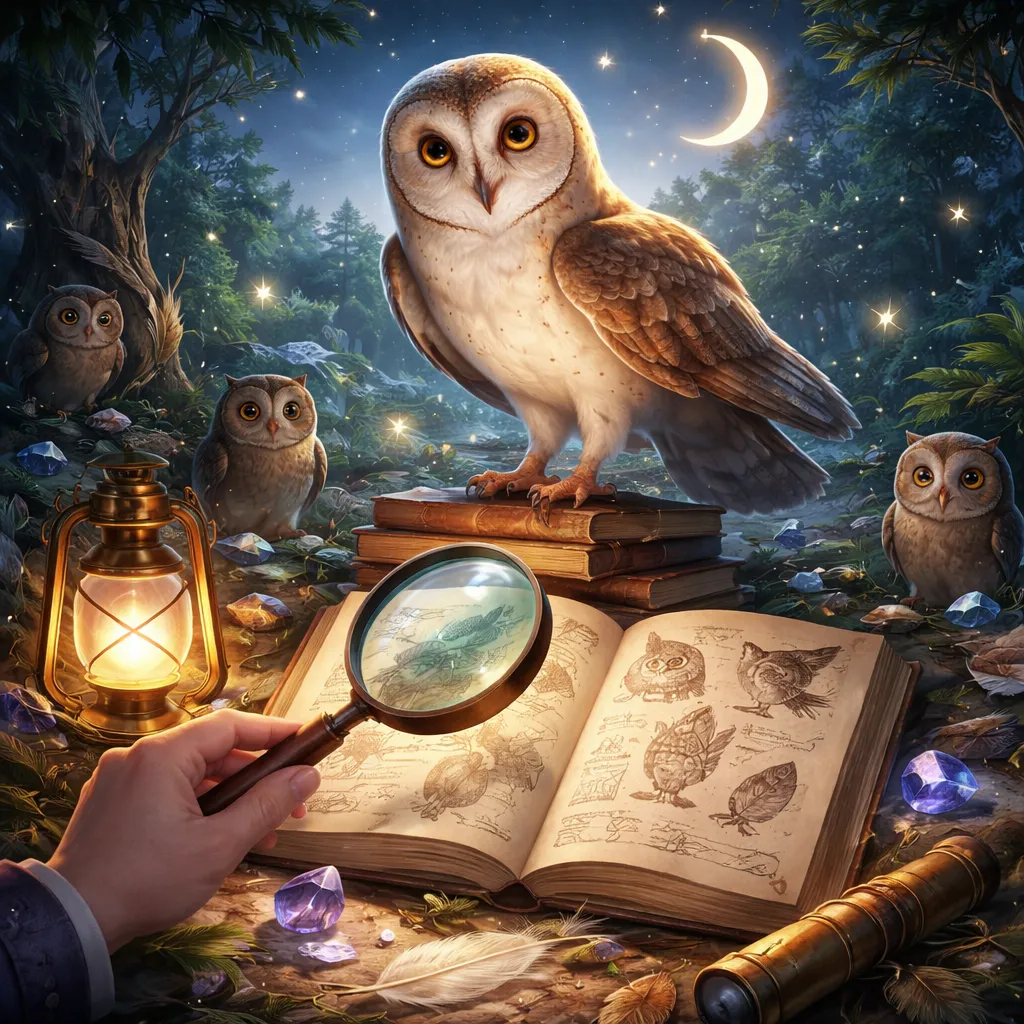

Have you ever heard a soft "hoot-hoot" sound outside your window at night? Or seen a picture of a bird with big, round eyes and a face that looks like a flat plate? That’s an owl! These mysterious birds of the night are amazing hunters and full of surprises. Learning about owls takes us on a quiet adventure into the world of darkness, where hearing and seeing are superpowers. Let’s begin our journey of learning about owl secrets and skills.
English Language Learning
Vocabulary and Spelling Our mysterious night friend is called an owl. The word "owl" is a noun. A noun names a person, place, or thing. So, an owl is a thing—a bird of prey that is active at night. Spelling "owl" is very short: O-W-L. The 'O' starts the word, and it ends with 'W-L'. O-W-L spells owl.
Sound and Pronunciation Let’s say the word correctly. It sounds like this: /aʊl/. We can say it in one clear part. It’s a sound that starts with "ah" and ends with a soft "ul", almost like you’re saying "howl" without the 'h'. Now, say it together! Owl! Great! The word "owl" has just one beat, or one syllable. Clap your hands once: Owl! It’s a short, deep word.
Related Words Learning about owls is more fun with new words! Here are some important ones. Sound: The call an owl makes is a hoot. A group of owls is called a parliament. Body Part: The ring of stiff feathers around an owl’s eyes is called a facial disc. It helps direct sound to their ears. Baby: A baby owl is called an owlet.
A Famous Saying People often use the phrase: "Wise as an owl." This means someone is very smart and makes good decisions. It comes from the owl’s calm, watchful appearance, which makes it look thoughtful. It reminds us that being observant and calm can help us make wise choices. Say the saying with me: "Wise as an owl." It’s a wonderful compliment!
Now you know the word "owl"! Are you ready to fly into some amazing facts? Let’s glide from words to wonderful knowledge!
Animal Knowledge
Who Are They? – Family and Group What kind of animal is an owl? Owls are birds. They are warm-blooded, have feathers, and lay eggs. They are birds of prey, or raptors, in the order Strigiformes. Their cousins are other owls! There are over 200 species, like the Barn Owl, the Great Horned Owl, and the tiny Elf Owl.
What Do They Look Like? – Amazing Bodies Owls can be as small as a sparrow or as large as a child. They have large heads, big forward-facing eyes, and sharp, hooked beaks. Their most famous features are their large, fixed eyes and their special feathers for silent flight. Owls cannot move their eyes in their sockets. Instead, they can turn their heads almost all the way around! Their feathers have soft edges that break up the air, letting them fly without making a sound. This helps them sneak up on their prey. Owls have special adaptations. Their ears are often unevenly placed on their head, which helps them pinpoint exactly where a sound is coming from. Their sharp talons are perfect for catching and holding their food.
Where Do They Live and How? – Home and Habits Owls live on every continent except Antarctica. Their homes are forests, deserts, mountains, and even cities. They often live in tree holes, barns, or old nests built by other birds. Owls are carnivores. This means they are meat-eaters. They are expert hunters, eating mice, voles, insects, and sometimes fish. They usually swallow their prey whole and later cough up a pellet of bones and fur. Most owls are nocturnal, meaning they are most active at night. They are usually solitary. They spend their nights hunting, and their days resting in a safe, hidden spot. A group of owls is called a parliament.
An Owl’s Life Story – Growing Up A baby owl is called an owlet. Owls are birds, so owlets hatch from eggs. The mother owl usually lays two to six round, white eggs in a nest. The mother owl stays with the eggs and the young owlets to keep them warm and safe. The father owl brings food to the nest. Both parents are very protective. Owlets are born with soft, fluffy down feathers. They grow quickly and are very hungry. They stay in the nest for several weeks, getting bigger and growing their adult feathers. Then, they learn to fly and hunt with their parents' help.
How Do They "Talk"? – Communication Owls talk with many sounds. They hoot, screech, whistle, and hiss. Each species has its own call. A hoot can mean "This is my territory" or "I am here." They also use their bodies. They might fluff up their feathers to look bigger if they are scared. They use their facial expressions to show how they feel. Their best senses are their incredible hearing and eyesight. They can hear a tiny mouse moving under leaves or snow from far away. Their eyes are very large and can see well in almost complete darkness.
Are They Okay? – Taking Care of Them Some owl species are common, but many are threatened or endangered. They face dangers from people and changes in the environment. The main threats are losing their forest homes, being hit by cars, eating poisoned rodents, and getting hurt by power lines or fences. Sometimes they are disturbed by people getting too close to their nests. You can be an owl friend! You can learn about them and tell others. You can put up nest boxes in safe places to give them a home. You can be careful when driving at night. Never use poison to kill rodents, as owls can eat the poisoned animals and get sick. Keep your distance from owl nests.
Life Connections and Inspiration
How to Be With Them – Safety and Love Owls are wild birds of prey. They are beautiful but not pets. We must always respect them and watch from a safe distance. The rule is: Observe quietly from far away. Use binoculars to watch owls in the wild. Never try to touch, feed, or get close to an owl or its nest. If you find a baby owl on the ground, it might be learning to fly. Watch from a distance; its parents are likely nearby. If the owl looks hurt, tell an adult who can call a wildlife rehabilitator. We show our love by protecting the dark, quiet forests and fields they need to hunt and live. We can turn off unnecessary lights at night to help them hunt.
Super Qualities We Learn from Them Owls teach us wonderful things. One super quality is silent observation and patience. Owls can sit perfectly still and quiet for a long time, just watching and listening. They teach us the power of being patient, watching carefully, and listening before we act. Another quality is adapting to your strengths. Owls are not fast runners, but they are masters of the night. They use their super hearing and silent flight to hunt. This reminds us that we all have our own special strengths, and we can find ways to use them to succeed. Think about it: When is a time you need to be patient and observant, like when doing a puzzle or waiting your turn? What is a special strength you have, and how can you use it in a new way?
Take Action! – Your "Owl Pellet" Project Let’s do a careful and observing activity! Your project is to become a scientist and dissect a pretend owl pellet. You cannot get real owl pellets easily, so let’s make a model. Take a ball of clay or playdough. Press small, clean chicken bones (from cooked food), bits of dry pasta (for insect parts), or craft fur into it. This is your pretend pellet. Now, use a toothpick or tweezers to carefully take apart the pellet. What did the owl eat? Sort the "bones" and "fur." Draw a picture of the animal you think the owl ate. This shows how scientists learn about an owl’s diet by being patient and observant.
Closing Learning about owl mysteries is a fascinating adventure! We learned the word "owl" and how to say its one-syllable name. We discovered amazing facts about their silent flight, their super hearing, and their life as nocturnal hunters. We know that owls are patient, observant birds who are important for keeping nature in balance. You can use your new words to share the secrets of these night flyers. You can use your knowledge to be a respectful wildlife watcher and protector of the night. The animal world is full of patient and adaptive teachers. Always remember to respect wildlife from a safe distance, practice patience and observation in your own life, and use your unique strengths. Keep exploring with quiet curiosity, watch and listen carefully, and be a friend to the creatures of the night. Your thoughtful actions and observant mind make you a true friend to the amazing owl.