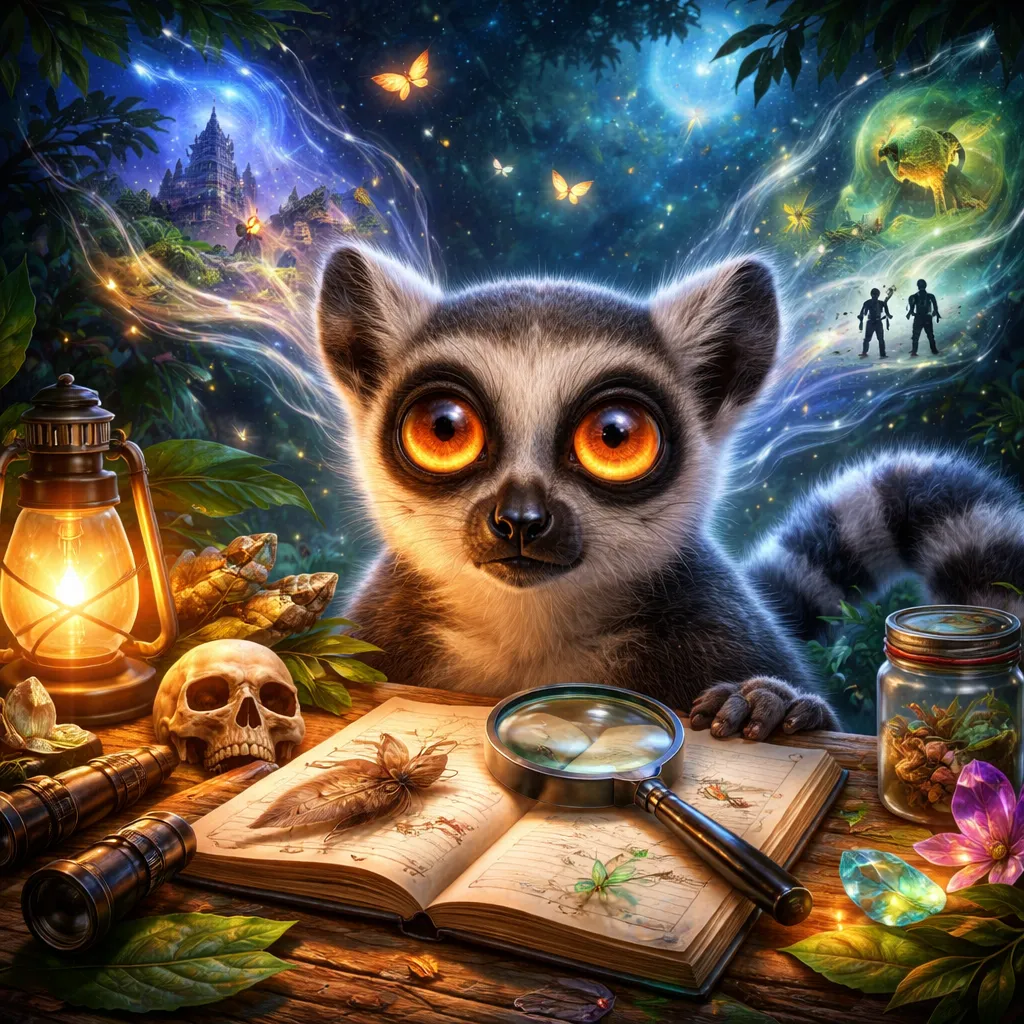

Imagine you’re in a magical forest on a faraway island, and you see a creature with huge, curious eyes and a tail with black and white rings leaping through the trees. That’s a lemur! These amazing animals are found only on the island of Madagascar. Learning about lemurs is a journey to a unique world full of bouncing, chattering, and playful creatures. Let’s leap into our adventure of learning about lemur magic and mystery.
English Language Learning
Vocabulary and Spelling
Our wide-eyed island friend is called a lemur.
The word "lemur" is a noun. A noun names a person, place, or thing. So, a lemur is a thing—a unique, living animal.
Spelling "lemur" is short: L-E-M-U-R. The 'L' starts the word, the 'E' and 'M' are in the middle, and it ends with 'U-R'. L-E-M-U-R spells lemur.
Sound and Pronunciation
Let’s say the word correctly. It sounds like this: /ˈliː.mɚ/.
We can say it in two clear parts. First, say "lee". It rhymes with "see" or "tree". Next, say "mer". It’s a soft sound, like the end of "summer".
Now, put it together! "Lee" "mer". Lemur! Great!
The word "lemur" has two beats, or two syllables. Clap your hands twice: Le-mur. It’s a light, airy word.
Related Words
Learning about lemurs is more fun with new words! Here are some important ones.
Group: A family of lemurs is called a troop. A baby lemur is called an infant or a pup.
Action: The way lemurs move by jumping from tree to tree is called leaping or bounding.
Feature: Many lemurs have a long, striped tail that helps them balance.
A Famous Saying
The name "lemur" comes from a Latin word meaning "ghost" or "spirit."
Early explorers thought their silent, big-eyed faces and nocturnal habits made them look like ghosts in the forest. It’s a name that adds to their mystery and reminds us of the magic of the natural world.
Say the meaning with me: "Lemur means ghost or spirit." Isn’t that a mysterious name?
Now you know the word "lemur"! Are you ready to leap into some amazing facts? Let’s jump from words to wonderful knowledge!
Animal Knowledge
Who Are They? – Family and Group
What kind of animal is a lemur? Lemurs are mammals. They have fur, are warm-blooded, and mother lemurs feed their babies milk.
They are a type of primate, which is the same group that includes monkeys, apes, and humans. But lemurs are more ancient and are called prosimians. They are found only on the island of Madagascar.
What Do They Look Like? – Amazing Bodies
Lemurs come in many sizes, from as small as a mouse to as large as a big cat. They have soft, thick fur that can be gray, brown, black, white, or even red! Their most famous features are their huge, round eyes and their long, bushy tails.
Their large eyes help them see very well at night. Many lemurs have tails with striking rings, like the ring-tailed lemur. Their tails are not for grabbing, but for balance and communication. They have a special "toothcomb" made of bottom teeth for grooming their fur.
Lemurs have special adaptations. They are excellent climbers and leapers. Their sense of smell is very important, and they have scent glands to mark their territory. Some lemurs, like the sifaka, move on the ground with amazing sideways hops.
Where Do They Live and How? – Home and Habits
Lemurs live only on the island of Madagascar, off the coast of Africa. Their homes are rainforests, dry forests, and spiny deserts on the island. They are the most famous animals of Madagascar.
Most lemurs are herbivores. This means they mostly eat plants. They eat fruits, leaves, flowers, and tree bark. Some lemurs also eat insects or small animals. They are very important for the forest because they spread seeds from the fruit they eat.
Lemurs are very social and live in troops. Troops can have a few members or up to 30! They are active during the day or night, depending on the species. They spend their time foraging for food, sunbathing, playing, and grooming each other.
A Lemur’s Life Story – Growing Up
A baby lemur is called an infant or a pup. Lemurs are mammals, so infants are born live from their mother. A mother lemur usually has one or two tiny babies at a time.
The mother lemur is a caring parent. For the first few weeks, the infant clings to her belly. Later, it rides on her back. All the females in the troop often help take care of and protect the babies.
Infants are born with their eyes open and a full coat of fur. They are playful and curious. They drink their mother’s milk for several months but start trying solid food when they are young. They stay with their troop for a long time, learning how to survive.
How Do They "Talk"? – Communication
Lemurs talk in many ways! They have different calls, like chirps, clicks, wails, and barks. The indri lemur makes a loud, haunting song that can be heard for miles.
They use scent marking a lot. They have scent glands on their wrists, chest, or bottom. They rub these glands on trees to leave messages for other lemurs. They also use their tails for signaling.
Their best senses are their amazing sense of smell and hearing. Their nose is their main guide to the world. Their large ears can hear the smallest sounds in the forest. Their big eyes are great for seeing in low light.
Are They Okay? – Taking Care of Them
Most lemur species are in great danger. Over 100 species of lemurs are endangered, and many are critically endangered. This means they could disappear forever.
The main threat is people cutting down the forests of Madagascar for farming, logging, and mining. This destroys their only home. They are also sometimes hunted for food or captured for the illegal pet trade.
You can be a lemur hero! You can learn and tell everyone about these unique animals. You can support groups that plant trees and protect the forests of Madagascar. You can choose to recycle and be mindful of what you buy, because protecting forests everywhere helps. Never buy a lemur as a pet—they belong in the wild.
Life Connections and Inspiration
How to Be With Them – Safety and Love
Lemurs are wild animals. They are not pets. We must always respect them and want them to be free in their forest home.
The rule is: Protect their home and admire from a distance. We watch them in nature documentaries or at zoos that are part of important breeding programs. In the wild, we must never try to touch, feed, or take a lemur. Responsible tourism keeps a safe distance and supports local conservation.
We show our love by protecting the island of Madagascar. We can be a voice for the trees and the unique animals that live nowhere else on Earth.
Super Qualities We Learn from Them
Lemurs teach us wonderful things. One super quality is unique community and cooperation. Lemurs live in close troops where everyone helps. They groom each other, play together, and watch for danger. They teach us the importance of working together, being part of a community, and helping each other.
Another quality is adapting to a unique home. Lemurs evolved in isolation on an island, becoming many different and special species. This reminds us that our own unique home, family, and talents make us special. It also shows how important it is to protect unique places in our world.
Think about it: How can you be a good member of your own community, like your family or class? What makes you or your home special and unique?
Take Action! – Your "Lemur Troop" Project
Let’s do a fun and cooperative activity! Your project is to create a lemur troop mask and act out a day in the forest.
On a paper plate, draw and color a lemur face with huge eyes. Cut out eye holes. Attach a stick to hold it. Now, with your family or friends, form a "troop." Act out a day: one person can be the lookout for danger, others can "forage" for paper fruit, and everyone can "groom" each other by gently patting each other's backs. This shows how lemurs live and work together in their troop.
Closing
Learning about lemur magic is a wonderful and important adventure! We learned the word "lemur" and how to say its two-part name. We discovered amazing facts about their huge eyes, their leaping skills, and their life in troops on a unique island. We know that lemurs are social, special animals who are in great danger because their forest home is disappearing. You can use your new words to teach others about these incredible creatures. You can use your knowledge to understand the importance of protecting unique places and all living things. The animal world is full of cooperative and unique teachers. Always remember to respect all wildlife, value your own community, and protect the special places on our planet. Keep exploring with wonder, work together with your troop, and be a friend to the wild. Your caring actions and community spirit make you a true friend to the amazing lemur.