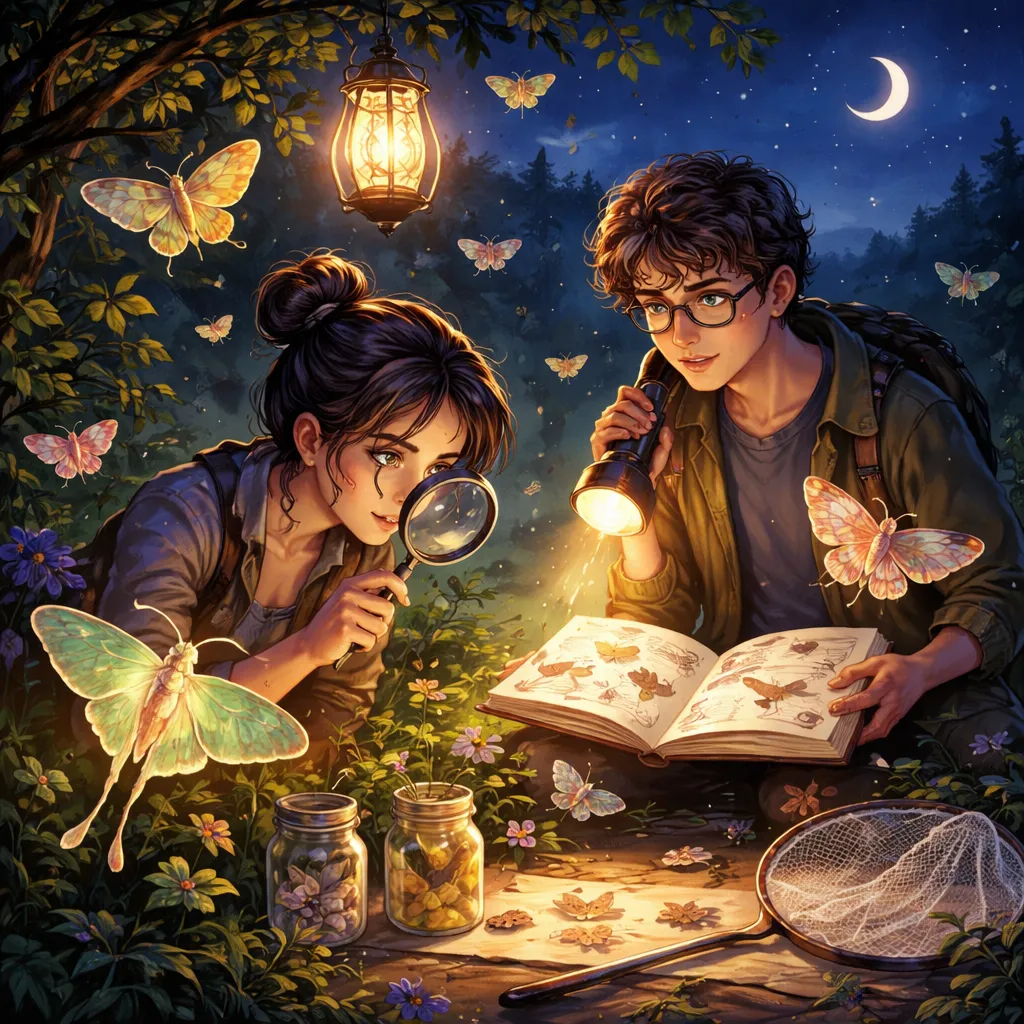

What Is This Animal?
A moth is an insect with four wings covered in tiny scales. Its body is often thick and fuzzy. Moths come in many sizes. Some are as small as a fingernail. Others are larger than a bird’s wing. Most moths fly at night.
Moths are close relatives of butterflies. They belong to the same insect group. Moths usually have feathery antennae. They rest with their wings flat or folded like a tent. Butterflies have smooth antennae and rest with wings held upright.
These insects live in many places. You find them in gardens, forests, and fields. They come out at night. They are attracted to light. A porch light can draw many moths. Their wings show beautiful patterns when the light hits them.
For children, moths are mysterious. They appear when the sun goes down. Their soft bodies and delicate wings make them special. They show us that nighttime holds its own kind of beauty.
English Learning About This Animal
Let us learn the English word moth. We say it like this: /mɒθ/ or /mɔːθ/. The m sound starts with the lips together. The o is short, like in “hot.” The th uses the tongue between the teeth. Say it together: moth. Say it three times. Moth. Moth. Moth.
Now let us learn words about a moth’s body. The antennae are feathery or threadlike. They help the moth smell. The wings are covered in tiny scales. The scales create the wing colors and patterns. The thorax is the fuzzy middle part. The abdomen is the back part. The proboscis is the long tube for drinking nectar.
There is a gentle saying about moths. The poet William Blake wrote, “The caterpillar on the leaf / Repeats to thee thy mother’s grief.” This speaks to the quiet life of moths and their kin. Another simple saying is, “The moth seeks the light, not knowing the flame.” This reminds us to follow what draws us but to stay safe.
These English words help children understand moth anatomy. When they say antennae, they notice the feathery feelers. When they say scales, they learn what makes the wings colorful. Parents can practice these words while looking at moth pictures. Point to the parts. Say the words together.
Animal Facts and Science Knowledge
Moths belong to the insect order Lepidoptera. This group includes both moths and butterflies. Moths make up about ninety percent of Lepidoptera species. There are over 160,000 moth species around the world. New species are still being discovered.
Moths live in nearly every habitat. They live in forests, grasslands, deserts, and mountains. Some moths live in the Arctic. Others live in tropical rainforests. Most moths are nocturnal. They rest during the day. They fly at night to find food and mates.
Moths eat nectar from flowers. Some moths do not eat at all as adults. They live only a short time. Moth caterpillars eat leaves, flowers, or other plant parts. Some moth caterpillars eat fabric or stored food. These are the moths people sometimes find in closets.
Moths have special abilities. Their wings have scales that create colors and patterns. Some moths have patterns that look like eyes. These scare away birds. Some moths can hear bat sounds. They drop to the ground when they hear a bat nearby. Some moths can mimic the smell of bees to avoid predators.
Moths go through complete metamorphosis. They start as eggs. They hatch into caterpillars. The caterpillar grows and forms a cocoon. Inside the cocoon, the caterpillar transforms into a moth. The adult moth emerges, dries its wings, and flies away.
How to Interact With This Animal Safely
Moths are gentle wild insects. They do not bite or sting. They are safe to observe up close. If you see a moth on a wall or window, let your child watch it. Notice the wing patterns. Look at the feathery antennae. Then let the moth rest.
If a moth lands on your child’s hand, stay still. It may rest for a moment. It may taste the skin with its feet. Then it will fly away. Do not grab or squeeze it. Moth wings are covered in scales. Touching the wings can rub off scales and make flying harder.
Teach children to be gentle. If you want to move a moth, use a piece of paper. Gently guide it onto the paper. Carry it outside. Place it near a plant or tree. Wash hands after touching a moth. The scales are harmless but may leave dust on fingers.
Never keep a moth in a jar for long. Moths need to fly. They need to find food and mates. If your family finds a moth indoors at night, turn off the lights and open a window. The moth will fly toward the outdoor light and leave.
Teach children to protect moth homes. Leave some areas of the garden wild. Avoid using bright lights that confuse moths. Plant night-blooming flowers. These provide nectar for moths. When we care for their habitat, we help moths thrive.
What Can We Learn From This Animal
Moths teach us about finding light in darkness. They fly at night. They seek light. Children learn that even in dark times, we can look for light. Kindness, hope, and family are lights that guide us.
Moths teach us about quiet beauty. They do not have the bright colors of butterflies. But their wings hold intricate patterns. Children learn that beauty comes in many forms. Being quiet, gentle, and observant are beautiful qualities.
Moths teach us to be adaptable. They live in many places. Some survive in harsh environments. Children learn that they can adapt too. Moving to a new place, trying something new, or facing a challenge are chances to grow stronger.
Moths teach us about patience in darkness. The caterpillar waits in the cocoon. It emerges at night. Children learn that waiting is part of life. Waiting for the right time, waiting for growth, and waiting for new opportunities all take patience.
Fun Learning Activities
Let us make learning about moth fun. One activity is the moth light game. On a summer evening, turn on a porch light. Place a white sheet near the light. Wait for moths to come. Count how many you see. Notice the different sizes and patterns. Use words like “antennae” and “wings.”
Another activity is drawing a moth. Look at pictures of moths. Notice the feathery antennae and wing patterns. Draw a moth with wings spread flat. Add scales and patterns. Label the parts. Say the words aloud.
Create a story about a moth’s night. Ask your child where the moth flies. Does it visit night flowers? Does it rest on a tree? Does it see the moon? Write a few sentences together. Let your child draw pictures. Read the story aloud before bed.
Make a moth from craft materials. Use brown or gray paper for wings. Add fuzzy yarn for the body. Attach pipe cleaner antennae. Add patterns with markers. Hang the moth near a window. Practice saying “moth flies at night” and “moth rests in the day.”
Learn about moth caterpillars. Find pictures of different moth caterpillars. Notice how they look different from butterfly caterpillars. Talk about what they eat. Use words like “cocoon” and “metamorphosis.”
These simple activities bring learning to life. Children build English vocabulary while playing. They learn science through observation. They connect with nature in quiet ways. Learning about moth becomes a journey into the night. Each moment spent together strengthens language, curiosity, and a lasting appreciation for the soft-winged fliers that dance around porch lights, reminding us that beauty does not disappear when the sun goes down—it simply changes form.