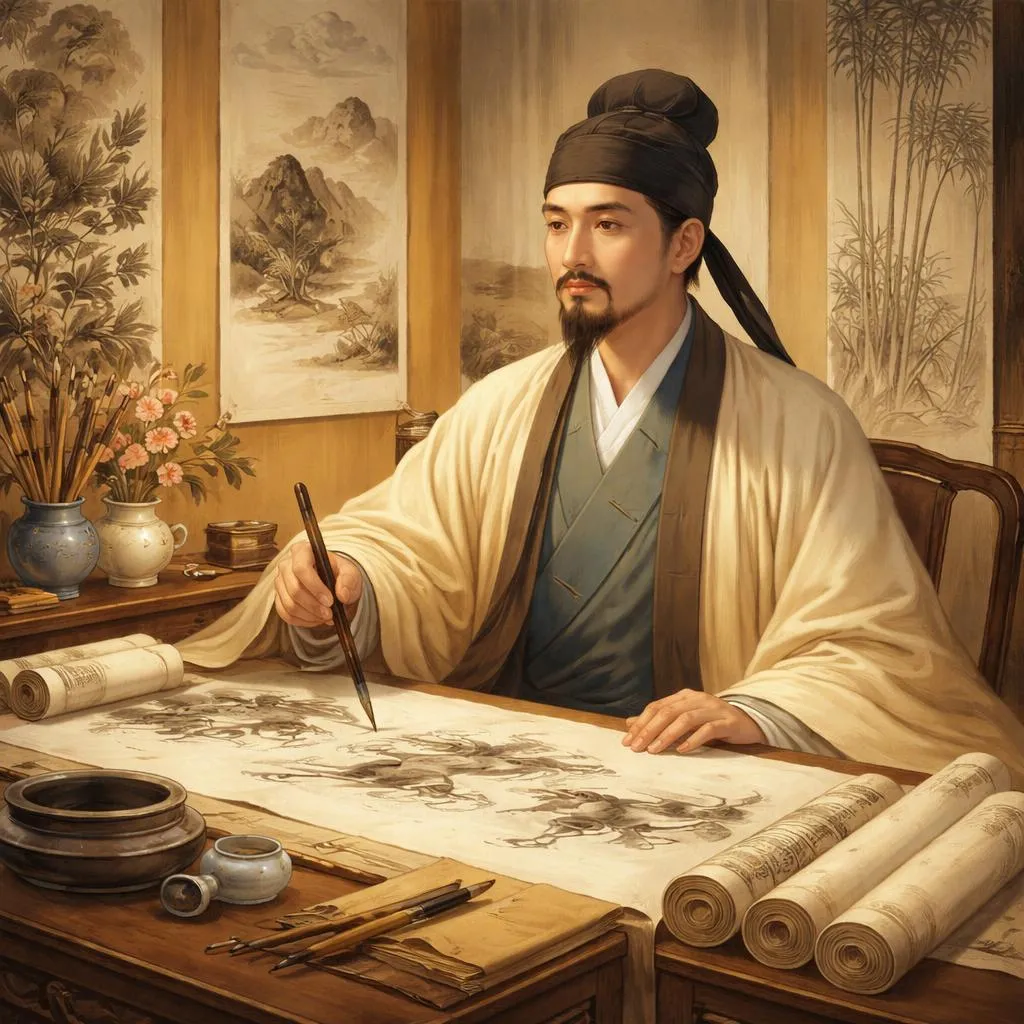

Who Is This Celebrity?
Zhao Mengfu was one of the most versatile artists in Chinese history. He lived about 700 years ago during the Yuan Dynasty. He mastered calligraphy, painting, poetry, and seal carving. He could write in every calligraphy style with equal skill. He painted horses, people, and landscapes with equal beauty. He served the Mongol emperor as a scholar and official. His work influenced Chinese art for 700 years. His story shows that mastering many skills is better than mastering one.
Early Life and Childhood
Zhao Mengfu was born in 1254 CE in Wuxing, now called Huzhou, Zhejiang Province, China. His family were scholars and officials of the Song Dynasty. Young Zhao grew up in a home filled with books and paintings. He loved drawing and writing from a very young age. He would paint for hours in the garden. He also enjoyed reading poetry and history. His father died when Zhao was 11. His mother raised him alone and encouraged his artistic talents. She told him that art would be his escape from a world of chaos. The Song Dynasty fell when he was 22.
Education and Learning Journey
Zhao Mengfu received a classical education from the best teachers. He studied the Confucian classics, history, and literature. He also studied calligraphy with masters of different styles. He learned the bold Yan style, the precise Ouyang style, and the elegant Wang style. He did not just copy. He absorbed each style and made it his own. He also studied painting. He learned figure painting from Song masters. He learned landscape painting from Tang masters. He learned horse painting from ancient masters. He spent hours copying old paintings. He studied poetry and seal carving. He became one of the most educated men of his generation.
How Did They Become Successful?
Zhao Mengfu became successful by serving a new dynasty. The Mongol Yuan Dynasty conquered China in 1279. Many Song officials refused to serve the conquerors. They retired to the mountains and lived as hermits. Zhao chose a different path. He accepted the Mongol emperor's invitation to serve. He became a scholar at the imperial court. Some Chinese called him a traitor. Zhao ignored the criticism. He used his position to preserve Chinese culture. He convinced the Mongol emperor to support traditional Chinese arts. He protected ancient paintings and calligraphy. He taught Mongol officials to appreciate Chinese culture. His work saved countless artworks from destruction.
Big Ideas and Achievements
Zhao Mengfu's biggest achievement was his painting of horses. He studied how horses moved and stood. He captured their spirit on paper. His most famous painting is "Man Riding a Horse." The brushstrokes are simple but full of life. He also excelled at landscape painting. He revived the blue-green landscape style from the Tang Dynasty. He also painted bamboo with incredible skill. Each leaf looked like it was blowing in the wind. In calligraphy, he could write in any style. His running script was as good as Wang Xizhi's. His standard script was as precise as Ouyang Xun's. No one before or since has mastered so many styles.
Challenges and Difficult Times
Zhao Mengfu faced constant criticism from his own people. They called him a traitor for serving the Mongol conquerors. Some former friends refused to speak to him. They burned his letters and paintings. Zhao never defended himself publicly. He expressed his feelings through art. He painted a famous picture of a horse with an ugly groom. The groom represented the Mongol rulers. The horse represented himself, trapped in service. He also faced the challenge of balancing many arts. He could have specialized in one style. He chose to master them all. This required incredible discipline. He woke early every day to practice. He studied until late every night. He never took a day off.
Fun Facts About the Celebrity
Zhao Mengfu loved eating lotus seeds. He believed they improved his memory. He also enjoyed drinking tea made from jasmine flowers. He never drank alcohol, even at official banquets. He said alcohol ruined his brush control. He kept a small garden with a pond of goldfish. He watched them swim while thinking about new compositions. He also loved playing the guqin, a seven-stringed instrument. He played it every evening before bed. He never wore the fancy robes of a court official. He preferred simple dark robes. He kept a pet songbird in a bamboo cage. The bird's song helped him focus while painting.
Why Is This Celebrity Important Today?
Zhao Mengfu's paintings hang in the greatest museums of the world. The Beijing Palace Museum has dozens of his works. The Shanghai Museum has his famous horse paintings. The Metropolitan Museum in New York has his landscapes. His calligraphy is still copied by students. His style influenced generations of later artists. His life also raises important questions about loyalty and survival. Should he have refused to serve the Mongols? Would that have helped anyone? His choice preserved Chinese art and culture. Historians now praise him as a protector of tradition. His versatility continues to inspire artists. He proved that one person can master many arts.
What Can Kids Learn from This Story?
You can learn that mastering many skills is possible. Zhao excelled at calligraphy, painting, poetry, and carving. You can also learn to ignore what others say. People called him a traitor. He kept working. You can learn to use your position for good. He served the Mongols but protected Chinese culture. You can learn to express your feelings through art. He painted his frustration in a picture of a horse. You can also learn that no one can please everyone. He made some people angry no matter what he did. He focused on his work instead.
Quick Quiz or Practice Time
Let's see what you remember about Zhao Mengfu.
Question 1: What animal did Zhao Mengfu love painting the most?
Answer: Horses.
Question 2: What food did Zhao Mengfu believe improved his memory?
Answer: Lotus seeds.
Question 3: What instrument did Zhao Mengfu play every evening?
Answer: The guqin.
Question 4: What did Zhao Mengfu use to express his frustration about serving the Mongols?
Answer: A painting of a horse with an ugly groom.
Question 5: How many styles of calligraphy could Zhao Mengfu master?
Answer: Every style (he could write in all of them).
Activity: Try learning two different skills today. Practice writing your name in both print and cursive. Then draw a simple picture of an animal. Then write a two-line poem about that animal. This is how Zhao Mengfu worked across multiple arts. You are practicing versatility. Draw a picture of Zhao painting a horse while writing a poem at the same time.
Zhao Mengfu could have retreated to the mountains. He could have refused to serve the Mongol conquerors. He could have lived as a hermit, painting only for himself. No one would have blamed him. Many of his friends chose that path. Instead, Zhao walked into the enemy's court. He wore their robes and ate their food. He bowed to their emperor. His old friends called him a traitor. They burned his letters. They spread rumors about him. Zhao did not defend himself. He painted. He painted horses with the sadness of a trapped servant. He painted landscapes with the longing of an exile. He painted bamboo that bent but did not break. And he protected Chinese culture from the inside. He saved paintings that would have been burned. He preserved calligraphy that would have been lost. He taught Mongol rulers to love the art of the people they conquered. His story teaches us that there are many ways to serve. The hermit in the mountain serves by remembering. The official in the court serves by protecting. Both are honorable. Both are necessary. Zhao chose the harder path. He endured the criticism. He died with his reputation damaged. But his art survived. His culture survived. His students carried on his work. And in time, history understood his choice. Now it is your turn to choose your path. Will you retreat or engage? Will you fight openly or work from the inside? There is no single right answer. But whatever you choose, do it with skill. Do it with dedication. Do it with art. That is the way of Zhao Mengfu. That is your way too.