
Who Is This Celebrity?
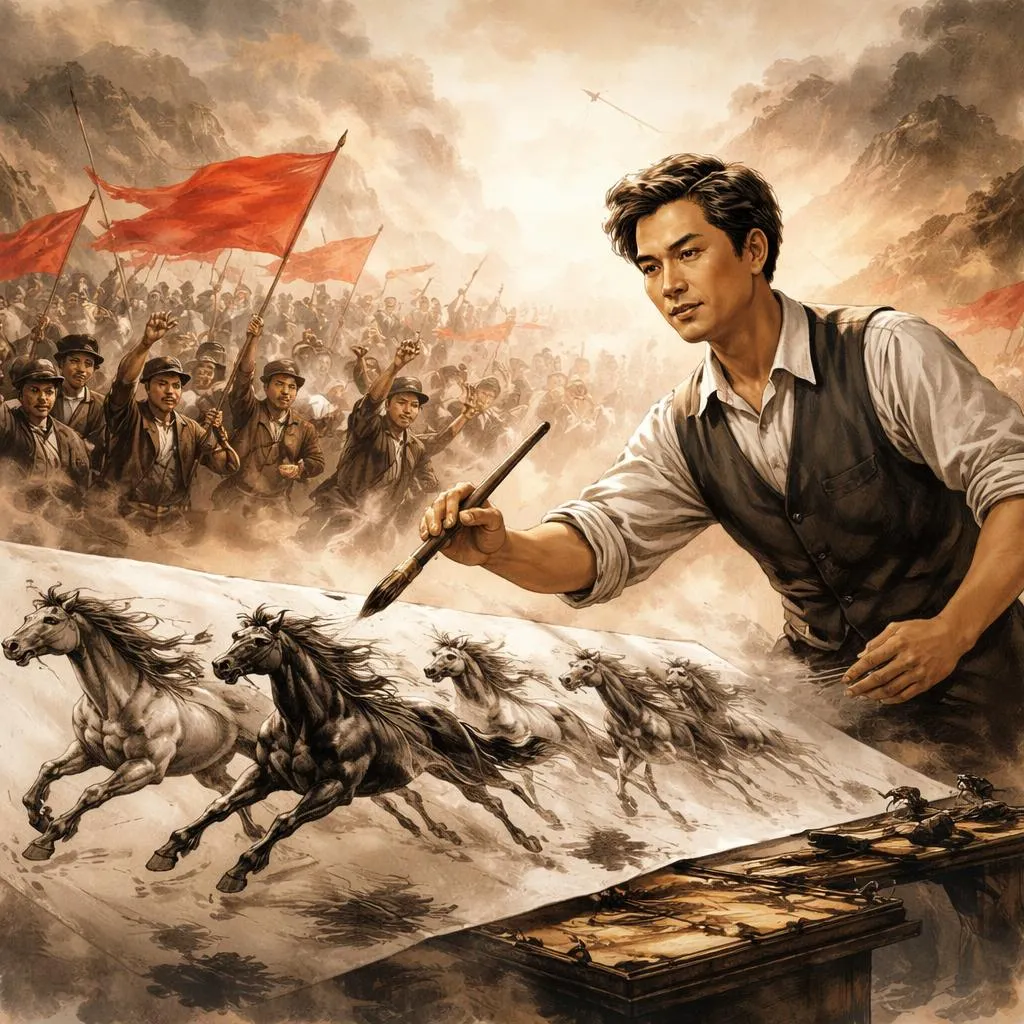
Xu Beihong was the father of modern Chinese painting. He lived from 1895 to 1953. He studied art in France and brought Western techniques back to China. He combined Chinese brushwork with Western realism. He painted horses that looked like they were galloping off the paper. During World War II, his horses became symbols of Chinese resistance. He also reformed art education in China. His story shows that art can inspire a nation.
Early Life and Childhood
Xu Beihong was born in 1895 in Yixing, Jiangsu Province, China. His father was a poor painter and teacher. Young Xu grew up with a brush in his hand. His father taught him to paint and write calligraphy from age four. He could not afford paper. He practiced on leaves and the ground. He also loved reading poetry and history. His family moved often because of floods and poverty. Xu saw the suffering of ordinary people. He dreamed of using art to help his country.
Education and Learning Journey
Xu Beihong had almost no formal education. His father taught him at home. At age 17, he moved to Shanghai to study art. He worked odd jobs to survive. He painted signs and did illustrations for magazines. He met wealthy patrons who recognized his talent. They paid for him to study in Japan in 1917. He spent a year there studying modern art. Then he returned to China and taught at a university. In 1919, he won a scholarship to study in France. He spent eight years in Europe. He studied oil painting and drawing at the école Nationale Supérieure des Beaux-Arts in Paris.
How Did They Become Successful?
Xu Beihong became successful by combining East and West. Chinese painters traditionally focused on line and wash. Western painters focused on light, shadow, and anatomy. Xu mastered both. He drew horses with Chinese brushwork but gave them Western three-dimensionality. His horses looked real but also energetic. He returned to China in 1927 and became a professor at the National Central University. He organized exhibitions of modern art. He wrote articles about art reform. He became the most influential artist in China. In 1946, he became the president of the National Beiping Art School, the future Central Academy of Fine Arts.
Big Ideas and Achievements
Xu Beihong's biggest achievement was his painting of galloping horses. He painted hundreds of them. His most famous is "Six Galloping Horses." The horses run with their manes flying and legs stretched out. They look full of power and freedom. During the Japanese invasion of China, these horses became symbols of resistance. People saw the galloping horse as China itself—refusing to stop, refusing to fall. Xu also painted large historical oil paintings. "The Departure of the Artist" and "Tian Heng and His Five Hundred Men" showed heroic figures from Chinese history. These paintings inspired patriotism.
Challenges and Difficult Times
Xu Beihong faced constant poverty in his early years. He often had no money for food or art supplies. He once had to sell his coat to buy paint. He also faced the challenge of war. Japan invaded China in 1937. Xu fled with his paintings. He traveled across Southeast Asia, raising money for war relief. He sold his paintings and gave the money to support Chinese refugees and soldiers. He also faced the challenge of poor health. He suffered from high blood pressure and kidney disease. He continued painting and teaching despite frequent illness. He died in 1953 at age 58.
Fun Facts About the Celebrity
Xu Beihong loved eating fried dough sticks for breakfast. He believed they gave him energy. He also enjoyed drinking strong black tea, never green tea. He kept a small studio where he painted only horses. He would not let anyone enter while he painted them. He studied horse anatomy obsessively. He could draw a horse from memory in 30 seconds. He also loved collecting ancient Chinese paintings. He donated his entire collection to the National Art Museum of China. He never wore Western suits after returning from France. He preferred traditional Chinese robes. He kept a pet rooster that would crow outside his studio every morning.
Why Is This Celebrity Important Today?
Xu Beihong is considered the father of modern Chinese painting. Every Chinese art student learns his name. His paintings of galloping horses are icons of Chinese culture. They appear on posters, stamps, and in textbooks. The Central Academy of Fine Arts, which he led, is the most prestigious art school in China. His teaching methods still influence art education. He insisted that art students master drawing before expressing themselves. This emphasis on fundamentals shaped generations of Chinese artists. His wartime patriotism made him a national hero. He showed that an artist could serve their country with a brush.
What Can Kids Learn from This Story?
You can learn to combine different influences. Xu mixed Chinese and Western techniques. You can also learn that art can inspire people. His horses gave hope during war. You can learn to work hard even when poor. He had no paper as a child. He practiced on leaves. You can learn to give back. He sold his art to help war refugees. You can also learn that you do not need to live long to leave a legacy. He died at 58. His horses live forever.
Quick Quiz or Practice Time
Let's see what you remember about Xu Beihong.
Question 1: What animal did Xu Beihong paint that became a symbol of Chinese resistance?
Answer: Galloping horses.
Question 2: Which country did Xu Beihong study art in for eight years?
Answer: France.
Question 3: What food did Xu Beihong love eating for breakfast?
Answer: Fried dough sticks.
Question 4: What did Xu Beihong donate to the National Art Museum of China?
Answer: His collection of ancient Chinese paintings.
Question 5: What pet crowed outside Xu Beihong's studio every morning?
Answer: A pet rooster.
Activity: Try drawing an animal in motion. Choose a horse, dog, or bird. Look at photos of the animal running or flying. Notice how its legs and body stretch. Then draw it with simple lines. Do not worry about details. Try to capture the feeling of motion. This is what Xu Beihong did. You are practicing dynamic drawing. Draw a picture of Xu Beihong painting a galloping horse.
Xu Beihong could have stayed in Paris. He was successful there. His paintings sold. His teachers praised him. He had a comfortable life. But he returned to a China that was poor, war-torn, and divided. He returned to teach students who had no materials. He returned to paint for a nation that was losing its freedom. He painted horses. He painted them running, leaping, charging. He painted them with manes flying and muscles straining. He painted them refusing to stop. People looked at those horses and saw themselves. They saw a China that would not give up. They saw a people who would keep running. Xu could not fight with a gun. He could not lead an army. He could only hold a brush. That was enough. His brush gave hope. His brush inspired a nation. His story teaches us that you do not need to be a soldier to serve your country. You can be a painter. A poet. A teacher. A musician. Whatever your tool, use it to lift others. Use it to give hope. Use it to inspire. Xu Beihong did that with a brush. Now it is your turn. Find your tool. Use it to gallop. That is the way of Xu Beihong. That is your way too. Now go create something that moves.