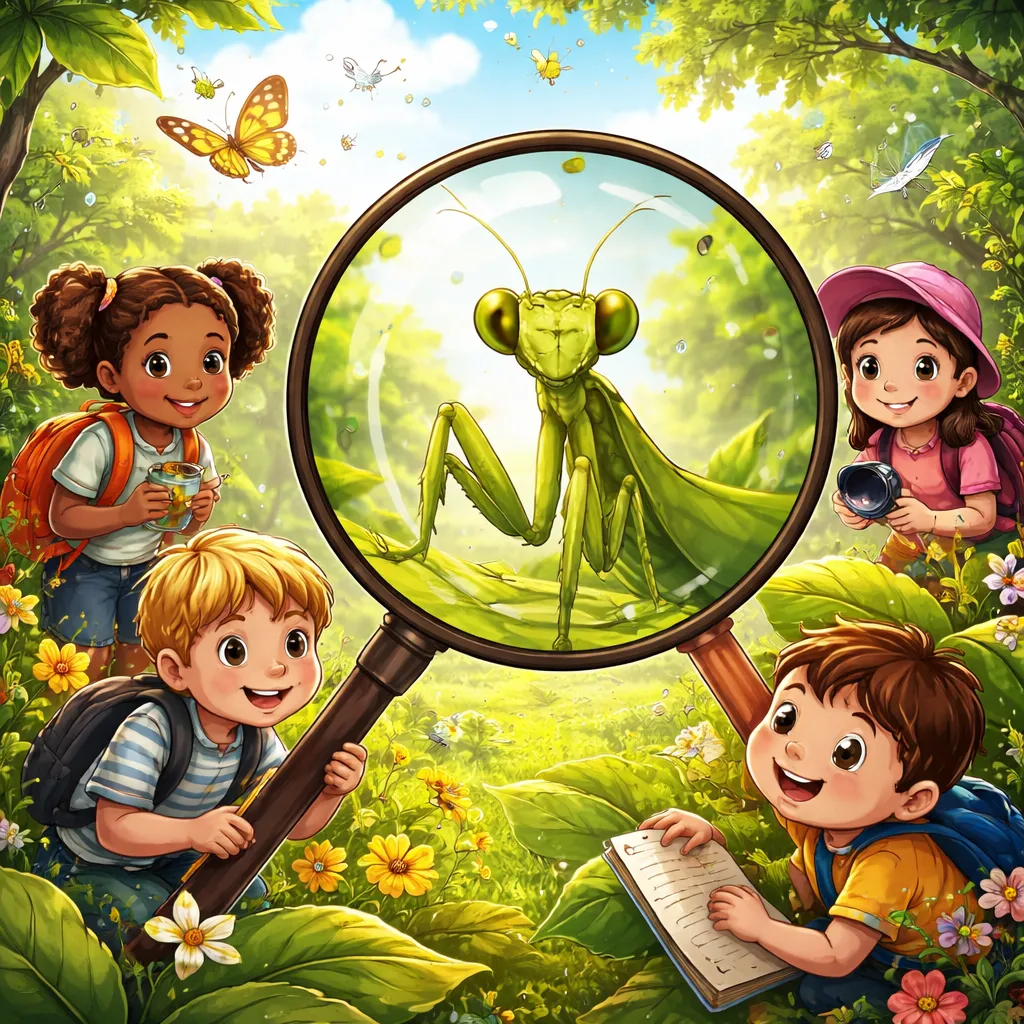

What Is This Animal?
A mantis is an insect with long, slender body and folded front legs. It holds its front legs together as if praying. This is why it is often called a praying mantis. Its head can turn from side to side. It is one of the few insects that can look over its shoulder.
Mantises are hunters. They sit very still. They wait for prey to come close. Then they strike with their front legs. They catch flies, crickets, and other insects. They are fast and accurate. Their front legs have sharp spines to hold prey.
These insects live in gardens, meadows, and forests. They blend in with leaves and stems. Some look like green leaves. Others look like brown twigs. Their camouflage helps them hide from predators and sneak up on prey.
For children, mantises are fascinating. Their praying posture looks gentle. But they are fierce hunters. They teach children about patience, stillness, and the balance of nature.
English Learning About This Animal
Let us learn the English word mantis. We say it like this: /ˈmæntɪs/. The word has two parts. Man sounds like “man.” Tis sounds like “tiss.” Put them together: mantis. Say it three times. Mantis. Mantis. Mantis. Some people say praying mantis.
Now let us learn words about a mantis’s body. The head is triangular and can turn. The eyes are large and compound. The antennae are long and thin. The thorax is long and flexible. The front legs are folded and have spines for grasping. The wings cover the abdomen when at rest.
There is a wise saying about mantises. An old observation says, “The mantis prays with folded legs, but its eyes are watching.” This reminds us that stillness can hide great alertness. Another saying is, “Patience is the mantis’s greatest weapon.” This teaches the value of waiting.
These English words help children understand mantis anatomy. When they say thorax, they learn about the long neck. When they say spines, they understand how it holds prey. Parents can practice these words while watching a mantis in the garden. Point to the parts. Say the words together.
Animal Facts and Science Knowledge
Mantises belong to the insect order Mantodea. There are over two thousand mantis species. They are found on every continent except Antarctica. Most live in warm, tropical regions. Some live in temperate areas. Mantises are relatives of cockroaches and termites.
Mantises live in gardens, meadows, and forests. They live on plants where insects gather. They stay still for hours. They wait for prey to come within reach. They blend in with leaves, flowers, and twigs. Some mantises look exactly like orchids or dead leaves.
Mantises are carnivores. They eat insects and spiders. Large mantises eat small lizards, frogs, and even birds. They catch prey with their front legs. They hold it tight. They eat it alive, starting with the head. They are not picky. They eat whatever they can catch.
Mantises have special abilities. They can turn their heads 180 degrees. They can see in 3D. Their large eyes give them excellent vision. They can detect movement from far away. They strike in a fraction of a second. Their legs have spines that lock onto prey.
Mantises go through simple metamorphosis. Females lay eggs in a foam case called an ootheca. The foam hardens into a protective case. Nymphs hatch in spring. They look like tiny adults without wings. They shed their skin several times as they grow. Adults grow wings and can fly.
How to Interact With This Animal Safely
Mantises are fascinating to watch. They are not dangerous to people. They may pinch if threatened. Their front legs can give a small pinch. It is not harmful. Teach children to watch without grabbing. Observe from a close distance.
If a mantis lands on your child, stay still. Let it crawl. It may clean its legs or look around. It will fly away when ready. Do not grab it. Do not pull its legs. Mantises are delicate. Their legs can break if handled roughly.
If your child wants to hold a mantis, show them how. Let it crawl onto a hand. Hold the hand still. Watch its head turn. Watch its eyes follow movement. Then place it back on a plant. Mantises need to hunt. They need to find food.
Teach children not to keep wild mantises as pets without preparation. Mantises need live food every day. They need space. They need proper temperature. If your family wants to raise a mantis, learn about its needs first. Many people raise mantises successfully with care.
Mantises are helpful in gardens. They eat pest insects. Encourage them to stay. Do not use pesticides that kill them. A mantis in the garden is a natural pest controller.
What Can We Learn From This Animal
Mantises teach us about patience. They wait for hours without moving. They do not chase. Children learn that waiting can be powerful. Waiting for the right moment, listening before speaking, and being still all have value.
Mantises teach us about focus. They watch their prey with full attention. Children learn that focusing on one thing helps us succeed. Paying attention in school, listening to others, and working on a task without distraction lead to better results.
Mantises teach us about camouflage. They blend in to stay safe. Children learn that sometimes fitting in helps. Other times, standing out is good. Knowing when to blend and when to show ourselves is a skill.
Mantises teach us about being prepared. Their front legs are always ready. Children learn that preparation helps us act when the moment comes. Practicing skills, being organized, and thinking ahead prepare us for opportunities.
Fun Learning Activities
Let us make learning about mantis fun. One activity is the mantis pose game. Ask your child to stand still. Fold arms in front like mantis legs. Turn the head slowly side to side. Wait. Then pretend to catch a fly with fast hands. Say “mantis waits” and “mantis strikes.”
Another activity is finding a mantis in the garden. Look carefully on green leaves and brown stems. Mantises are hard to see. When you find one, watch it. See how long it stays still. Count how many minutes it waits. Use words like “camouflage” and “patient.”
Draw a mantis and label its parts. Draw the triangular head, large eyes, long thorax, folded front legs, wings, and abdomen. Write the words next to each part. Say them aloud. For younger children, draw the mantis first. Let them point to the parts as you say the words.
Create a story about a mantis hunting. Ask your child what the mantis sees. Does it see a fly? Does it wait? Does it strike? Write a few sentences together. Let your child draw pictures. Read the story aloud.
Make a mantis craft. Use a green paper roll for the body. Add paper wings. Add large paper eyes. Add folded front legs from paper or pipe cleaners. Attach long antennae. Move the craft mantis. Practice saying “mantis waits” and “mantis turns its head.”
Learn about mantis relatives. Compare mantises to grasshoppers and crickets. Notice the differences in front legs and head movement. Talk about how mantises are built for hunting while grasshoppers are built for jumping. Use words like “predator” and “adaptation.”
These simple activities bring learning to life. Children build English vocabulary while playing. They learn science through observing predators. They develop patience through mantis watching. Learning about mantis becomes a lesson in stillness, focus, and the quiet power of waiting. Each moment spent together strengthens language, curiosity, and a growing appreciation for the insect that prays with folded legs but watches with unblinking eyes, teaching us that sometimes the best action is no action at all.