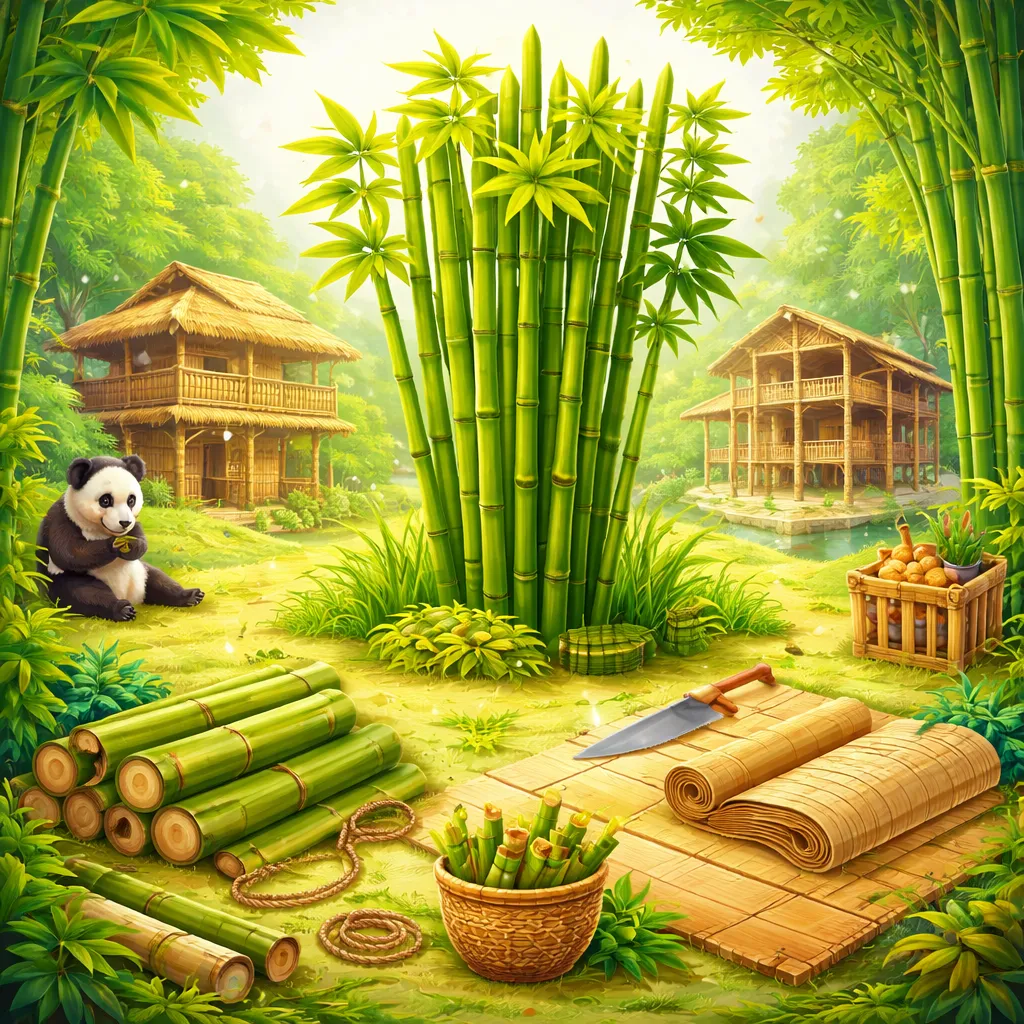

Have you ever seen a plant that grows so fast, you can almost watch it get taller? It has a tall, hollow stem with rings, and it makes a gentle clacking sound in the wind. It is as strong as wood, but it’s not a tree. It is a type of giant grass! In some parts of the world, people build whole houses, make furniture, and even create musical instruments from it. It is the favorite food of a very special, cuddly-looking animal. This amazing, fast-growing wonder is the incredible Bamboo. Let’s go on a speedy adventure to learn about the Bamboo plant.
Let’s Learn the Word! – Open the Treasure Box of Language
Formal Name and Pronunciation
This speedy giant is called Bamboo. You can say it like this: /ˌbæmˈbuː/ (bam-BOO). The first part, “bam,” rhymes with “ham,” and the second part, “boo,” is like the sound a ghost makes. Bam-boo. Say it: Bamboo. It’s a fun, bouncy word.
The Etymology Tale
The word “Bamboo” has traveled the world! It likely comes from the Malay or Kannada word “mambu.” Dutch and Portuguese traders brought the word to Europe. The “bam” part might be the sound of the plant exploding when it is burned, because the hollow stems can pop in a fire! So, its name is a bit onomatopoeic, meaning it sounds like what it does.
Nicknames and Friendly Aliases
Bamboo has many descriptive names. Because it is a grass, it is called Giant Grass. Some types are called Timber Bamboo for building. The lucky bamboo houseplant is called Dracaena. In Asia, it is often called the Friend of the People. Because it grows in groups, a forest of bamboo is called a Grove or a Clump.
Building Your Word Web: Core Parts
Let’s learn the words for Bamboo’s amazing body. The Culm is the main woody stem, the part we usually call the “stalk.” It is hollow between the rings, or Nodes. The solid rings are the Internodes. The Shoot is the new, pointy growth that pops from the ground. The Rhizome is the thick, underground stem that spreads and creates new shoots. The Leaf is usually long, thin, and pointed. A Branch grows from the nodes of the culm. A Grove is a whole family of bamboo plants connected by rhizomes.
Action and State Words
Bamboo is a champion of action. It grows at an incredible speed. It spreads through its underground rhizomes. The culms clack and rustle in the breeze. People harvest the mature culms. Bamboo is strong, flexible, fast-growing, and evergreen (in warm climates).
Ecosystem Friends Vocabulary
The bamboo forest is a unique habitat. The Giant Panda is the most famous friend, eating almost nothing but bamboo shoots and leaves. Red Pandas also eat bamboo. Mountain Gorillas snack on it. Many birds and insects live in the grove. The hollow stems are homes for some bees and small creatures. It is a vital part of the ecosystem in Asia.
Cultural Imprint in Language
Bamboo is a symbol of strength, flexibility, and resilience in many cultures. A famous Chinese proverb says, “The bamboo that bends is stronger than the oak that resists.” This teaches that being flexible is a great strength. The poet Li Bai wrote, “I sit among the bamboos alone, Playing my lute and whistling long.” This paints a peaceful picture of the quiet, musical sound of the bamboo grove. In many stories, bamboo is a symbol of elegance and simplicity.
Ready for Discovery
We know its strong, speedy name. Are you ready to be a nature detective and discover the super-growing secrets of this giant grass? Let’s explore the world of the Bamboo plant.
Discover the Plant’s Secrets! – A Nature Detective’s Notebook
The Plant Passport
Bamboo belongs to the grass family, Poaceae. Its big group is the subfamily Bambusoideae. It is the tallest and fastest-growing grass in the world. A bamboo plant has tall, jointed, usually hollow culms that can be green, yellow, or even black. The leaves are long and slender. It rarely flowers—sometimes only once every 50 to 100 years! It grows from rhizomes and can form vast forests. It is an evergreen plant in warm climates.
Survival Smarts
Bamboo’s superpower is its underground network. The rhizomes spread under the soil, storing energy. Then, when conditions are perfect, they send up many shoots at once. This helps the plant take over an area quickly. Another trick is its flowering strategy. Some types flower all at the same time, everywhere in the world, then produce many seeds and die. This saturates the area with seeds so that some will survive to grow new plants, even if animals eat most of them.
Its Role and Gifts
Bamboo is a cornerstone of its ecosystem. It prevents soil erosion with its dense network of roots. It provides food and shelter for many animals. As an environmental superstar, it grows incredibly fast, absorbing more carbon dioxide and producing more oxygen than many trees. It is a sustainable building material, growing back quickly after harvesting. People use it for everything from scaffolding and flooring to paper and textiles.
Human History and Cultural Symbol
For thousands of years, bamboo has been essential in Asian cultures. It was used for writing strips, building materials, weapons, and musical instruments. In Japan, the bamboo is a symbol of purity and strength. In India, it is considered sacred. Today, it is a symbol of sustainable living because it grows so fast and has so many uses. It represents resilience, utility, and harmony with nature.
Fun “Wow!” Facts
Get ready for a speed fact! The world record for fastest-growing plant is held by a type of bamboo. It can grow up to 35 inches in a single day! That’s almost 1.5 inches every hour—you could literally watch it grow. And here’s a flowering mystery: Some bamboo species flower only once every 65 or 120 years, and then the whole grove dies. Scientists are still trying to solve this puzzle!
From Ancient Forest to Your Garden
The Bamboo plant’s story is one of incredible growth and versatility. Would you like to grow your own super-grass? You can, but you must be a careful and responsible gardener. Let’s see how.
Let’s Grow It Together! – A Little Guardian’s Action Guide
Good for Home Growing?
Yes, but you must choose the right type! Bamboo can be a wonderful garden plant, but some types spread very aggressively with their running rhizomes. For a home garden, it is best to choose a clumping bamboo variety, which grows in a neat, non-invasive clump. You can also grow bamboo in a large, sturdy pot to control its spread. It is a fantastic plant for creating a green screen or a calming rustling sound.
Little Gardener’s Toolkit
You will need a clumping bamboo plant from a garden center. Get a very large, heavy pot with drainage holes or pick a garden spot with a root barrier. Use rich, well-draining potting soil. Have a watering can, some mulch, and a slow-release fertilizer ready. A root barrier (a thick plastic sheet) is essential if planting running bamboo in the ground.
Step-by-Step Growing Guide
Planting Your Speedy Friend
The best time to plant is in spring. If planting in a pot, place the plant in the center. If in the ground, dig a hole twice as wide as the root ball. Place the bamboo in, fill with soil, and pat down. Water it deeply. Spread mulch around the base to keep the soil moist. For running types, install a root barrier that goes at least 2 feet deep around the planting area.
Care Calendar
Bamboo likes consistent moisture, especially when young. Water it regularly so the soil stays damp but not soggy. It loves full sun to part shade. Feed it in spring and summer with a balanced, slow-release fertilizer. The most important care for running bamboo is checking that the rhizomes are not escaping where you don’t want them!
Watch and Be Friends
The most exciting part is watching for new shoots in spring! They emerge like pointed spears and grow incredibly fast. Measure a new shoot’s height every day for a week—it’s amazing! Listen to the sound of the leaves rustling. Watch how the new culms start soft and green and then harden and turn yellow. Be a patient observer of this speedy life.
Problem Diagnosis
If leaves turn yellow, it might need more water or nitrogen fertilizer. If the tips are brown, the air might be too dry or it might have gotten too much fertilizer. For pests like aphids or mites, spray the leaves with a strong jet of water. The biggest problem is controlling spread, so choose clumping types or use barriers.
Your Rewards and Gifts
Your gift is watching a natural marvel of speed. You are growing one of the most useful plants on Earth. Caring for bamboo teaches you about responsible gardening, the power of growth, and the importance of choosing the right plant for the right place. You learn to be a thoughtful steward of a powerful grower.
Creative Fun
Start a Speed-Growth Journal. Take a photo of a new shoot at the same time every day to make a time-lapse movie with your pictures. Make bamboo wind chimes with cut culms of different lengths. Do a leaf rubbing of the long, slender bamboo leaves. Build a small model house or bridge using bamboo skewers. Write a haiku poem about the sound of bamboo in the wind. Draw a comic about a panda enjoying your bamboo.
Growing a Sustainable Future
By planting bamboo responsibly, you are not just growing a plant. You are growing a lesson in sustainability, a habitat for wildlife, and a living example of nature’s incredible engineering. You are a grower of green solutions.
Conclusion and Forever Curiosity
What an exhilarating journey of growth and sound! You started by learning the word “Bamboo,” you discovered its secrets as the world’s fastest-growing giant grass, and you learned how to responsibly invite this green powerhouse into your world. You now know the Bamboo plant is not just a panda’s snack; it is a symbol of flexibility, a champion of speed, a sustainable resource, and a musician of the wind. Remember, its strength is in its community and its incredible growth. Your curiosity helps you appreciate the quiet, speedy wonders of the plant world. Keep listening for the rustle of leaves, watching for new shoots, and wondering about the superpowers of the plants around you. Your adventure to learn about the Bamboo plant shows us that with knowledge and care, we can grow in amazing ways, too.