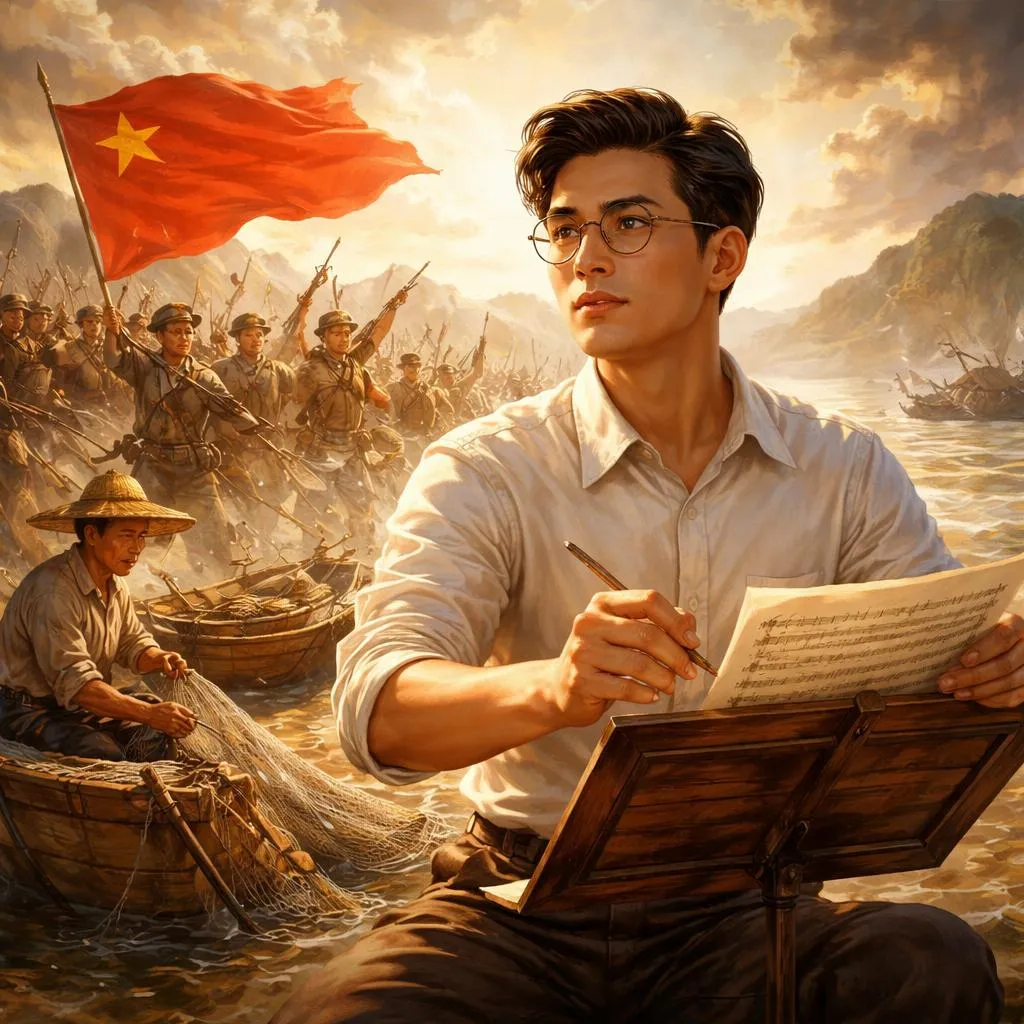

Who Is This Celebrity?
Xian Xinghai was one of China's greatest modern composers. He lived from 1905 to 1945. He grew up in extreme poverty. His father died before he was born. He worked odd jobs to survive. He taught himself music because he could not afford lessons. He later studied in Paris and became a famous composer. During Japan's invasion of China, he wrote the "Yellow River Cantata." This music gave hope to millions. His story shows that poverty cannot stop a determined spirit.
Early Life and Childhood
Xian Xinghai was born in 1905 in Macau. His family was extremely poor. His father died before he was born. His mother raised him alone. They lived on a fishing boat. Young Xian loved listening to the boatmen sing. Their voices were rough but powerful. He also loved watching the waves and listening to the wind. He had no toys. He had no books. He had only the sounds of the sea. He dreamed of making music himself. He could not afford an instrument. He made a simple violin from a tin can and bamboo.
Education and Learning Journey
Xian Xinghai had almost no formal education. He learned to read from his mother. He learned to write by copying signs. At age 7, he moved to Singapore with his mother. He worked as a laborer during the day. He studied at a night school. A kind teacher saw his musical talent. The teacher gave him his first real music lessons. He learned to play the violin and clarinet. At age 20, he earned a scholarship to study in Beijing. He then studied at the National Shanghai Conservatory of Music. But he wanted more. In 1929, he borrowed money and sailed to France.
How Did They Become Successful?
Xian Xinghai became successful through sheer determination. In Paris, he lived in a tiny, cold room. He had no money for food or heat. He worked as a dishwasher, a waiter, and a street cleaner. He practiced music in the freezing dark before going to work. He wrote music on scraps of paper. He studied at the Paris Conservatory. His teachers were amazed by his talent and dedication. He won awards for his compositions. He could have stayed in Paris. He could have become a famous composer in Europe. Instead, he returned to China in 1935. Japan had invaded. His country needed him.
Big Ideas and Achievements
Xian Xinghai's biggest achievement was the "Yellow River Cantata." He wrote it in 1939. The piece has eight movements. It uses folk songs, Western harmony, and Chinese instruments. It describes the power of the Yellow River and the suffering of the Chinese people under invasion. The most famous movement is "The Song of the Yellow River Boatmen." It begins with low, rough voices chanting like laborers pulling a rope. Then the music rises like waves. It ends with a cry of resistance. The cantata was performed for soldiers and refugees. It gave them hope. It made them feel united. It became the anthem of the resistance.
Challenges and Difficult Times
Xian Xinghai faced poverty his entire life. As a child, he had no shoes. He wore rags. He often went hungry. As a student in Paris, he froze in his unheated room. He once collapsed from hunger on the street. He also faced the challenge of war. When Japan invaded, he fled with other refugees. He continued composing while bombs fell. He led singing groups among soldiers. He also faced the challenge of poor health. He had chronic lung disease from years of living in cold, damp rooms. In 1940, he traveled to the Soviet Union for treatment. The war trapped him there. He died in Moscow in 1945 at age 40.
Fun Facts About the Celebrity
Xian Xinghai loved eating cheap noodles with spicy sauce. It was all he could afford for years. He also enjoyed drinking hot water with ginger. He believed it helped his throat. He never owned a suit. He wore simple Chinese robes or European worker's clothes. He kept a small notebook where he wrote musical ideas. He filled dozens of notebooks. He also loved watching Chinese opera. He incorporated opera melodies into his compositions. He never learned to drive a car or ride a bicycle. He walked everywhere. He kept a pet cricket in a bamboo cage. Its chirping inspired his rhythms.
Why Is This Celebrity Important Today?
Xian Xinghai's "Yellow River Cantata" is still performed today. It is considered one of the greatest Chinese musical works of the 20th century. It has been adapted into a piano concerto, a film, and a dance drama. Every Chinese child learns his story in school. His music is taught in conservatories across China. He is remembered not just as a composer, but as a patriot. He used his art to serve his country. He chose poverty and war over comfort and safety. The Central Conservatory of Music in Beijing has a museum dedicated to him. His name is carved in the hall of famous composers in Moscow.
What Can Kids Learn from This Story?
You can learn that poverty does not define you. Xian had nothing but a tin-can violin. He became a great composer. You can also learn that hard work beats talent. He practiced in freezing rooms while others slept. You can learn to serve your community. He returned from France to help his country. You can learn that art can give hope. His music inspired soldiers and refugees. You can also learn that a short life can be meaningful. He died at 40. His music lives forever.
Quick Quiz or Practice Time
Let's see what you remember about Xian Xinghai.
Question 1: What is Xian Xinghai's most famous musical work?
Answer: The Yellow River Cantata.
Question 2: What instrument did young Xian make from a tin can and bamboo?
Answer: A simple violin.
Question 3: What food did Xian Xinghai love eating when he was poor?
Answer: Cheap noodles with spicy sauce.
Question 4: What pet's chirping inspired Xian Xinghai's rhythms?
Answer: A cricket.
Question 5: Where did Xian Xinghai die?
Answer: Moscow, Russia.
Activity: Listen to a recording of "The Song of the Yellow River Boatmen." Close your eyes. Imagine you are pulling a heavy rope on a boat. Feel the rhythm. Hear the waves. This is the power of music to tell a story. Draw a picture of the scene you imagined while listening.
Xian Xinghai could have stayed in Paris. He was successful there. His music was praised. His future was bright. But he heard the news from China. Japan had invaded. His people were dying. He packed his bags and boarded a ship. He returned to a country at war. He returned to poverty. He returned to danger. He slept in caves. He ate whatever he could find. He led soldiers in song. He composed in bomb shelters. He wrote the "Yellow River Cantata" in six days. The music spread like fire. Soldiers sang it before battle. Refugees sang it in camps. Children sang it in schools. It gave them strength. It gave them hope. It gave them a reason to keep fighting. Xian died at 40, far from home. He never saw the victory. But his music did. His music outlived the war. Outlived the invaders. Outlived him. His story teaches us that you do not need a long life to leave a legacy. You need passion. You need courage. You need to serve something greater than yourself. Xian Xinghai did all of that. Now it is your turn. Find your Yellow River. Write your cantata. Sing it loud. That is the way of Xian Xinghai. That is your way too. Now go make some noise.