
Opening Introduction
Mia stood in front of her closet. The sun was shining brightly. "Should I wear my fluffy sweater?" she wondered. Her brother Leo laughed. "No! Look outside. The leaves are green, and it's hot. That's summer weather. You need a T-shirt and shorts!" Their mom joined them. "Leo is right. Every season has its own weather. And for every type of weather, we have corresponding clothing. Getting dressed is easier when you know the seasons and corresponding clothing. It's like being a weather detective who chooses the perfect costume!" Mia put her sweater back. She picked a blue dress. She was ready to be a detective. Let's solve the dressing mystery together.
Core Knowledge Explanation
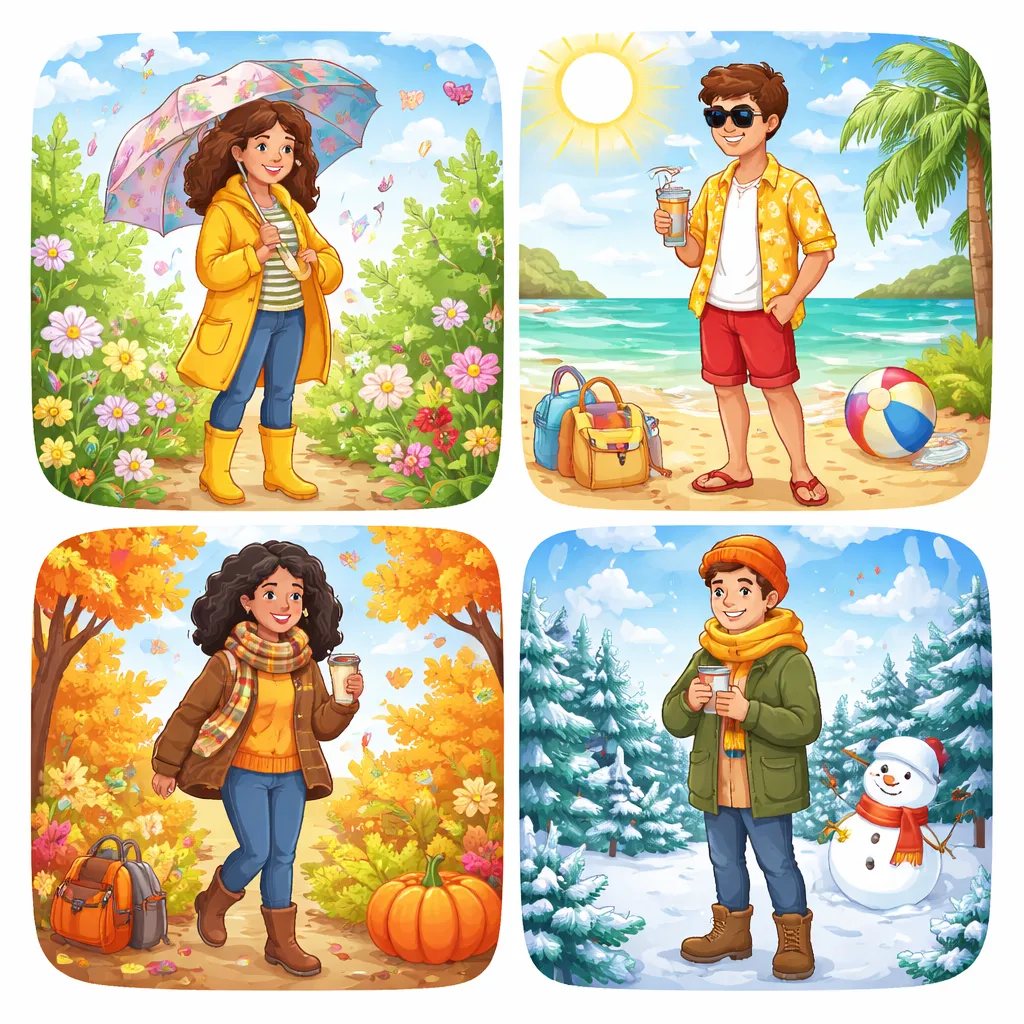
A season is one of the four parts of the year. Each season has different weather, light, and temperature. The four seasons are spring, summer, autumn (or fall), and winter. In each season, we wear different clothes to stay comfortable and healthy. Learning about the seasons and corresponding clothing is a practical and fun way to connect with nature. Let's explore each season. First, spring. Spring comes after winter. The weather gets warmer. Flowers bloom. It can be sunny, but it can also be rainy. The corresponding clothing for spring is often light layers. You might wear a long-sleeved shirt, a light sweater, or a jacket. You can wear jeans or long pants. You might need a raincoat and boots on wet days. Spring clothing is about being ready for change.
Second, summer. Summer is the hottest season. The sun is strong. Days are long. The corresponding clothing for summer is light and cool. You wear T-shirts, tank tops, shorts, skirts, and summer dresses. You wear sandals or sneakers without socks. A sun hat and sunglasses are important for protection. Your clothes are made of thin cotton to help you stay cool. Summer clothing is about beating the heat. Third, autumn or fall. Autumn comes after summer. The weather gets cooler. Leaves change color and fall. The corresponding clothing for autumn is cozy layers. You might wear a sweater, a sweatshirt, or a light jacket. You wear long pants and closed shoes. As it gets colder, you add more layers. Autumn clothing is about staying warm as the temperature drops.
Fourth, winter. Winter is the coldest season. In some places, it snows. Days are short. The corresponding clothing for winter is warm and protective. You wear a heavy coat, a thick sweater, a scarf, a hat, and mittens. You wear warm socks and boots. You might wear thermal underwear. Winter clothing is about keeping the cold out. These are the main seasons and corresponding clothing. Remember, the weather can change, so it is good to be prepared. Knowing what to wear makes playing outside safe and fun all year round.
Fun Interactive Learning
Let's play a game called "Dress the Paper Doll." This is a coloring and dressing activity. Ask a grown-up to help you find a paper doll template online or draw a simple person shape. Make four copies. Now, you have four paper dolls for the four seasons. For the spring doll, color and cut out clothes: a raincoat, jeans, and boots. For the summer doll, cut out a T-shirt, shorts, and a sun hat. For the autumn doll, cut out a sweater and long pants. For the winter doll, cut out a heavy coat, a scarf, and mittens. Dress each doll for its season. As you dress them, say, "In spring, I wear a raincoat. In summer, I wear a T-shirt." This activity uses art to teach the seasons and corresponding clothing.
Another fun activity is the "Season Guess" game. One person describes the weather and clothing without saying the season. "I am wearing a thick coat, a scarf, and boots. I am building a snowman. What season is it?" The others guess, "Winter!" Then switch. You can also play "What's Wrong?" Dress a toy in the wrong clothes. Put a snowsuit on a teddy bear and say it's going to the beach. Your friend must say what is wrong and choose the correct seasons and corresponding clothing. "No! For the beach in summer, you need a swimsuit and a sun hat!" This game is silly and teaches the right choices.
Expanded Learning
Seasons happen because the Earth tilts as it goes around the sun. In different parts of the world, seasons are opposite. When it is summer in the United States, it is winter in Australia. The seasons and corresponding clothing are switched there. In places near the equator, it is warm all year, so people wear summer clothes most of the time. In very cold places, people wear heavy winter clothes for many months. People have worn different clothes in different seasons for thousands of years. Long ago, they used animal skins in winter. Today, we have modern fabrics that keep us warm or cool.
Learning about the seasons and corresponding clothing is also about science. You learn about temperature, weather patterns, and how to protect your body. It is a lesson in adapting to your environment. Many stories and holidays are tied to seasons. Let's make a seasons and clothing song. Sing to the tune of "This Is the Way We Wash Our Clothes."
This is the way we dress in spring, dress in spring, dress in spring! This is the way we dress in spring, with a light jacket on! This is the way we dress in summer, dress in summer, dress in summer! This is the way we dress in summer, in a T-shirt and shorts! This is the way we dress in autumn, dress in autumn, dress in autumn! This is the way we dress in autumn, in a cozy, warm sweater! This is the way we dress in winter, dress in winter, dress in winter! This is the way we dress in winter, in a coat and mittens warm!
What You Will Learn
You are learning about earth science, weather, and practical life skills. You are learning the four seasons and corresponding clothing: spring (raincoat, light jacket, boots), summer (T-shirt, shorts, sun hat), autumn (sweater, long pants, light jacket), winter (heavy coat, scarf, mittens, boots). You are also learning weather words like warm, hot, cool, cold, sunny, and rainy.
You are learning descriptive and instructional sentences. You can say, "In summer, I wear a sun hat to protect my head." You can explain, "When it is cold in winter, I wear a scarf around my neck." You can plan, "Tomorrow is rainy, so I will wear my boots." You are using English to make smart decisions based on the environment. This builds critical thinking and vocabulary.
You are building important knowledge and habits. You are building observation skills. You look at the weather to choose clothes. You are building sequencing skills. You know the order of the seasons. You are building self-care skills. You learn to dress appropriately. You are building scientific understanding. You connect the Earth's tilt to seasonal changes. You are building independence. You can get yourself ready for the day.
Using What You Learned in Life
Use your new knowledge every morning. Look out the window. Check the temperature. Think, "What season is it? What is the weather like today?" Then, choose your clothes. You can be the weather helper for your family. Remind your sibling, "It's cold. Don't forget your sweater." When you go shopping for clothes, think about the seasons and corresponding clothing. "I need a new swimsuit for summer. I need a warm hat for winter." Plan your wardrobe for the whole year.
At school, you can talk about the seasons in science class. You can draw pictures of trees in different seasons and dress a paper person for each. You can also read books about seasons and point out the clothing the characters wear. The more you practice thinking about the seasons and corresponding clothing, the more it will become a natural part of your day. You are becoming a weather-wise and independent person.
Closing Encouragement
You are a season expert. You are a clothing chooser. You are a smart and observant learner. I am so proud of you. Learning about the seasons and their corresponding clothing shows you understand the world around you and know how to take good care of yourself.
May you always be dressed right for the weather, ready for sunny play or snowy adventures. Remember, every season is a gift, and you have the right outfit to enjoy it. You are learning the language of nature and fashion, and that is a language of comfort and joy.
You are prepared, you are knowledgeable, and you are ready for every season. Great work, my wonderful weather detective.