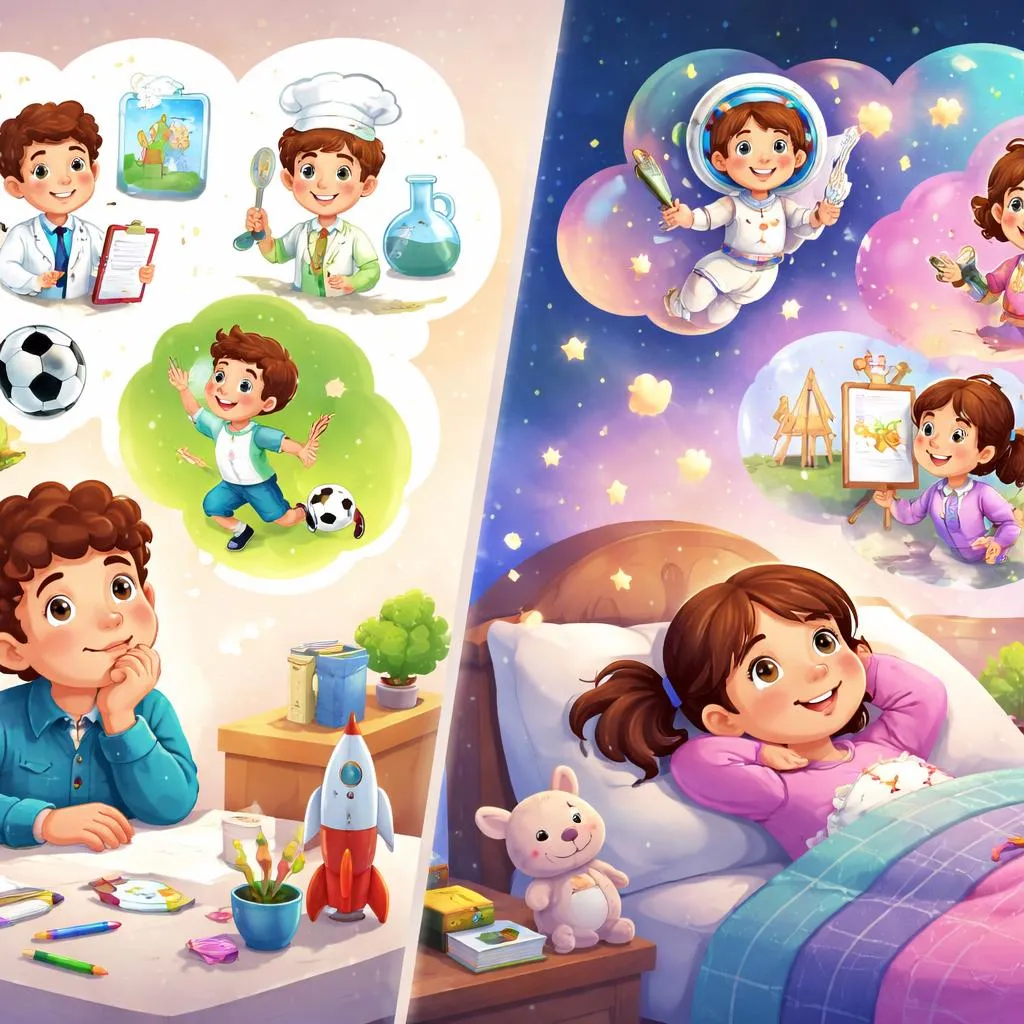

What Do These Expressions Mean? “I want to be” and “my dream is” both tell someone about a future goal or wish. They express what a child hopes to become or achieve when they grow up. Children say these words when talking about jobs, talents, or big hopes. Both describe aspirations.
“I want to be” means I have a desire to become a certain kind of person or worker. It is direct and common. A child says it when saying “I want to be a teacher.” It is a statement of intention.
“My dream is” means my deepest wish for the future is this. It is more emotional and powerful. A child says it when sharing a heartfelt goal. It feels more special.
These expressions seem similar. Both mean “I hope to become this.” Both describe future goals. But one is a direct statement while one is a deeper, more emotional wish.
What's the Difference? One is a direct statement of desire. One is a heartfelt, deeper wish. “I want to be” is what you say in everyday conversation. It is simple and clear. It is the most common phrase for children.
“My dream is” is stronger and more emotional. It means “this is what I truly hope for more than anything.” It is used for bigger, more passionate goals. It is not for everyday small wishes.
Think of a child saying “I want to be a firefighter.” That is a goal. Now think “My dream is to be a firefighter.” That sounds more passionate. One is for stating. One is for sharing a deep hope.
One is for everyday talk. The other is for special moments. “I want to be” for school assignments. “My dream is” for bedtime conversations. Use the first for routine. Use the second for heartfelt sharing.
Also, “my dream is” implies the goal might be harder to reach. A dream is something you hope for deeply. A want is something you desire.
When Do We Use Each One? Use “I want to be” for most everyday goal talk. Use it for career day, family questions, or simple statements. Use it as the standard phrase. It fits daily life.
Examples at home: “I want to be a doctor like my mom.” “I want to be a pilot when I grow up.” “I want to be strong like my dad.”
Use “my dream is” for deeper, more heartfelt sharing. Use it when you really feel strongly about the goal. Use it in special moments. It fits emotional talk.
Examples for dreams: “My dream is to be a singer on a big stage.” “My dream is to help animals every day.” “My dream is to travel the world.”
Children can use both. “I want to be” for everyday. “My dream is” for passion. Both share goals.
Example Sentences for Kids I want to be: “I want to be a chef.” “I want to be an artist.” “I want to be a bus driver.”
My dream is: “My dream is to be a famous dancer.” “My dream is to work at a zoo.” “My dream is to invent something new.”
Notice “I want to be” is simple and direct. “My dream is” is deeper and more emotional. Children learn both. One for saying. One for feeling.
Parents can use both. Career talk: “I want to be.” Heartfelt sharing: “my dream is.” Children learn different expression levels.
Common Mistakes to Avoid Some children say “my dream is” for every small thing. That makes the word less special. Save “my dream is” for deep, passionate wishes. Use “I want to be” for everyday goals.
Wrong: “My dream is to eat ice cream.” (too small) Better: “I want to eat ice cream.”
Another mistake: using “I want to be” for a dream that feels very strong. That is fine, but “my dream is” adds emotion. If you feel deeply, use “my dream is.”
Wrong: “I want to be a hero.” (fine) Better for passion: “My dream is to be a hero.”
Some learners think “dream” is only for sleeping. In English, “dream” also means a deep hope. Teach both meanings.
Also avoid saying “my dream is” for things you can control right now. If you can start today, say “I will be.” Save “dream” for long-term hopes.
Easy Memory Tips Think of “I want to be” as a pencil on paper. Write a goal. Simple. For everyday statements.
Think of “my dream is” as a star in the sky. Wish upon it. Special. For deep hopes.
Another trick: remember the strength. “Want” is everyday. “Dream” is passionate. Everyday gets “I want to be.” Passionate gets “my dream is.”
Parents can say: “Want for a plan. Dream for a grand span.”
Practice at home. Career day: “I want to be.” Bedtime wish: “my dream is.”
Quick Practice Time Let us try a small exercise. Choose the better phrase for each situation.
A child is asked what job they want by a friend at school. a) “My dream is to be a teacher.” b) “I want to be a teacher.”
A child is talking to a parent about their deepest hope of becoming an astronaut. a) “I want to be an astronaut.” b) “My dream is to be an astronaut.”
Answers: 1 – b. A casual, everyday question fits the direct “I want to be.” 2 – b. A deep, passionate hope fits the emotional “my dream is.”
Fill in the blank: “When I tell my teacher what job I hope for, I say ______.” (“I want to be” is the natural, everyday, direct choice.)
One more: “When I share my biggest hope with my mom at night, I say ______.” (“My dream is” fits the heartfelt, passionate, emotional language.)
Every child has a dream. “I want to be” shares the plan. “My dream is” shares the heart. Teach your child both. A child who learns both can speak their future and feel it too.