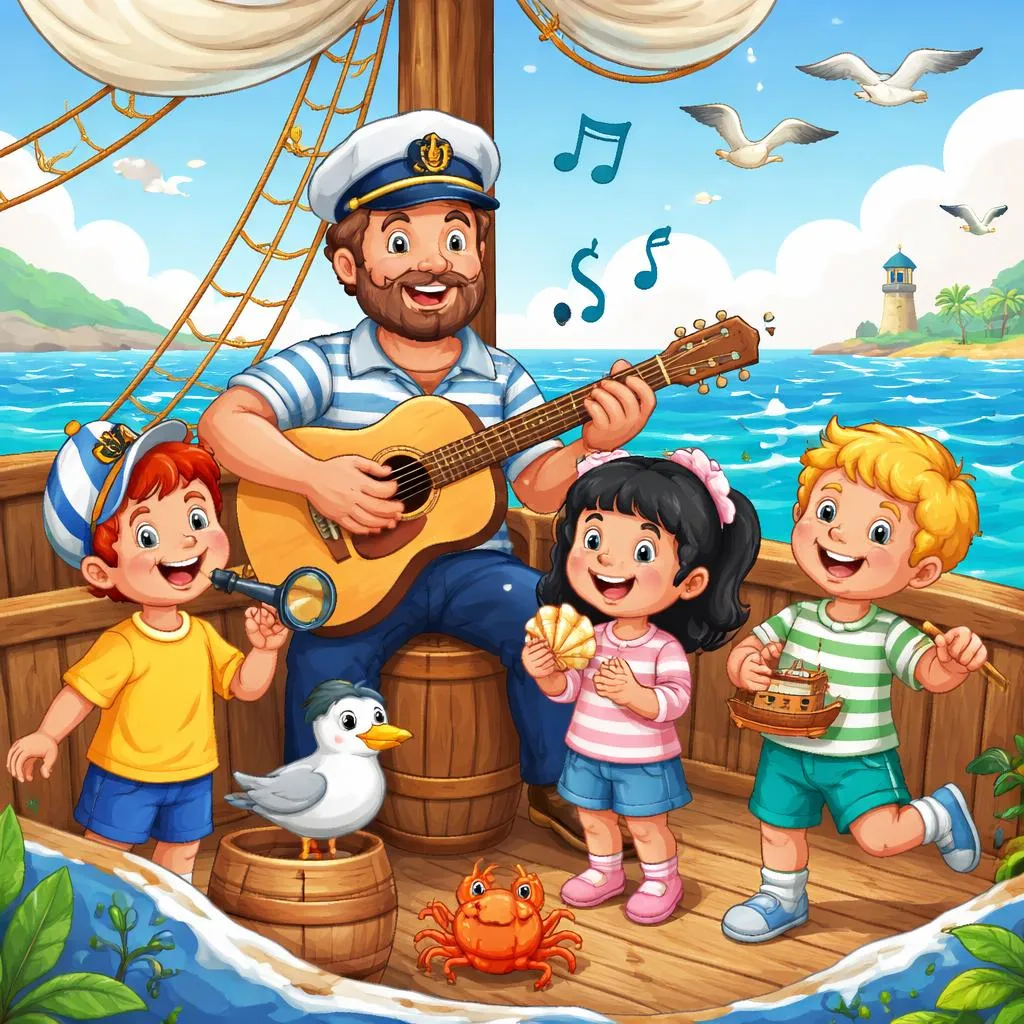

Hello, young sailors! Welcome to our musical voyage today. We climb aboard a big ship. We ask the question what's the sailor song about. This rhyme takes us on an ocean adventure.
Sailor songs tell stories about life at sea. Some are about working on ships. Some are about faraway places. Some are about coming home again. They have been sung for hundreds of years.
Let us hoist the sails and catch the wind. Let us discover the stories behind these songs. The ocean of English learning awaits us.
What is the Rhyme?
To answer what's the sailor song about, we must look at different sailor songs. Many exist. One famous one is "A Sailor Went to Sea, Sea, Sea." Children love this clapping rhyme.
Another is "My Bonnie Lies Over the Ocean." This is a gentle song about missing someone far away. Sailors sang it while thinking of home.
"The Big Ship Sails on the Alley-Alley-O" is another. It describes a ship sailing through wind and waves. Children sing it in a circle game.
These songs are about adventure, work, and longing. They tell of life on the ocean. They mention parts of ships and the sea. They help children imagine what sailors do.
Sailor songs often have strong rhythms. Sailors used them to work together. Pulling ropes and raising sails needed teamwork. The songs kept everyone moving at the same time.
The Lyrics of Nursery Rhymes
Let us look at a popular sailor song. These lyrics help answer what's the sailor song about.
A sailor went to sea, sea, sea,
To see what he could see, see, see.
But all that he could see, see, see,
Was the bottom of the deep blue sea, sea, sea.
Another version has more verses.
A sailor went to chop, chop, chop,
To see what he could chop, chop, chop.
But all that he could chop, chop, chop,
Was the bottom of the deep blue chop, chop, chop.
A sailor went to knee, knee, knee,
To see what he could knee, knee, knee.
But all that he could knee, knee, knee,
Was the bottom of the deep blue knee, knee, knee.
This is a clapping game. Children do actions while singing. They make sea motions, chopping motions, and knee slaps. The words are simple and repeat.
Another famous sailor song is "My Bonnie Lies Over the Ocean."
My Bonnie lies over the ocean,
My Bonnie lies over the sea.
My Bonnie lies over the ocean,
Oh, bring back my Bonnie to me.
Bring back, bring back,
Oh, bring back my Bonnie to me, to me.
Bring back, bring back,
Oh, bring back my Bonnie to me.
This song tells of missing someone named Bonnie. Bonnie could be a person or a place. Sailors far from home sang it with feeling.
Vocabulary Learning
These sailor songs teach many useful words. Let us look at each important word.
Sailor: A sailor is a person who works on a ship. Sailors travel across oceans. They know how to navigate and handle boats.
Sea: The sea is the big salt water covering much of Earth. It is also called the ocean. Sailors spend their lives on the sea.
Ship: A ship is a large boat. It carries people and things across water. Ships have sails or engines to move.
Bottom: The bottom is the lowest part. The bottom of the sea is the ground under all the water. The sailor in the song sees only the bottom.
Deep blue: This describes the ocean. Deep means far down. Blue is the color of clean water. The deep blue sea is a common phrase.
Chop: This means to cut with quick strokes. In the clapping game, children make chopping motions with their hands.
Knee: This is the joint in the middle of the leg. Children slap their knees in the clapping game.
Bonnie: This could be a person's name. It might also mean pretty or beautiful in Scottish English. My Bonnie means my pretty one or my loved one.
Ocean: The ocean is the huge body of salt water. There are five oceans on Earth. The Atlantic, Pacific, Indian, Arctic, and Southern.
Bring back: This means to return something or someone. The singer wants Bonnie brought back to them.
Phonics Points
Now let us practice some sounds from sailor songs. Phonics helps us read and say words correctly.
Listen to the beginning of "sailor." It starts with the "s" sound. Put your tongue near the roof of your mouth. Let air flow over it. Say "s-s-s." Now say "sailor." Feel the air moving.
Listen to the long "a" sound in "sailor" and "sea." In "sailor," the "ai" makes a long a sound. Say "ay-ay-ay." In "sea," the "ea" makes a long e sound. Say "ee-ee-ee." These are different.
Listen to the "sh" sound in "ship." Put your lips forward a little. Let air flow out. Say "sh-sh-sh." Now say "ship." This sound is soft and quiet.
Listen to the "b" sound in "bottom" and "blue." Press your lips together. Let air build. Pop them open. Say "b-b-b." Now say "bottom." Now say "blue."
Listen to the long "o" sound in "ocean" and "Bonnie." Say "oh-oh-oh." Now say "ocean." The "o" is the first sound. For "Bonnie," the "o" is short like in "hot."
Grammar Patterns
These sailor songs teach us some useful grammar. Grammar is how we put words together in sentences.
We see the past tense in "A sailor went to sea." "Went" is the past of go. This tells us the action happened before. The sailor already went to sea.
We see the modal "could" in "all that he could see." "Could" shows ability in the past. He was able to see only the bottom.
We see repetition for emphasis and rhythm. "Sea, sea, sea" repeats three times. "See, see, see" repeats. "Chop, chop, chop" repeats. This makes the song bouncy and fun.
We see prepositions of place. "Over the ocean" tells us where Bonnie lies. "Over the sea" repeats the idea. Prepositions show location.
We see commands or requests. "Bring back my Bonnie" asks someone to return Bonnie. This is a polite command using the base verb.
We see the possessive "my" showing ownership. "My Bonnie" means Bonnie belongs to me or is loved by me. Possessives show relationships.
Learning Activities
Let us do some fun activities with sailor songs. These help answer what's the sailor song about through hands-on learning.
Activity 1: Clapping Game
Teach the clapping motions for "A Sailor Went to Sea." For "sea, sea, sea," make wave motions with hands. For "chop, chop, chop," make chopping motions. For "knee, knee, knee," slap knees. Practice the song with motions.
Activity 2: Paper Boat Making
Fold paper to make simple boats. Use instructions to create origami boats. Float them in a tub of water. Sing sailor songs while the boats float. This connects words to real objects.
Activity 3: Ocean Drawing
Draw a picture of the ocean. Include a ship, waves, and maybe a sailor. Label the parts in English. Ship, sea, sailor, waves, sky. This combines art with vocabulary.
Activity 4: Bonnie Drawing
Ask children to imagine who or what Bonnie might be. Draw a picture of Bonnie. It could be a person, a pet, or even a place. Share drawings and explain.
Printable Materials
We can make printable materials for sailor songs. These help answer what's the sailor song about through visual learning.
Lyric Sheet
Print the words of both sailor songs on one page. Use large, clear letters. Add drawings of ships, waves, and sailors. Children follow along while singing.
Coloring Page
Draw a simple ship on the ocean. Add waves and a sailor. Children color the picture. Below, write the words "ship" and "sailor" for tracing.
Boat Number Match
Draw several boats with numbers on their sails. 1, 2, 3, 4, 5. On another sheet, draw the same number of waves next to each number. Children match the boats to the correct wave groups.
Word Cards
Print cards with words from the songs. Sailor, sea, ship, ocean, bottom, Bonnie, bring, chop, knee. On the back, draw simple pictures. Practice matching words to pictures.
Story Sequencing Sheet
For "A Sailor Went to Sea," print pictures showing the sailor going to sea, looking, and seeing the bottom. Children arrange in order and retell the story.
Educational Games
Games make learning with sailor songs even more fun. Here are some games to play.
Game 1: Sailor Says
Play like Simon Says but with a sailor. The sailor gives commands related to ships. Sailor says climb the mast. Sailor says look through the telescope. Sailor says row the boat. Children follow only if "Sailor says" comes first.
Game 2: Sea, Sea, Sea Freeze
Play the sailor song. Children dance like sailors on a ship. They can pretend to climb, row, or look through telescopes. When the music stops, everyone freezes like statues. The last to freeze sits down.
Game 3: What's in the Ocean?
Place pictures of ocean things in a bag. Fish, whale, ship, sailor, treasure, shell. Children pull one out and name it. They can also say a sentence. "A fish lives in the ocean."
Game 4: Bonnie, Bonnie, Sailor
Play like Duck, Duck, Goose. Children sit in a circle. One child walks around tapping heads saying "Bonnie, Bonnie, Bonnie." When they tap someone and say "Sailor," that child jumps up and chases them around the circle.
Game 5: Memory Match
Make pairs of cards with words and pictures from the songs. Sailor, sea, ship, ocean, Bonnie. Lay all cards face down. Players take turns flipping two cards. If they match, they keep the pair and say the word.
Game 6: What Word Is Missing?
Write the lyrics on the board with some words missing. A sailor went to ___, sea, sea. To see what he could ___, see, see. Children guess the missing words. This builds memory and reading skills.
Game 7: Sailor Movement Game
Call out different sailor actions. Climb the mast - children reach up high. Row the boat - children make rowing motions. Look through telescope - children make circles with hands at eyes. Swab the deck - children pretend to mop. This builds listening and following directions.
Game 8: Rhyming Word Match
Find words from the songs that rhyme. Sea and see rhyme. Chop and stop rhyme. Knee and me rhyme. Ocean and motion rhyme. Bring and sing rhyme. Make cards with these words and have children find rhyming pairs.
Game 9: Story Sequencing for Bonnie
Print pictures showing a possible story for Bonnie. Bonnie with the sailor. The sailor leaving. Bonnie waiting. The sailor returning. Children arrange in order and tell the story.
Game 10: Pass the Ship
Sit in a circle with a small toy ship. Play a sailor song softly. Children pass the ship around. Stop the music suddenly. The child holding the ship must say a word from the sailor song.
Game 11: Ocean Animal Game
Name an ocean animal. Fish, whale, dolphin, shark, octopus. Children act out that animal moving in the ocean. This combines movement with vocabulary.
Game 12: Sailor Hat Craft
Make simple sailor hats from paper. Use white paper and fold into hat shapes. Add a blue ribbon or draw an anchor. Wear the hats while singing sailor songs.
Game 13: What's the Sailor Song About? Discussion
Have a class discussion answering the question. What are sailor songs about? The sea, ships, missing people, working, adventure. Write ideas on the board. This builds comprehension and speaking.
Game 14: Create a Verse
Encourage children to make their own verse for "A Sailor Went to Sea." A sailor went to ___, ___, ___. To see what he could ___, ___, ___. Fill in with new words. A sailor went to jump, jump, jump. This builds creativity.
Game 15: Bonnie Letter Writing
Pretend to be the sailor far from Bonnie. Write a short letter to Bonnie. "Dear Bonnie, I miss you. The sea is big and blue. I will come home soon." This builds writing skills.
Game 16: Wave Action
Use a long blue scarf or piece of fabric. Children hold the edges and make wave motions. They make small waves for calm sea. They make big waves for stormy sea. Sing sailor songs while making waves.
Game 17: Sailor Dress Up
Provide simple costume pieces. A sailor hat, a blue scarf for the sea, a telescope made from paper rolls. Children dress up and act out being sailors.
Game 18: Ship Building with Blocks
Use building blocks to construct a ship. Include a mast, a deck, and a cabin. While building, use words from the songs. "This is the mast. This is the deck."
Game 19: Compass Directions
Teach simple compass directions. North, South, East, West. Play a game where children move in different directions when called. "Sailors, go north!" This connects to navigation.
Game 20: Treasure Hunt
Hide a small treasure box somewhere in the room. Give clues using sailor language. "Sail south to the bookshelf. Look under the blue pillow." Children follow the clues to find treasure.
Game 21: Float or Sink Experiment
Gather small objects. A cork, a coin, a pencil, a rock. Predict if each will float or sink. Test in water. Use words from the songs. "The ship floats. The rock sinks to the bottom."
Game 22: Sailor Song Puzzle
Print the lyrics and cut them into separate lines. Mix up the lines. Children put them in the correct order of the song. This builds reading and sequencing skills.
Game 23: Ocean Sounds
Listen to recordings of ocean sounds. Waves crashing, seagulls calling, ships horn. Children close their eyes and imagine they are at sea. This builds listening and imagination.
Game 24: Sailor Journal
Pretend to be a sailor on a long voyage. Write a journal entry about one day at sea. "Today I saw dolphins. The weather was sunny. I miss home." This builds narrative skills.
Game 25: Sea Shanty Sing-Along
Learn a simple sea shanty. Shanties were work songs sailors sang. "What shall we do with a drunken sailor?" is a famous one. Sing together with strong rhythm.
So now we can answer what's the sailor song about. Sailor songs are about life at sea. They tell of adventure and work. They express longing for home and loved ones. They teach about ships, oceans, and sailing.
Every time children sing these songs, they travel in their imagination. They become sailors on the big blue sea. They learn that English can take them anywhere.
Keep singing and sailing. Keep learning new words about the ocean. The sea of English is wide and deep, and there is always more to discover. Happy sailing, everyone