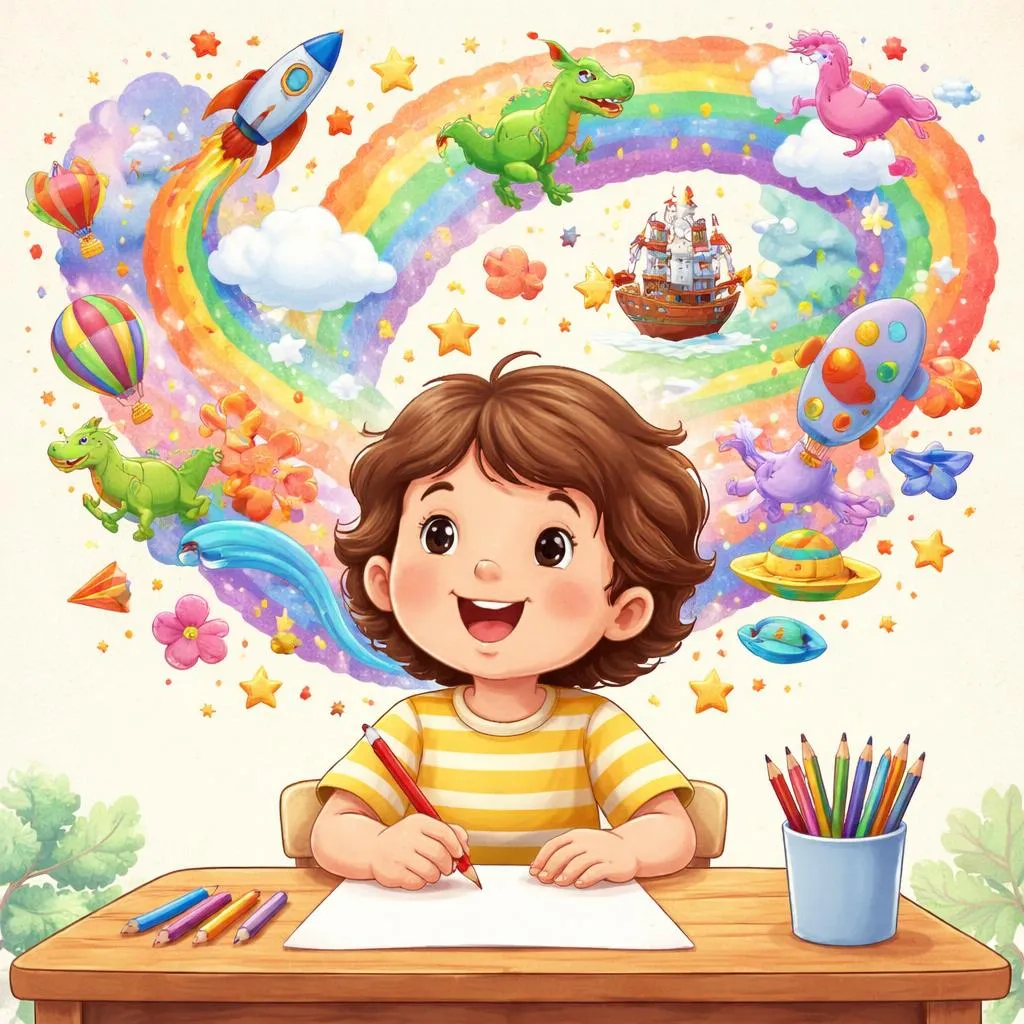

What Do These Expressions Mean? “Be creative” and “use your imagination” both mean to think of new, original, or unusual ideas. They tell a child to move beyond the obvious and explore possibilities. Children hear these words when drawing, writing, building, or solving problems. Both build innovation.
“Be creative” is a broad instruction to think originally. A parent says it when a child asks “What should I draw?” It encourages fresh thinking.
“Use your imagination” means to picture things in your mind that are not in front of you. It is about mental images and fantasy. A parent says it during pretend play. It feels more playful.
These expressions seem similar. Both mean “think of something new.” Both encourage originality. But one is about original thinking while one is about mental imagery.
What's the Difference? One is about original thinking and problem-solving. One is about mental imagery and pretend. “Be creative” is for art, inventions, and new solutions. It can be for practical things. It is broader.
“Use your imagination” is for play, stories, and picturing things. It is more about fantasy. It is for making believe. It is softer.
Think of a child building a fort. “Be creative with the blankets” means find new ways to use them. “Use your imagination to pretend this is a castle” means picture it. One is for design. One is for pretend.
One is for making new things. The other is for seeing new things in your mind. “Be creative” for a sculpture. “Use your imagination” for a story. Use the first for originality. Use the second for mental images.
Also, “be creative” can feel like pressure to some children. “Use your imagination” is softer.
When Do We Use Each One? Use “be creative” for original thinking and problem-solving. Use it for art, inventions, and new ideas. Use it to encourage innovation. It fits making talk.
Examples at home: “Be creative with your LEGOs.” “The box can be anything. Be creative.” “Be creative and find a new way to solve this.”
Use “use your imagination” for pretend play and mental imagery. Use it for stories, costumes, and make-believe. Use it to encourage fantasy. It fits pretend talk.
Examples for pretend: “Use your imagination to pretend you are in a jungle.” “What if you could fly? Use your imagination.” “Use your imagination to add a dragon to your story.”
Children can use both. “Be creative” for making. “Use your imagination” for pretend. Both build a creative child.
Example Sentences for Kids Be creative: “Be creative with your drawing.” “We need a new game. Be creative.” “Be creative and think of something no one has seen before.”
Use your imagination: “Use your imagination to picture a purple elephant.” “When you play, use your imagination.” “Use your imagination to make up a new ending.”
Notice “be creative” is for making new things. “Use your imagination” is for mental pictures and pretend. Children learn both. One for making. One for dreaming.
Parents can use both. Building: “be creative.” Pretending: “use your imagination.” Children learn different creativity words.
Common Mistakes to Avoid Some children think being creative means making something perfect. Creativity is about trying new things, not perfection. A messy drawing can be creative.
Wrong: “My drawing isn’t perfect, so I’m not creative.” Better: “I tried something new. That’s creative.”
Another mistake: thinking imagination is only for kids. Adults use imagination too. We all use imagination to solve problems.
Wrong: “Imagination is just for play.” Better: “Imagination helps us in art, science, and life.”
Some learners think “be creative” means you need materials. You can be creative with words, ideas, and movement too.
Also avoid comparing creativity. “His drawing is more creative than yours” is hurtful. Celebrate each child’s unique creativity.
Easy Memory Tips Think of “be creative” as a paintbrush making a new color. Mixing. Making. For original thinking.
Think of “use your imagination” as a rocket ship made of a cardboard box. Pretending. Dreaming. For mental imagery.
Another trick: remember the activity. “Be creative” = making. “Use your imagination” = imagining. Making gets “be creative.” Imagining gets “use your imagination.”
Parents can say: “Create for a make. Imagine for a fake.”
Practice at home. Building: “be creative.” Pretend play: “use your imagination.”
Quick Practice Time Let us try a small exercise. Choose the better phrase for each situation.
A child wants to build a fort with couch cushions. a) “Use your imagination to pretend it’s a cave.” b) “Be creative with how you stack the cushions.”
A child is telling a story about a talking squirrel. a) “Be creative with the squirrel.” b) “Use your imagination. What happens next?”
Answers: 1 – a or b. Both work. “Be creative” is for building; “imagination” is for pretending. 2 – b. A storytelling moment fits the playful “use your imagination.”
Fill in the blank: “When my child needs to solve a problem in a new way, I say ______.” (“Be creative” is the original-thinking, problem-solving, making choice.)
One more: “When my child starts a pretend game, I say ______.” (“Use your imagination” fits the mental-imagery, pretend-play, story-making description.)
Creativity is a superpower. “Be creative” makes new things. “Use your imagination” sees new worlds. Teach your child both. A child who learns both will build and dream.