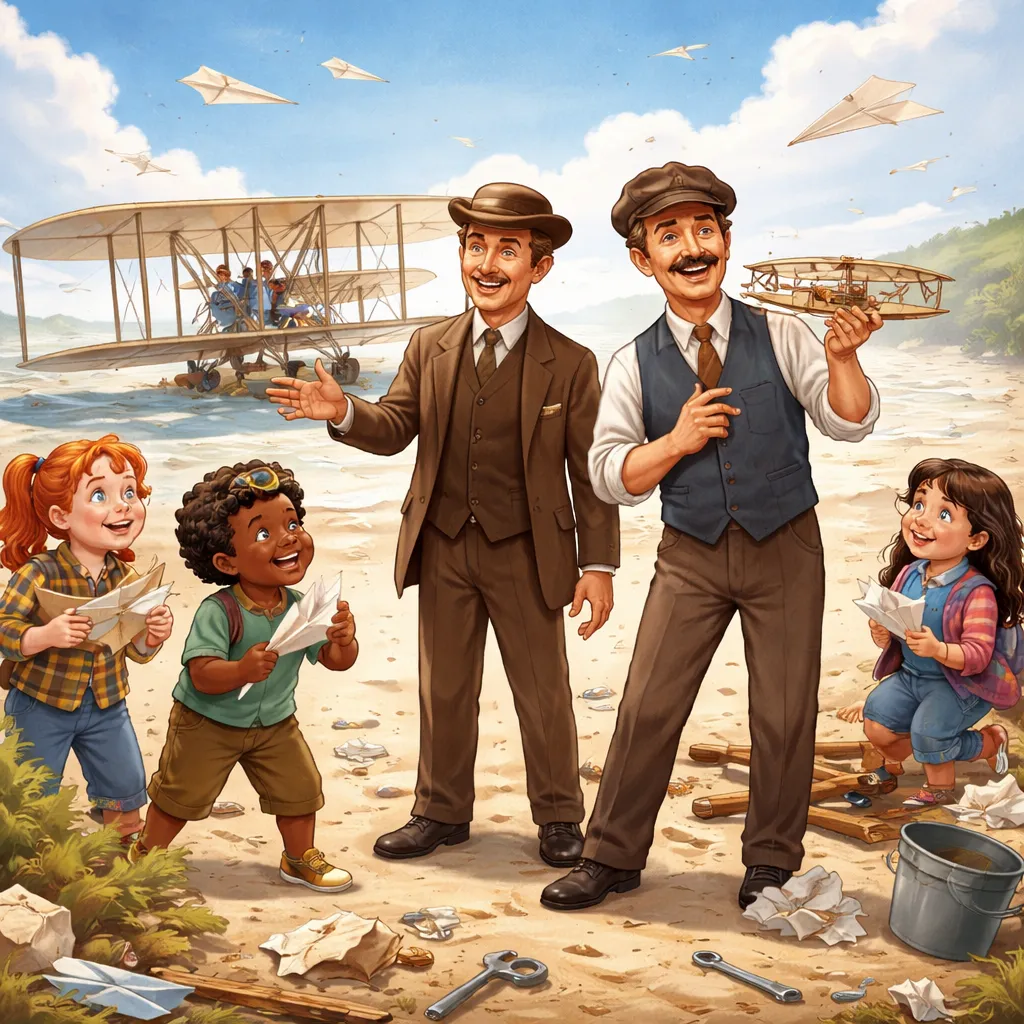

Introduction to Wright Brothers
The Wright brothers were two American inventors and aviation pioneers. Their names were Wilbur Wright and Orville Wright. This celebrity story: Wright Brothers shows how two ordinary men solved an impossible puzzle. They built the first successful powered airplane. Children can learn that big dreams need patience and practice. Parents can use their story to teach problem-solving and teamwork. The brothers did not go to college. They did not have government money. They owned a bicycle shop. Yet they changed how humans travel forever. Their story proves that curiosity and hard work beat fame and fortune. Every family can find lessons in their quiet determination.
Early Life and Background
Wilbur Wright was born in 1867 in Millville, Indiana. Orville Wright was born in 1871 in Dayton, Ohio. Their father, Milton Wright, was a bishop in the Church of the United Brethren in Christ. Their mother, Susan Wright, loved building things. She made toys and repaired household machines. The family moved often but settled in Dayton. Both brothers loved learning, but neither finished high school. Wilbur planned to attend Yale. A hockey accident injured his face and broke his teeth. He spent three years at home recovering. He lost his chance to go to college. Orville dropped out of high school to start a printing business. Together they printed a small newspaper. Later they opened a bicycle repair and sales shop. They built their own bicycles. Working with wheels, chains, and gears taught them about balance and control. That knowledge became useful for flying machines. Their mother died from tuberculosis in 1889. The brothers stayed close to their father and sister, Katharine. She supported their flying experiments for many years.
Career Highlights and Achievements
The Wright brothers began studying flight in 1899. They read every book about birds and gliders. They watched how vultures kept their balance in the wind. First they built kites. Then they built gliders. They traveled to Kitty Hawk, North Carolina, for strong and steady winds. The sand dunes also made crash landings softer. Between 1900 and 1902, they tested over 200 different wing shapes. They built their own wind tunnel. No one had ever done such careful flight experiments. On December 17, 1903, their hard work paid off. Orville flew the first powered airplane, the Wright Flyer. The flight lasted 12 seconds and covered 120 feet. Wilbur flew 852 feet in a later flight that same day. Only five people watched. The brothers did not call newspapers immediately. They wanted to improve their invention first. Over the next two years, they built better airplanes. By 1905, they could fly for 30 minutes at a time. They received a U.S. patent for their wing-warping control system. In 1908, Wilbur flew in France for huge crowds. He became a world celebrity overnight.
Famous Works or Performances
The Wright brothers’ most famous work is the 1903 Wright Flyer. This airplane had a wingspan of 40 feet. It weighed only 605 pounds without the pilot. The Flyer used a 12-horsepower engine built by their mechanic, Charlie Taylor. The brothers designed the propellers themselves. No existing propeller worked for their needs. Another famous work is the 1905 Wright Flyer III. This was the first practical airplane. It could turn, bank, and stay in the air for over 30 minutes. Many people consider it the world’s first true aircraft. The brothers also built a wind tunnel in their bicycle shop. This small device was only 6 feet long. But it gave them accurate data on wing shapes. They tested over 200 miniature wings. Their wind tunnel experiments were more scientific than any previous flight research. The Wright Company, founded in 1909, produced many early training planes. The U.S. Army bought its first military airplane from the Wright brothers in 1909. These machines now live in museums. Visitors can see the 1903 Wright Flyer at the National Air and Space Museum in Washington, D.C.
Personal Life and Fun Facts
Neither brother ever married. They lived together their whole lives with their father and sister. A fun fact is that they never learned to drive a car. They preferred bicycles. Another interesting fact is that the brothers chose Kitty Hawk because of a letter from the U.S. Weather Bureau. They wrote asking for the windiest place in America. The answer was Kitty Hawk. Orville loved taking photographs. He captured the first aerial photo from a plane in 1908. Wilbur enjoyed reading and solving puzzles. He also liked playing the harmonica. The brothers almost never argued. When they disagreed, they talked calmly until they found a solution. They shared equal credit for everything. They flipped a coin to decide who would fly first on December 17, 1903. Orville won the coin toss. One more fun fact is that their sister Katharine helped pay for their early experiments. She worked as a teacher and sent them money. The brothers called her “the best sister on earth.”
Legacy and Influence
The Wright brothers changed the world completely. Before 1903, humans could only dream of flying. After 1903, flight became real. Their invention led to military aviation, commercial airlines, and space travel. Every pilot today uses the three-axis control system they invented. Roll, pitch, and yaw. Those terms come directly from Wright brothers’ patents. Their wind tunnel methods became standard in engineering. The Smithsonian Institution honors them in its main air and space museum. The Wright brothers’ bicycle shop still stands in Dayton, Ohio. It is part of the Dayton Aviation Heritage National Historical Park. December 17 is now Wright Brothers Day in the United States. Schools and museums celebrate their achievement. Their influence reaches every child who folds a paper airplane. Every passenger who looks out a plane window. Every astronaut who floats in space. Two bicycle mechanics from Ohio started all of it. Their legacy proves that you do not need a university degree or a rich family. You need curiosity, patience, and a willingness to fail.
Quotes or Famous Sayings
The Wright brothers left many wise words. Wilbur once said, “It is possible to fly without motors, but not without knowledge and skill.” Orville said, “If we worked on the assumption that what is accepted as true really is true, then there would be little hope for advance.” Another famous quote from Wilbur is, “The desire to fly is an idea handed down to us by our ancestors who looked up at the birds and envied them.” Orville also said, “Isn’t it astonishing that all these secrets have been preserved for so many years just so we could discover them?” Families can read these quotes together. Ask children, “What does it mean to question what everyone believes?” The brothers did not accept that humans could never fly. They tested everything themselves. That attitude can help children in school and in life.
How to Learn from Wright Brothers
Children can learn several lessons from the Wright brothers. First, failure is not the end. It is data. They crashed many gliders. Each crash taught them something new. Second, start with what you know. They understood bicycles. Then they applied that knowledge to wings. Third, work as a team. Neither brother could have succeeded alone. Parents can encourage young children to build and test simple things. Fold different paper airplane designs. See which one flies farthest. Record the results. That is a mini Wright brothers experiment. Older children can build a rubber-band-powered model plane. They can measure flight time and distance. Change one part at a time. See what improves. Families can also visit a science museum with an aviation exhibit. Look for the three-axis controls. Another idea is to read a children’s book about the Wright brothers together. Then draw a picture of your own flying machine. What shape would the wings have? Where would the pilot sit? The Wright brothers showed that ordinary people can achieve extraordinary things. They did not have magic. They had patience, curiosity, and a bicycle shop. Every child holds those same tools. The sky is not the limit. It is just the beginning.