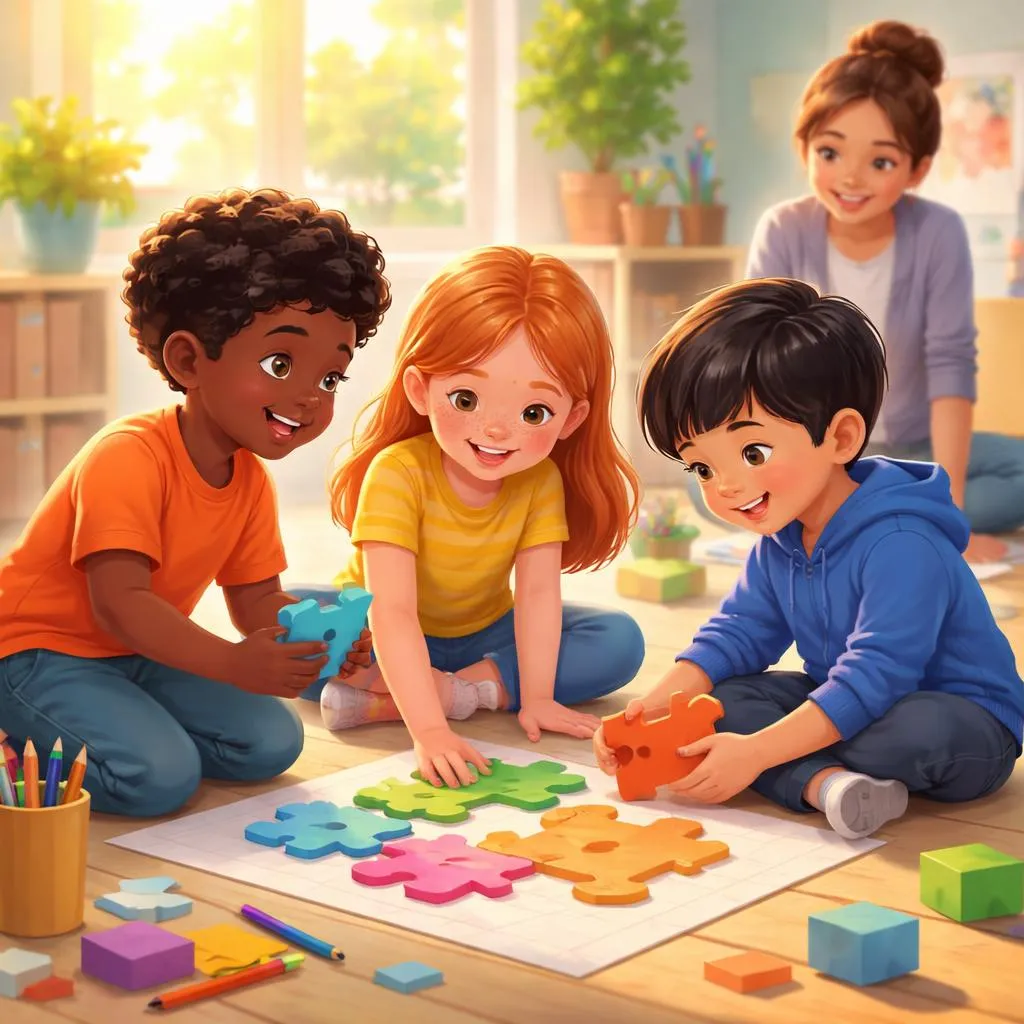

What Do These Expressions Mean? “Work together” and “cooperate” both tell children to join efforts to reach a common goal. They instruct kids to share ideas, take turns, and help each other. Children hear these words during group projects, clean-up time, or sports. Both build teamwork.
“Work together” means join your actions to complete a task. It is concrete and clear. A parent says it when two children need to build something. It focuses on the shared action.
“Cooperate” means act in a way that helps the group succeed. It is a more general attitude. A teacher says it during a class activity. It focuses on the spirit of helpfulness.
These expressions seem similar. Both ask children to stop fighting and start helping. Both get tasks done faster. But one is about the action while one is about the attitude.
What's the Difference? One is about the action. One is about the attitude. “Work together” names the action of joining hands. It is specific and easy to picture. Young children understand it well.
“Cooperate” is about the willingness to help. It is a bigger word and a bigger idea. It means listening, sharing, and not fighting. It is more about the heart.
Think of children building a block tower. “Work together to make it tall” is clear. “Cooperate so it doesn't fall” is also good. One tells them what to do. One tells them how to be.
One is for specific tasks. The other is for general behavior. “Work together” for building, cleaning, or moving something heavy. “Cooperate” for playing, sharing, or being in a group. Use the first for tasks. Use the second for attitude.
Also, “cooperate” sounds a bit formal. Young children understand “work together” better. Say “work together” first. Then teach “cooperate” as they grow.
When Do We Use Each One? Use “work together” for specific shared tasks. Use it for cleaning up, building, moving, or creating. Use it when you want children to join their actions. It fits concrete moments.
Examples at home: “Work together to put the toys in the bin.” “If you two work together, you can lift that box.” “Work together on your fort. One holds, one tapes.”
Use “cooperate” for general behavior and attitude. Use it during group games, class activities, or sibling play. Use it when you want children to be helpful and not fight. It fits attitude guidance.
Examples for attitude: “Please cooperate during the game. No pushing.” “Cooperate with your brother. Let him have a turn.” “I need everyone to cooperate on this field trip.”
Children need both phrases. “Work together” for actions. “Cooperate” for attitude. Both build teamwork.
Example Sentences for Kids Work together: “Work together to carry the groceries.” “If we work together, we can finish faster.” “Work together like a team.”
Cooperate: “The teacher asked us to cooperate during the science experiment.” “Cooperate with your sister. Take turns.” “Cooperate or we cannot go to the park.”
Notice “work together” is about hands. “Cooperate” is about hearts and rules. Children learn both. One for doing. One for being.
Parents can use both. Clean-up: “work together.” Playtime: “cooperate.” Children learn teamwork at different levels.
Common Mistakes to Avoid Some parents say “cooperate” to a toddler. The toddler may not know the word. Say “work together” first. Teach “cooperate” when they are older.
Wrong: “Cooperate!” (to a 3-year-old). Better: “Work together. You take that end, I take this end.”
Another mistake: saying “work together” when the task does not need two people. Sometimes a child needs to work alone. Do not force teamwork. Learning to work alone is also a skill.
Wrong: “Work together to draw one picture.” (child wants to draw alone) Better: “You draw your picture. Then show your brother.”
Some learners forget that cooperation is not just agreeing. Cooperation includes listening, compromising, and sometimes letting someone else lead. Teach the whole skill, not just the word.
Also avoid yelling “cooperate” when children are fighting. First, stop the fight. Then teach cooperation calmly. Yelling does not teach teamwork.
Easy Memory Tips Think of “work together” as two hands holding the same box. The hands share the weight. Clear action. For tasks.
Think of “cooperate” as a circle of friends holding hands. The circle works because everyone participates. Shared spirit. For attitudes.
Another trick: remember the age. “Work together” for young children. “Cooperate” for older children. Young gets “work together.” Older gets “cooperate.”
Parents can say: “Work for the hand. Cooperate for the band.” That means physical tasks get “work together.” Group behavior gets “cooperate.”
Practice at home. Clean a room: “work together.” Play a board game: “cooperate and take turns.” Two different teamwork lessons.
Quick Practice Time Let us try a small exercise. Choose the better phrase for each situation.
Two children need to move a heavy chair across the room. a) “Cooperate with the chair.” b) “Work together to lift the chair.”
A group of children are playing a game that requires taking turns and no arguing. a) “Work together in the game.” b) “Cooperate. If you argue, the game stops.”
Answers: 1 – b. A physical task fits the action “work together.” 2 – b. A game requiring good behavior fits the attitude “cooperate.”
Fill in the blank: “When my children need to clean their room, I say ______.” (“Work together” is the clear, action-focused instruction.)
One more: “When my children play a group sport, I remind them to ______ with their teammates.” (“Cooperate” fits the behavior and attitude needed for team sports.)
Teamwork makes things easier. “Work together” gets the job done. “Cooperate” keeps the group happy. Teach your child both. A child who works and plays well with others will always be welcome.
Wrap-up “Work together” instructs children to combine their physical actions for a specific task. “Cooperate” teaches the general attitude of helpfulness, listening, and sharing in a group. Use “work together” for young children and concrete tasks. Use “cooperate” for older children and general behavior guidance. Both phrases build strong teams. A child who can work together and cooperate will succeed anywhere.