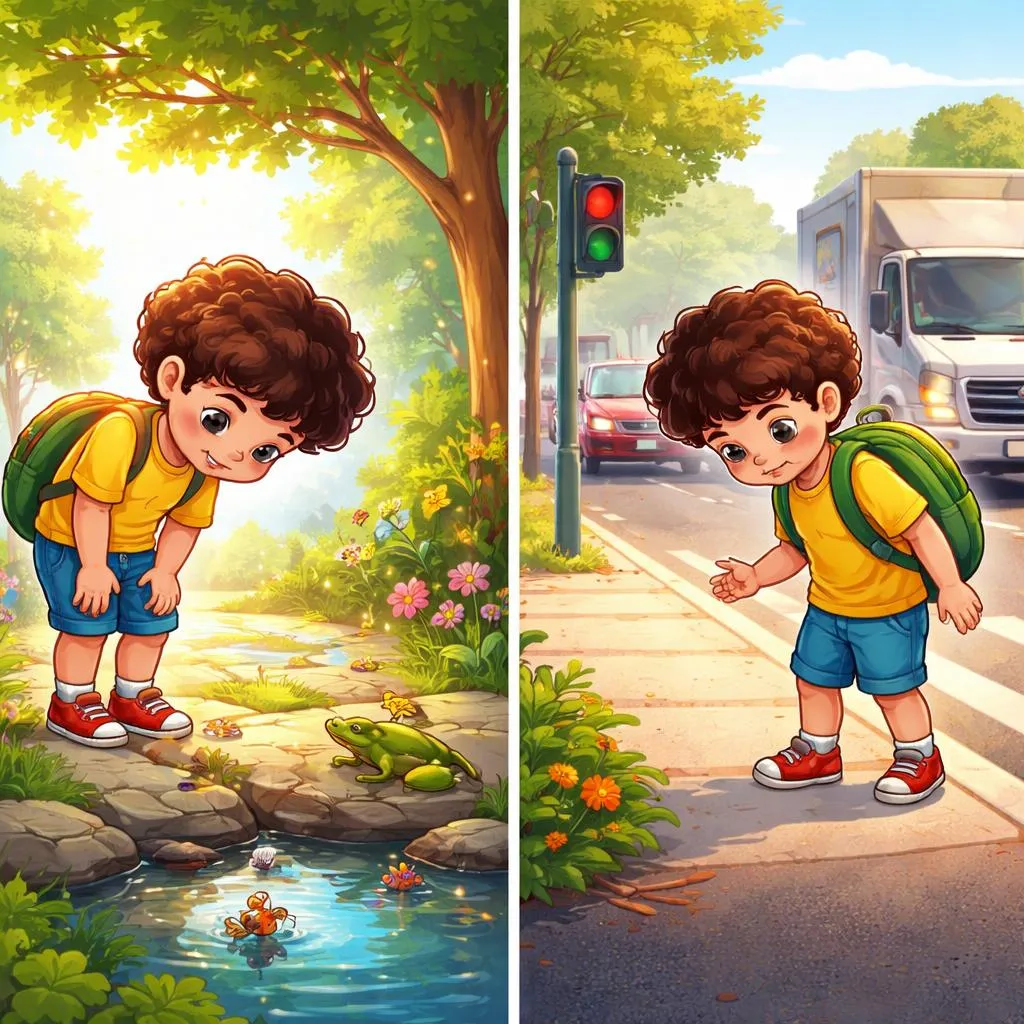

What Do These Expressions Mean? “Look at the ground” and “gaze downward” both direct someone to turn their eyes toward the earth. They tell a child to observe what is beneath their feet. Children hear these words when looking for lost items, watching insects, or avoiding tripping. Both encourage looking down.
“Look at the ground” means to direct your eyes to the earth, often for a practical reason. It is common and direct. A parent says it to help a child find a dropped toy. It is practical.
“Gaze downward” means to look down slowly, thoughtfully, or with wonder. It is poetic and gentle. A parent might say it when watching ants or looking at frost on the grass. It feels peaceful.
These expressions seem similar. Both mean “look down.” Both encourage observation. But one is for practical safety while one is for peaceful wonder.
What's the Difference? One is for practical or safety reasons. One is for peaceful observation. “Look at the ground” is for avoiding hazards, finding things, or checking your step. It is everyday language. It is for utility.
“Gaze downward” is for when you want to notice beauty in small things. A dewdrop, a beetle, a pattern in the dirt. It implies a slower, calmer look. It is for wonder.
Think of a child walking on a rocky path. “Look at the ground so you don’t trip” is right. Sitting quietly watching a caterpillar. “Gaze downward at the little creature” fits better. One is for safety. One is for wonder.
One is for hurry and caution. The other is for peace and awe. “Look at the ground” for finding a lost coin. “Gaze downward” for watching moss grow. Use the first for practical. Use the second for peaceful.
Also, “gaze” implies a soft, steady, admiring look. “Look” is neutral. Choose the word for the moment.
When Do We Use Each One? Use “look at the ground” for practical, safety, or searching reasons. Use it to avoid obstacles, find dropped things, or watch your step. Use it to be careful. It fits safety talk.
Examples at home: “Look at the ground so you don’t step in the puddle.” “Look at the ground for your lost earring.” “Look at the ground when you walk on the icy path.”
Use “gaze downward” for peaceful, awe-filled observation. Use it for insects, leaves, frost, or small treasures. Use it to encourage slow wonder. It fits quiet talk.
Examples for wonder: “Let’s sit on the grass and gaze downward at the ants.” “Gaze downward at the sparkling frost on the ground.” “Gaze downward and find a tiny flower.”
Children can use both. “Look at the ground” for safety. “Gaze downward” for wonder. Both are important.
Example Sentences for Kids Look at the ground: “Look at the ground. There’s broken glass.” “Look at the ground so you don’t trip.” “Look at the ground. I think I dropped my coin.”
Gaze downward: “Gaze downward at the tiny snail.” “Let’s gaze downward and watch the worm wiggle.” “Gaze downward. The frost looks like glitter.”
Notice “look at the ground” is for safety and finding. “Gaze downward” is for slow, peaceful wonder. Children learn both. One for caution. One for curiosity.
Parents can use both. A crack in the sidewalk: “look at the ground.” A ladybug: “gaze downward.” Children learn different ways to look down.
Common Mistakes to Avoid Some children say “gaze downward” when about to trip. That is the wrong time. Use “gaze” only for safe, calm moments. For danger, say “look at the ground.”
Wrong: “Gaze downward at that crack.” (walking) Better: “Look at the ground. There’s a crack.”
Another mistake: saying “look at the ground” for a beautiful ant trail. That is fine, but “gaze” adds wonder. If you want to inspire awe, use “gaze downward.”
Wrong: “Look at the ground at the ants.” (okay) Better: “Let’s gaze downward at the ants carrying food.”
Some learners forget that “gaze” is not for active walking. Gazing is for sitting or standing still. Do not gaze while running.
Also avoid saying “look at the ground” when the child should look up for safety. If a ball is coming, look up. Use the right direction.
Easy Memory Tips Think of “look at the ground” as a magnifying glass for finding. Practical. Careful. For safety and searching.
Think of “gaze downward” as a cozy blanket on the grass. Peaceful. Slow. For wonder.
Another trick: remember the purpose. “Look” is for utility. “Gaze” is for awe. Utility gets “look.” Awe gets “gaze.”
Parents can say: “Look for a lost toy. Gaze for a little joy.”
Practice at home. Find a lost key: “look at the ground.” Watch a snail: “gaze downward.”
Quick Practice Time Let us try a small exercise. Choose the better phrase for each situation.
A child is walking on a playground with broken wood chips. The parent wants to prevent a splinter. a) “Gaze downward at the wood chips.” b) “Look at the ground so you don’t get a splinter.”
A child notices a tiny beetle on the sidewalk. The parent wants to share a quiet moment. a) “Look at the ground at the beetle.” b) “Let’s gaze downward at the beetle together.”
Answers: 1 – b. A safety hazard fits the practical “look at the ground.” 2 – b. A small, beautiful creature fits the peaceful “gaze downward.”
Fill in the blank: “When I walk in the dark with a flashlight, I need to ______ to avoid tripping.” (“Look at the ground” is the safety-focused, practical choice.)
One more: “When I lie in the grass and watch a caterpillar crawl, I ______.” (“Gaze downward” fits the slow, peaceful, awe-inspired description.)
The ground holds many things. “Look at the ground” keeps you safe. “Gaze downward” shows you wonders. Teach your child both. A child who learns both will navigate the earth with care and with awe.
Wrap-up “Look at the ground” is for practical, safety, or searching reasons like avoiding hazards or finding lost items. “Gaze downward” is for slow, peaceful, wonder-filled observation of small beauties like insects, frost, or tiny flowers. Use “look at the ground” for caution, walking, and finding. Use “gaze downward” for sitting, marveling, and peaceful noticing. Both phrases point downward. A child who learns both will be safe on their feet and full of wonder at their feet.